PPWR recycled-content targets for plastic packaging
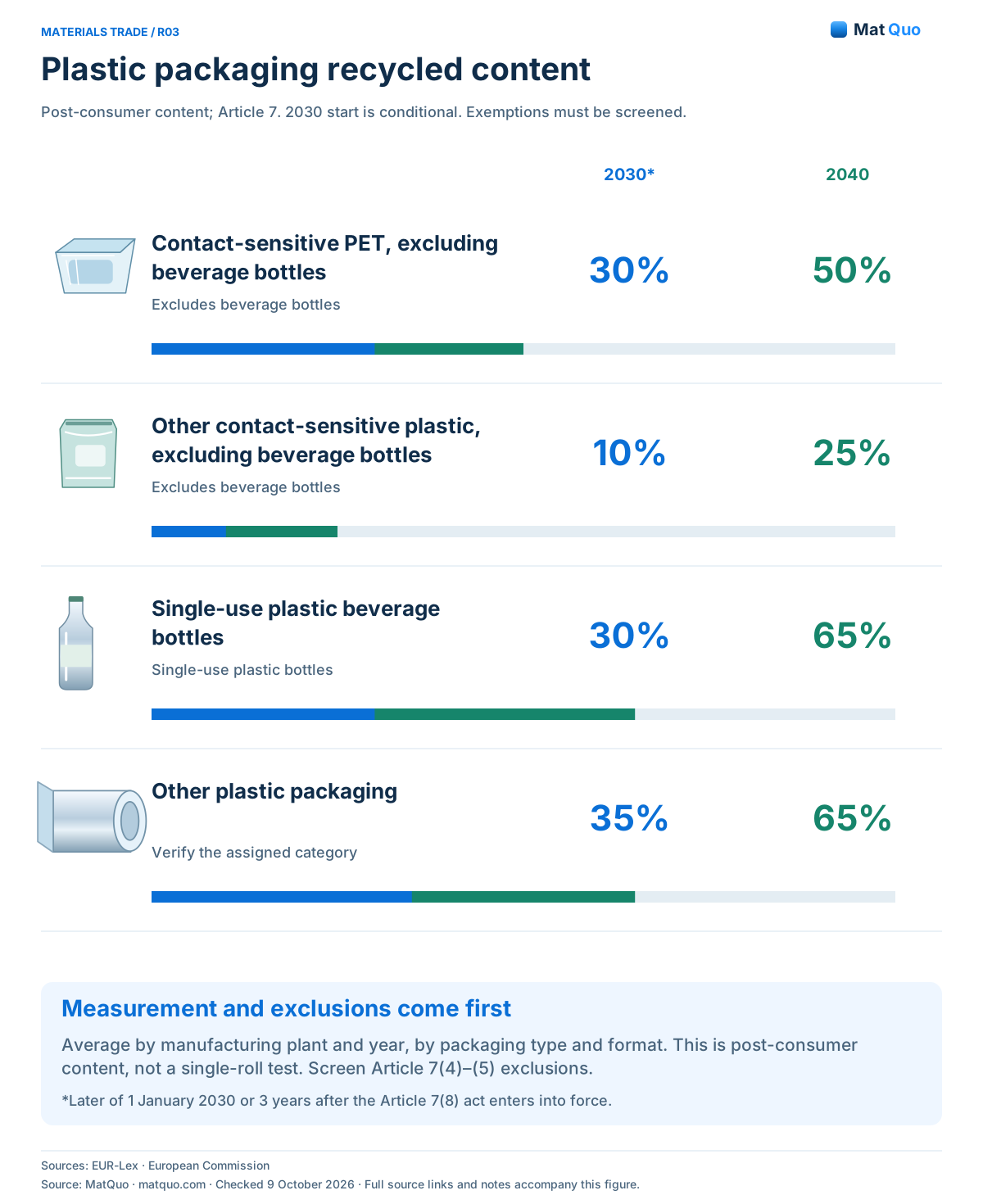
PPWR Article 7 assigns different recycled-content targets to contact-sensitive PET packaging, other contact-sensitive plastics, single-use plastic beverage bottles and other plastic packaging. The percentages concern post-consumer recycled content on the prescribed plant-and-year basis. Category, exemptions and the conditional first start date must be checked before applying a percentage to a purchasing specification.
Classify before calculating
A resin label alone does not establish the packaging category. Confirm the intended use, contact-sensitive status, bottle classification and complete packaging unit. Article 7(4) and (5) contain exclusions, including specified medical or pharmaceutical packaging, certain other uses, food-contact health conditions and plastic parts below the stated share of total packaging-unit mass. Review the full wording.
Keep the measurement boundary intact
The regulation describes an average per manufacturing plant and year, by packaging type and format. Do not silently turn that into a requirement for every individual roll or bag. Conversely, a purchase-order target for a particular batch can be a commercial specification without proving that the regulatory accounting method has been satisfied.
Use the same versioned table
The target lookup and graphic use one checked table. Unknown category or exemption status prevents an unconditional answer. The tool does not interpolate percentages between statutory years or certify food-contact suitability, recyclability or the conformity of a complete packaging design.
Comparison at a glance
| Category | 2030 target, conditional start | 2040 target |
|---|---|---|
| Contact-sensitive PET, excluding beverage bottles | 30% | 50% |
| Other contact-sensitive plastic, excluding beverage bottles | 10% | 25% |
| Single-use plastic beverage bottles | 30% | 65% |
| Other plastic packaging | 35% | 65% |
Worked example
Fictional planning exercise: 100 t of plastic material within a confirmed accounting scope at a 35% target corresponds arithmetically to 35 t post-consumer content and 65 t other material. This is not a verified compliance calculation. The applicable category, manufacturing-plant/year boundary, methodology, exclusions and evidence must first be established.
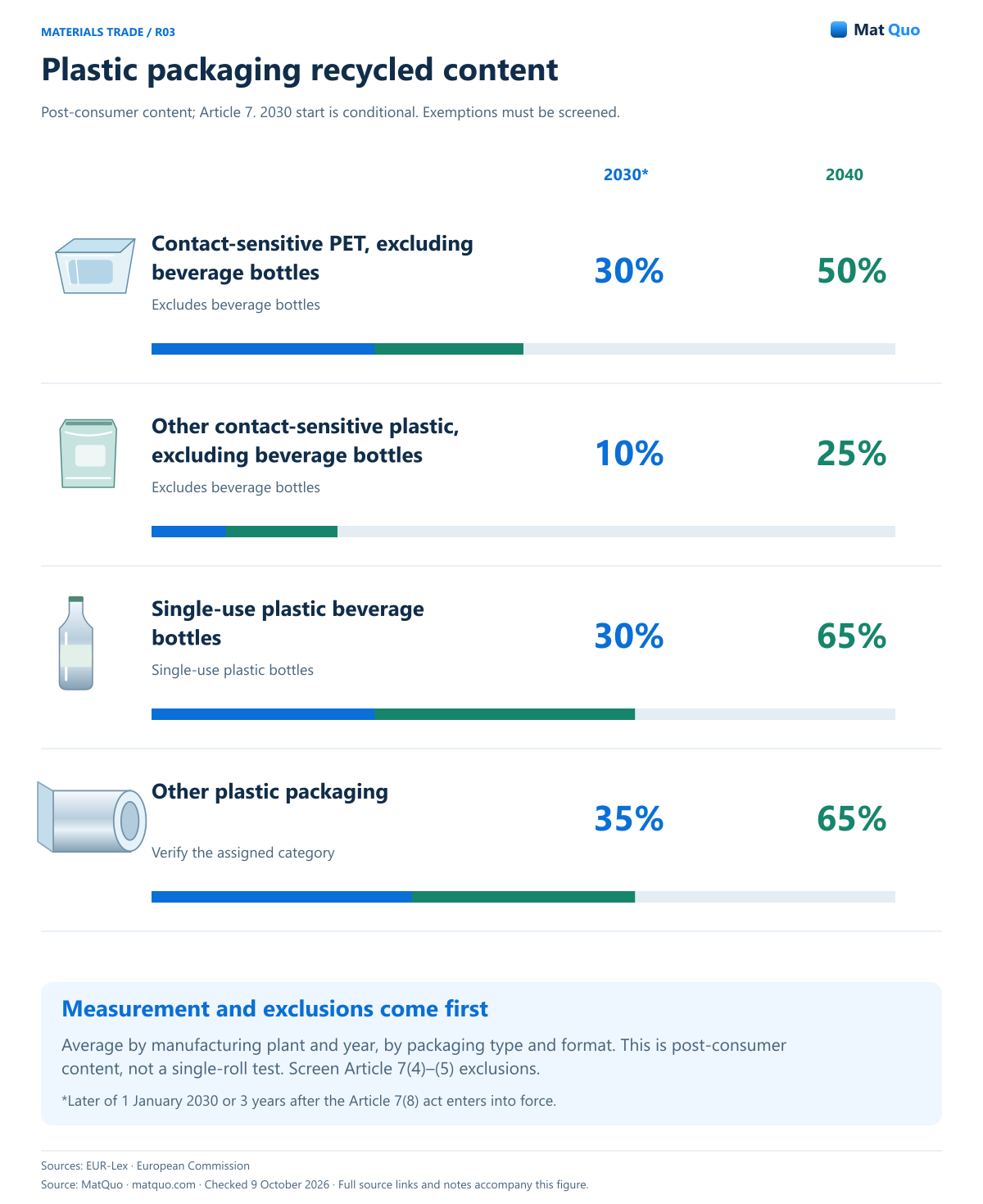
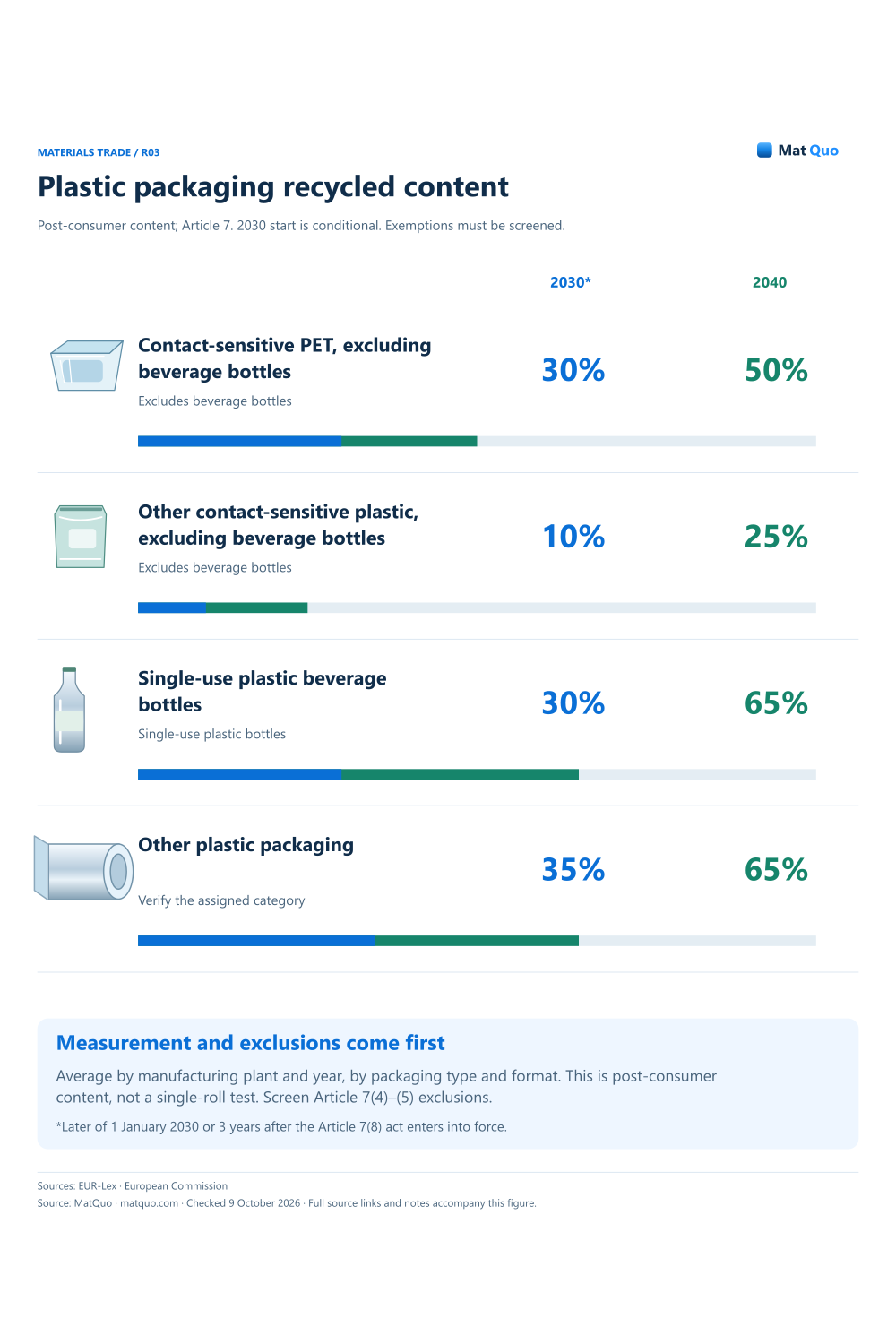
Plastic packaging recycled content
Post-consumer content; Article 7. 2030 start is conditional. Exemptions must be screened.
Detailed poster: scroll horizontally on a small screen, or open the full-size figure. The readable text equivalent is below.
EUR-Lex • Regulation (EU) 2025/40 · European Commission • PPWR implementation · Checked
Text equivalent and notes
- Contact-sensitive PET
- Excluding beverage bottles. 2030*: 30% → 2040: 50%
- Other contact-sensitive plastic
- Excluding beverage bottles. 2030*: 10% → 2040: 25%
- Single-use beverage bottles
- Plastic beverage bottles. 2030*: 30% → 2040: 65%
- Other plastic packaging
- Category assignment must be verified. 2030*: 35% → 2040: 65%
- Measurement basis
- Average by manufacturing plant. and year, by packaging type. and format; not a single roll test.
- Before using the table
- *Later of 2030 or 3 years after. the Article 7(8) act enters force.. Check Article 7(4)–(5) exclusions.
Embed with credit
Common mistakes
- Counting internal production trim as automatically post-consumer material.
- Interpolating a new target for each year between 2030 and 2040.
- Applying a percentage before screening the statutory exclusions.
Questions and answers
Does every plastic package need thirty-five percent?
No. Article 7 separates several packaging categories and provides exclusions. The thirty-five-percent figure is the first-table target for other plastic packaging, subject to the conditional start date. Confirm the actual category and scope before using it, and do not apply it as a universal specification for every plastic component or package.
Is internal production scrap automatically eligible PCR?
No. Post-consumer content and material recovered within a manufacturing process are different concepts. Keep the origin and accounting evidence for the claimed recycled material. An internal trim-return loop can improve material use, but that fact alone does not establish that its mass qualifies toward a post-consumer recycled-content obligation.
Can the lookup confirm compliance?
No. It identifies a statutory target category and its timing qualifications using the checked source table. Compliance also depends on the packaging definition, exclusions, methodology, plant-and-year accounting and supporting evidence. Treat the output as a review aid and preserve the source reference rather than using the displayed percentage as a certificate.
Sources and review scope
- EUR-Lex • Regulation (EU) 2025/40 — Articles 3, 6, 7, 12, 29, 44–45 and 71.
- European Commission • PPWR implementation — Implementation status checked; act-dependent dates remain conditional.