Pallet calculator: bags, boxes, layers and weight
Calculate boxes with the original pallet tool or use the additional bag mode to include filled dimensions, bag tare, pallet height and complete-layer limits. Both approaches separate geometric fit from gross mass. Measure the actual packed units and validate the physical pattern before treating a computed count as a loading instruction.
Enter one box and a pallet and get boxes per layer, layers, total boxes, product weight and gross weight, with an arrangement diagram. Everything updates as you type.
Existing worked example: a 1200 × 800 mm pallet holds 48 cartons of 400 × 300 × 250 mm at 1500 mm goods height. At 8 kg per carton and 25 kg pallet tare, the gross weight is 409 kg.
Box
Pallet
How the pallet calculator works
It tries your box in both footprint orientations on the pallet and keeps whichever fits more per layer, then stacks layers up to your maximum load height, and finally checks the total against your maximum gross weight — reporting whichever limit (height or weight) is reached first.
- Boxes per layer = best of (length-wise fit) and (rotated fit) on the pallet footprint.
- Layers = max load height ÷ box height, rounded down.
- Boxes per pallet = boxes per layer × layers, then capped so the load stays under the maximum gross weight.
- Product weight = boxes × box weight; gross weight adds the pallet's own weight.
This assumes a single box size stacked in a uniform block (the standard, safe assumption for a shipping estimate). Real loads may differ with mixed orientations, overhang rules or interlocked stacking.
Related tools
Handy equipment for this job
Links open Amazon. As an Amazon Associate, MatQuo earns from qualifying purchases — at no extra cost to you.
Choosing a pallet for your route
The default is an EUR-style 1200 × 800 mm pallet. It is useful for shipments into continental European distribution networks, but a UK warehouse may ask for the 1200 × 1000 mm industrial footprint instead. Select the actual receiving specification, rather than assuming that the larger pallet is always preferable. Its extra floor area changes the box layout and the space needed inside a vehicle. Dimensions alone do not establish an approved load rating.
Example: cartons of preserves
This is a planning example, not a measured commercial shipment. Suppose each packed carton is 400 × 300 × 250 mm and weighs 8 kg. On the EUR footprint, rotating the cartons places the 300 mm side along 1200 mm and the 400 mm side along 800 mm: four by two, or eight cartons per layer. With 1500 mm of available goods height, six layers fit, giving 48 cartons. Product mass is 384 kg; adding an assumed 25 kg pallet gives 409 kg gross. Enter those values to reproduce the result and inspect the arrangement diagram.
Change only the pallet to 1200 × 1000 mm and the simple uniform layout accommodates nine cartons per layer. Six layers would hold 54 cartons, or 432 kg of goods. With the preset 28 kg pallet tare, gross mass is 460 kg. This does not prove that the cartons can support six layers; compression strength, moisture and the receiver’s rules remain separate checks.
Example: a UK distribution carton
A hypothetical 600 × 400 × 300 mm carton of bottled drinks fits four times per layer on the EUR pallet. At 1200 mm goods height, four layers give 16 cartons. Assuming 12 kg per packed carton and a 25 kg pallet, the gross total is 217 kg. Measure the outside of the packed carton, including bulges, rather than the product’s nominal size.
Before booking collection
Compare the gross result with the carrier’s limit, count empty pallets separately and allow for wrap, corner boards and other packaging that the calculator does not add automatically. If the carrier quotes a total height including the pallet, subtract the measured deck height before entering the goods-height limit. For mixed cartons, calculate separate groups and check a physical layout. This tool compares two uniform box orientations; it does not optimise mixed patterns or certify load stability.
Pallet calculation questions
How do I calculate how many boxes fit on one pallet?
48 cartons fit in the existing EUR-pallet example: 400 × 300 × 250 mm cartons, a 1200 × 800 mm footprint and 1500 mm goods height. The calculator compares uniform orientations, then applies height and gross-weight limits. It estimates a single carton size and does not certify stacking strength or transport stability.
- Measure the packed carton and confirm the receiving pallet dimensions.
- Enter goods height, carton weight, measured pallet tare and the gross-weight limit.
- Review the count, arrangement and gross weight; check stacking strength and secure the load.
| Existing example | EUR footprint | Industrial footprint |
|---|---|---|
| Pallet size | 1200 × 800 mm | 1200 × 1000 mm |
| Cartons per layer | 8 | 9 |
| Cartons at 1500 mm goods height | 48 | 54 |
| Assumed tare | 25 kg | 28 kg |
| Gross weight | 409 kg | 460 kg |
How is pallet weight calculated?
Gross pallet weight is the number of loaded cartons multiplied by packed carton weight, plus the pallet tare. In the existing example, 48 cartons at 8 kg plus a 25 kg pallet give 409 kg gross. Wrap and other packaging are separate; replace the assumed tare with your measured pallet weight.
Which dimensions should I enter in the pallet calculator?
Enter the outside length, width and height of the packed carton, then the receiving pallet's actual footprint. The EUR preset is 1200 × 800 mm; the industrial option is 1200 × 1000 mm. The height field covers goods only, so subtract the pallet deck when a carrier specifies an overall height.
What is the pallet calculation formula?
The calculator takes the better uniform footprint orientation for boxes per layer, multiplies by complete layers under the goods-height limit, and caps the total using the gross-weight limit after pallet tare. The result is a planning estimate for one carton size; mixed patterns and the load's physical stability need separate checking.
The EUR preset uses a 1000 kg gross limit for planning; confirm your carrier's actual limit. The existing EUR description gives about 144 mm deck height. Measure the pallet used for the shipment.
Additional mode: filled bags
The original box calculator remains above. These defaults are a fictional bag example. Dimension presets do not supply a load rating or a verified actual tare.
Keep the familiar box calculation
The original box controls and formula are unchanged. Its default 1,800 mm product stacking height allows seven 250 mm layers; the existing six-layer worked example uses 1,500 mm. The new bag mode explicitly uses overall loaded height and subtracts pallet height, so the two height definitions are labelled rather than silently interchanged.
Use actual bag and pallet measurements
The bag mode compares two uniform horizontal orientations, then applies height and gross mass limits. Full-layer rounding is optional and explicit. EPAL and CP presets populate only sourced dimensions; confirm tare and loading conditions separately. See the bag-pattern guide for the physical checks behind the arithmetic.
Comparison at a glance
| Mode | Height definition | Mass treatment |
|---|---|---|
| Original boxes | Product stacking height | Existing box mass and pallet tare |
| Additional bags | Overall height including pallet | Net contents + bag tare + pallet tare |
| Both | Complete geometric layers | Gross constraint can govern the count |
Worked example
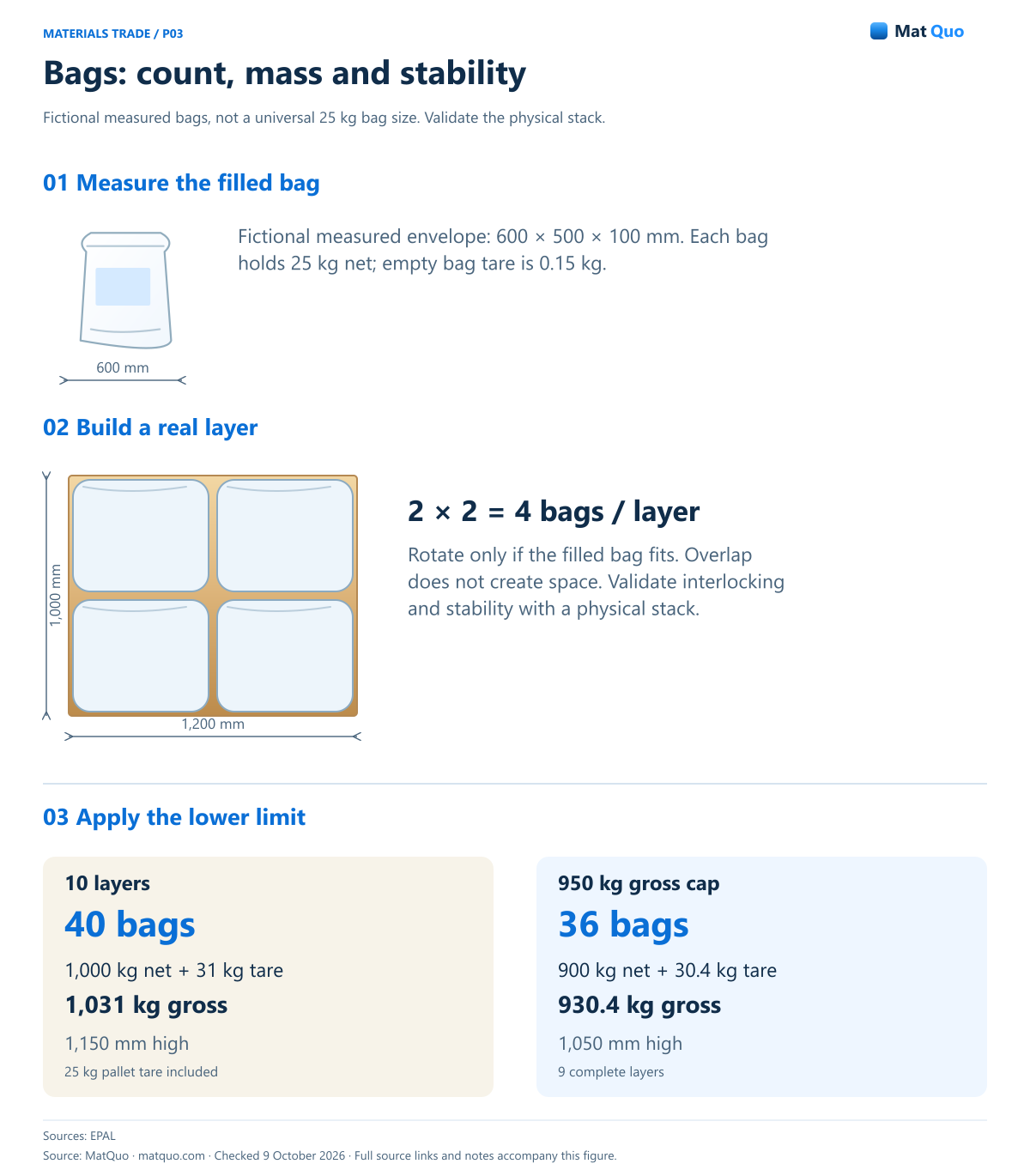
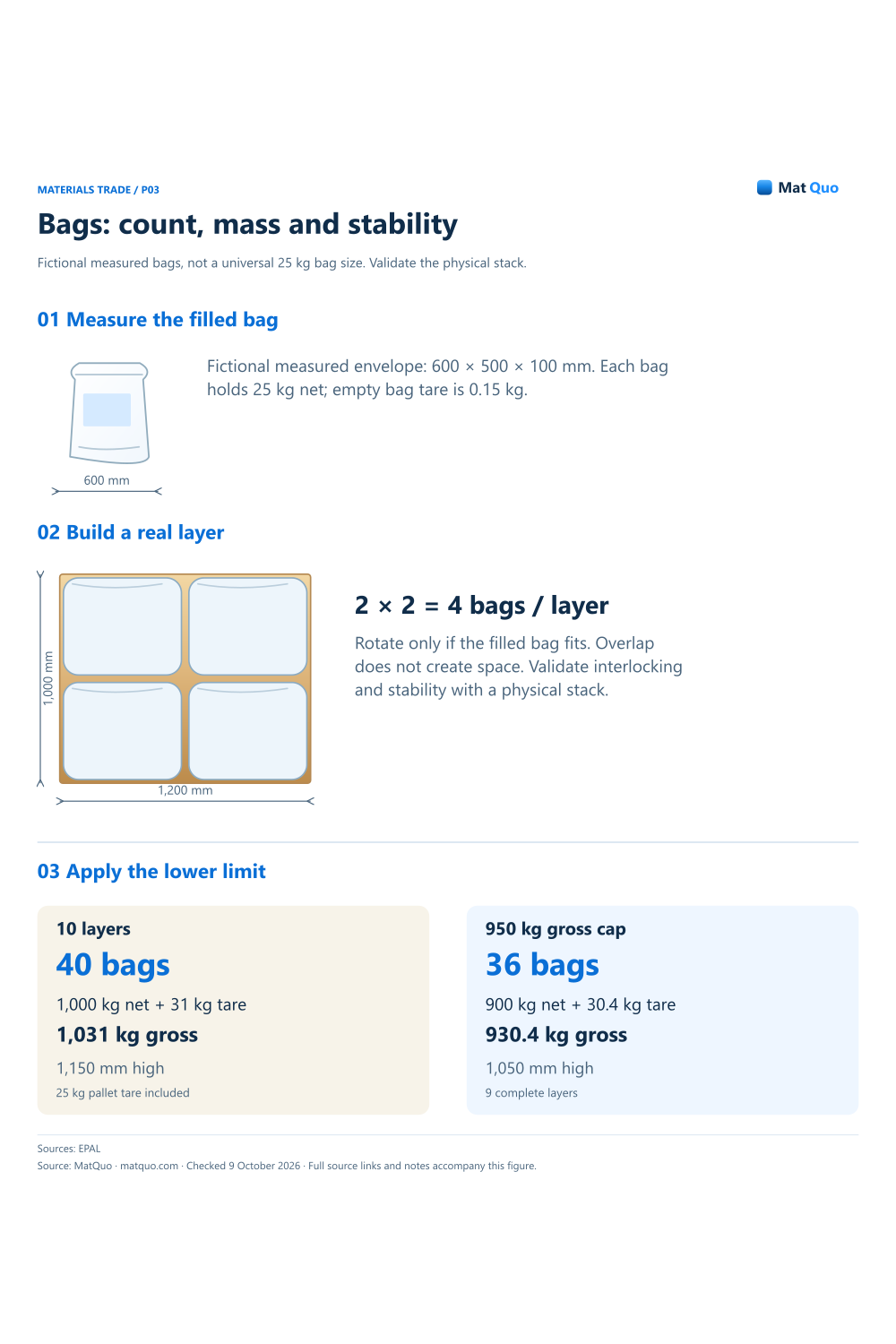
Fictional bag mode: 1,200 × 1,000 mm pallet, 600 × 500 × 100 mm bags, 25 kg net and 0.15 kg bag tare. Four bags per layer and ten layers gives 1,000 kg net. Adding 6 kg bags and a 25 kg pallet gives 1,031 kg gross. A 150 mm pallet makes overall height 1,150 mm; a 950 kg gross cap with full layers reduces the count to 36.
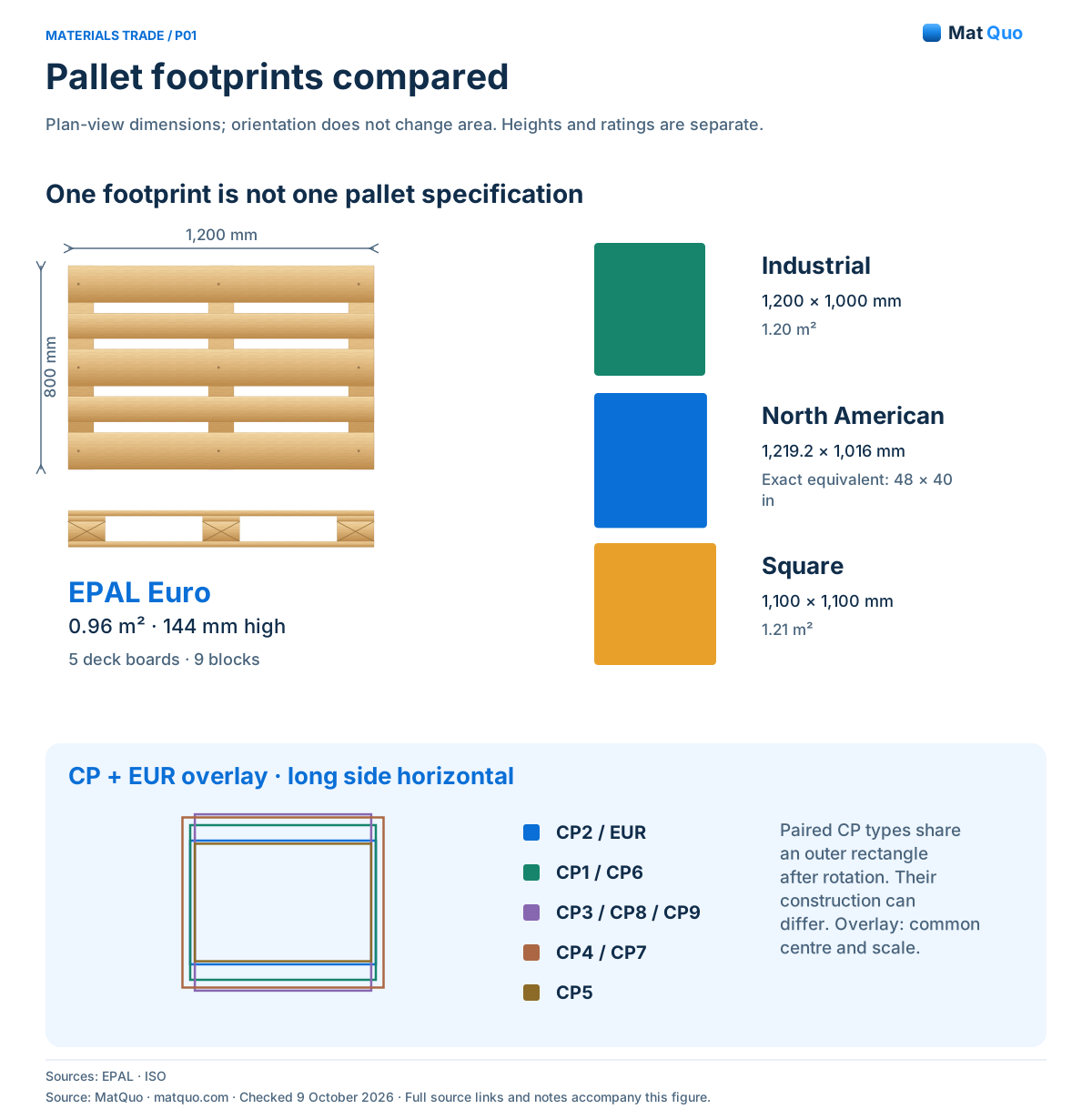
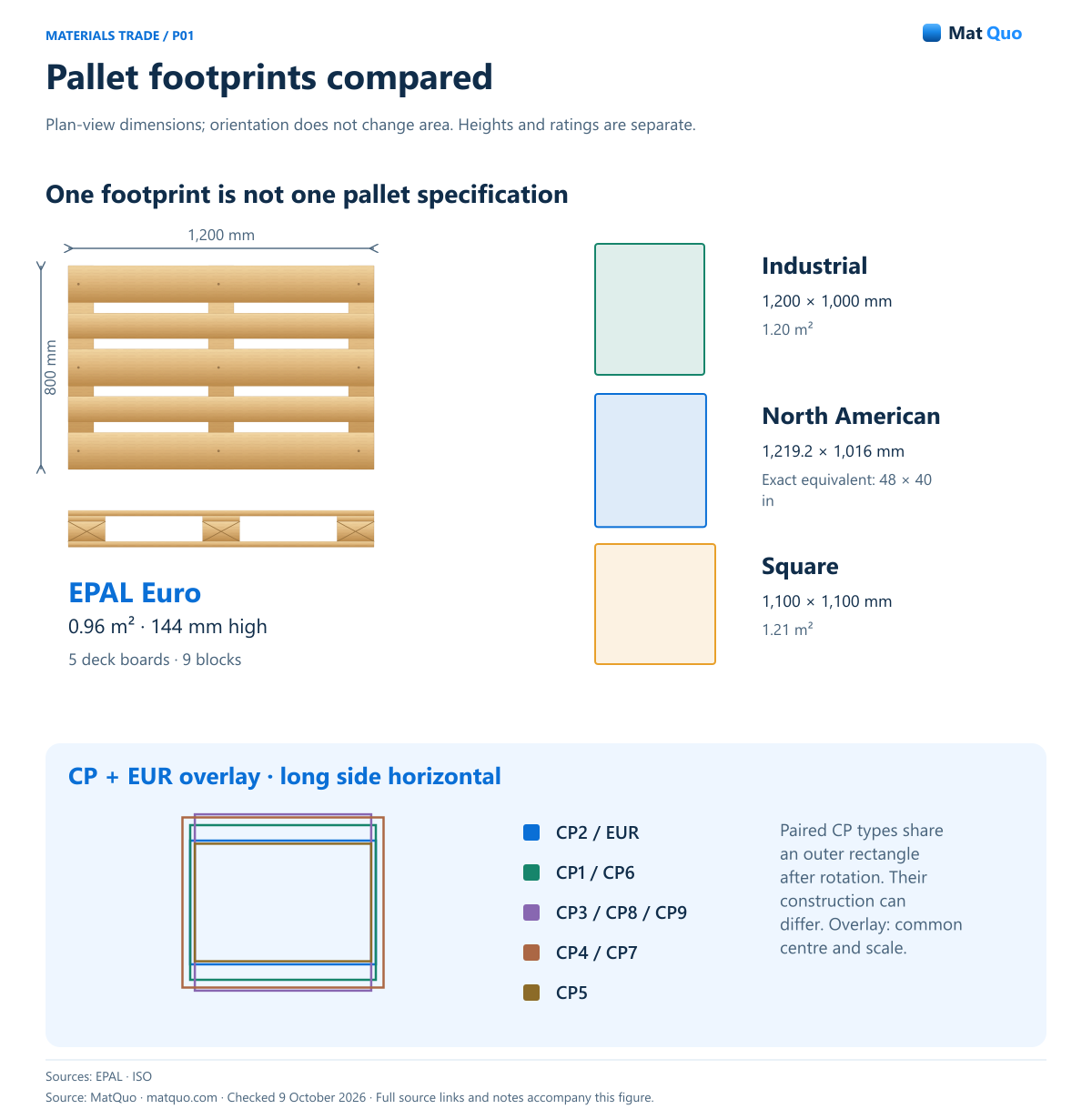
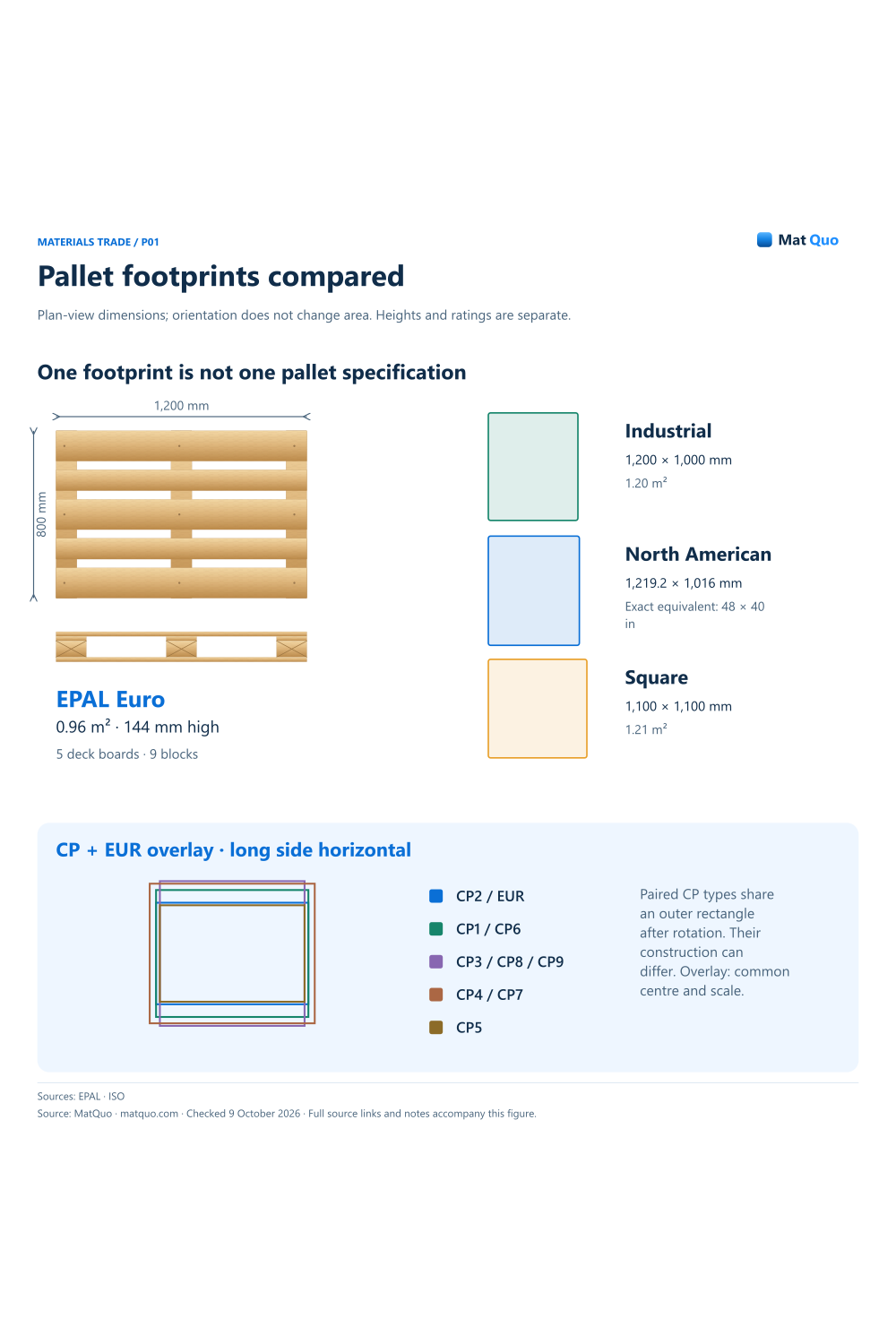
Pallet footprints compared
Plan-view dimensions; orientation does not change area. Heights and ratings are separate.
Detailed poster: scroll horizontally on a small screen, or open the full-size figure. The readable text equivalent is below.
EPAL • Euro pallet · ISO • Public pallet dimensions overview · EPAL • CP1 technical sheet · EPAL • CP2 technical sheet · EPAL • CP3 technical sheet · EPAL • CP4 technical sheet · EPAL • CP5 technical sheet · EPAL • CP6 technical sheet · EPAL • CP7 technical sheet · EPAL • CP8 technical sheet · EPAL • CP9 technical sheet · Checked
Text equivalent and notes
- EPAL Euro
- 800 × 1,200 mm. Area: 0.96 m² • height: 144 mm
- Industrial footprint
- 1,200 × 1,000 mm. Area: 1.20 m² • specify design
- 1,219.2 × 1,016 mm footprint (48 × 40 in)
- 1,219.2 × 1,016 mm. Exact inch conversion, not 1.2 m
- Square footprint
- 1,100 × 1,100 mm. Area: 1.21 m² • specify design
- CP and Euro footprint overlay
- Long side horizontal; common centre and scale.. CP2 and EUR: 800 × 1,200 mm. CP1 / CP6: 1,000 × 1,200 mm after rotation.. CP3 / CP8 / CP9: 1,140 × 1,140 mm. CP4 / CP7: 1,100 × 1,300 mm after rotation. CP5: 760 × 1,140 mm.. Shared footprints do not imply identical construction.
Embed with credit
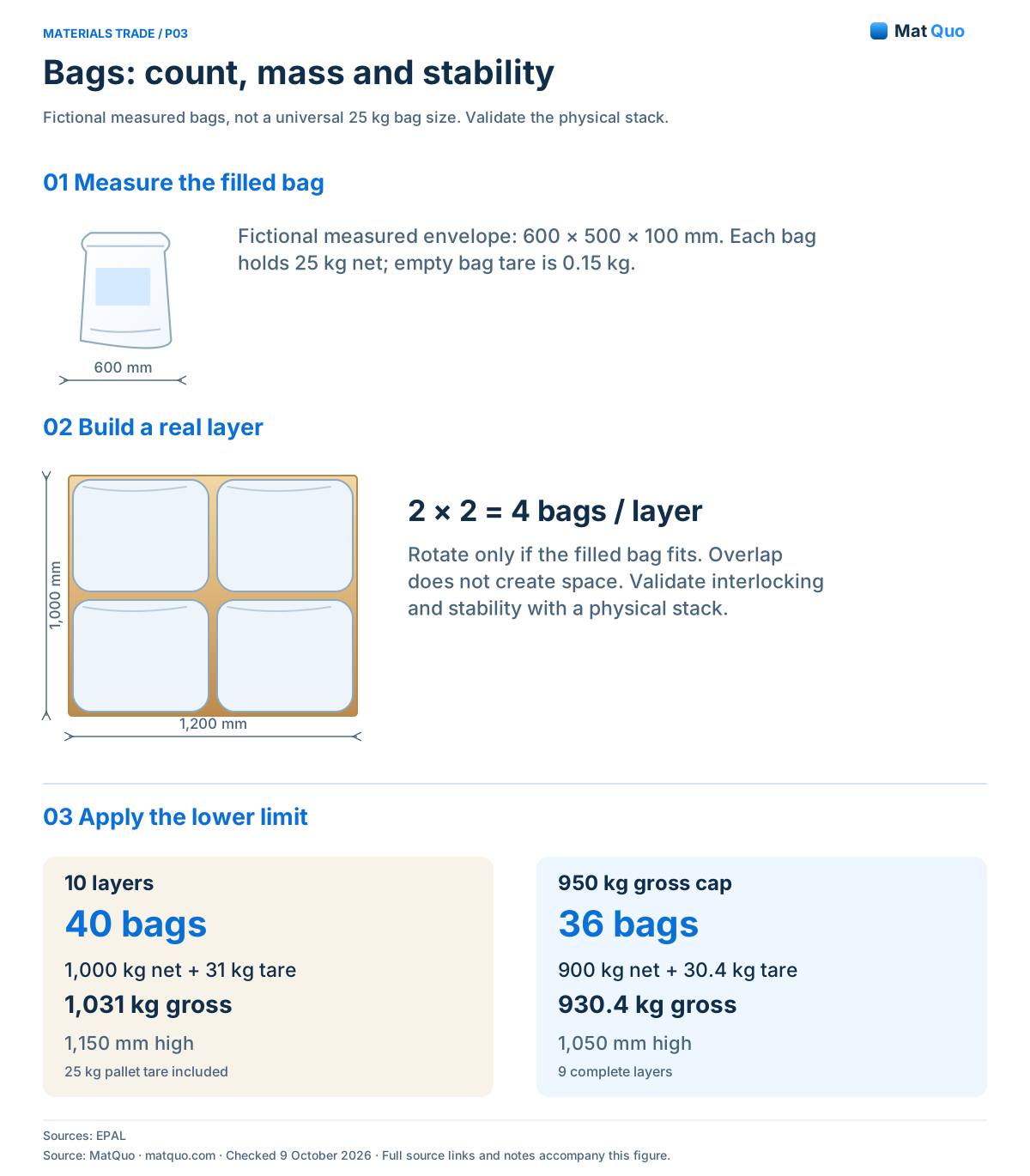
Bags: count, mass and stability
Fictional measured bags, not a universal 25 kg bag size. Validate the physical stack.
Detailed poster: scroll horizontally on a small screen, or open the full-size figure. The readable text equivalent is below.
EPAL • Euro pallet · EPAL • Chemical pallets · Checked
Text equivalent and notes
- Measured rectangle
- 600 × 500 mm on 1,200 × 1,000. 2 × 2 = 4 bags per layer. Aligned layers shown schematically.
- Alternate layers
- Rotate only if the filled bags fit.. Overlaps do not create free space.. Interlock needs a physical trial.
- Ten layers
- 40 × 25 kg = 1,000 kg net. 40 × 0.15 + 25 = 31 kg tare. 1,031 kg gross; 1,150 mm high
- 950 kg gross limit
- Full layers: 9 × 4 = 36 bags. 900 kg net + 30.4 kg tare. 930.4 kg gross; 1,050 mm high
Embed with credit
Common mistakes
- Entering overall height into a field labelled product stacking height.
- Assuming a 25 kg label supplies the filled bag dimensions.
- Applying a generic pallet tare or load rating without checking the actual design.
Questions and answers
Does the bag mode optimise every possible pattern?
No. It compares uniform horizontal orientations and applies the selected complete-layer rule. Mixed or interlocked patterns need their own physical validation and may behave differently with filled bags. The graphic explains the distinction, while the calculator keeps its geometric assumptions visible instead of presenting a simple rectangle count as a certified packing plan.
Do CP presets include a verified load rating?
No. They provide verified dimensional values for the named model. Actual tare, condition and applicable loading limits still need confirmation, and unverified ratings are not invented. Enter the appropriate gross allowance only after checking the intended pallet, packaging and handling conditions, then validate the complete unit before dispatch.
Sources and review scope
- EPAL • Euro pallet — 800 × 1200 × 144 mm; source gives approximately 25 kg tare and 1500 kg safe working load.
- EPAL • Chemical pallets — Nine named CP models; dimensions reproduced from individual product pages.
- ISO • Public pallet dimensions overview — Public 2007 explanation lists 1200 × 1000, 800 × 1200, 1,219.2 × 1,016 mm (48 × 40 in) and 1100 × 1100 mm.
- EPAL • CP1 technical sheet — PBCP 05/2025 EN, page 2: nominal construction drawing; page 1: board and block count.
- EPAL • CP2 technical sheet — PBCP 05/2025 EN, page 2: nominal construction drawing; page 1: board and block count.
- EPAL • CP3 technical sheet — PBCP 05/2025 EN, page 2: nominal construction drawing; page 1: board and block count.
- EPAL • CP4 technical sheet — PBCP 05/2025 EN, page 2: nominal construction drawing; page 1: board and block count.
- EPAL • CP5 technical sheet — PBCP 05/2025 EN, page 2: nominal construction drawing; page 1: board and block count.
- EPAL • CP6 technical sheet — PBCP 05/2025 EN, page 2: nominal construction drawing; page 1: board and block count.
- EPAL • CP7 technical sheet — PBCP 05/2025 EN, page 2: nominal construction drawing; page 1: board and block count.
- EPAL • CP8 technical sheet — PBCP 05/2025 EN, page 2: nominal construction drawing; page 1: board and block count.
- EPAL • CP9 technical sheet — PBCP 05/2025 EN, page 2: nominal construction drawing; page 1: board and block count.