PPWR timeline: which dates apply?
PPWR entered into force on 11 February 2025 and generally applies from 12 August 2026, but many detailed duties start later. Several labelling, recyclability and recycled-content dates depend on implementing or delegated acts. Read each deadline with its condition and distinguish a Commission adoption deadline from the date a packaging obligation applies.
Keep three kinds of dates separate
Record entry into force, general application and the specific obligation date in different fields. Where the regulation uses “whichever is later”, both dates matter. A nominal 2030 target is not enough to prove that the relevant obligation has begun for a particular packaging type. Verify exemptions and transitions as well.
Track the act dependency
The Commission implementation page is the official starting point for current work. As checked for this build, a definitive entry-into-force date for the Article 7(8) methodology act has not been verified here. The lookup therefore preserves the statutory dependency rather than inventing an unconditional 2030 application date.
Check scope when an amendment appears
The 2026 pallet-wrapping decision concerns Article 29(2) and (3). It should not be described as removing all PPWR duties for stretch film or straps. Keep the decision attached to the obligation it changes; do not let a short exemption headline overwrite unrelated recycled-content, design or EPR checks.
Comparison at a glance
| Obligation | Nominal date | Condition / scope |
|---|---|---|
| General application | 12 August 2026 | Specific duties and transitions can differ |
| Material-composition labels, Article 12(1) | 12 August 2028 | Or 24 months after relevant acts enter force, later date |
| Reusable-packaging labels, Article 12(2) | 12 February 2029 | Or 30 months after relevant act enters force, later date |
| Article 7 first target table | 1 January 2030 | Or 3 years after Article 7(8) act enters force, later date |
| Article 7 second target table | 1 January 2040 | Check category, exclusions and measurement rules |
Worked example
Fictional date exercise only: if an act subject to a three-year delay entered into force on 1 July 2028, adding three years gives 1 July 2031. Comparing that with 1 January 2030 selects 1 July 2031 as the later date. This arithmetic illustrates the rule; 1 July 2028 is not asserted as an actual adoption or entry date.
PPWR dates with their conditions
Legal baseline checked 9 October 2026. Later-date rules cannot be reduced to a year alone.
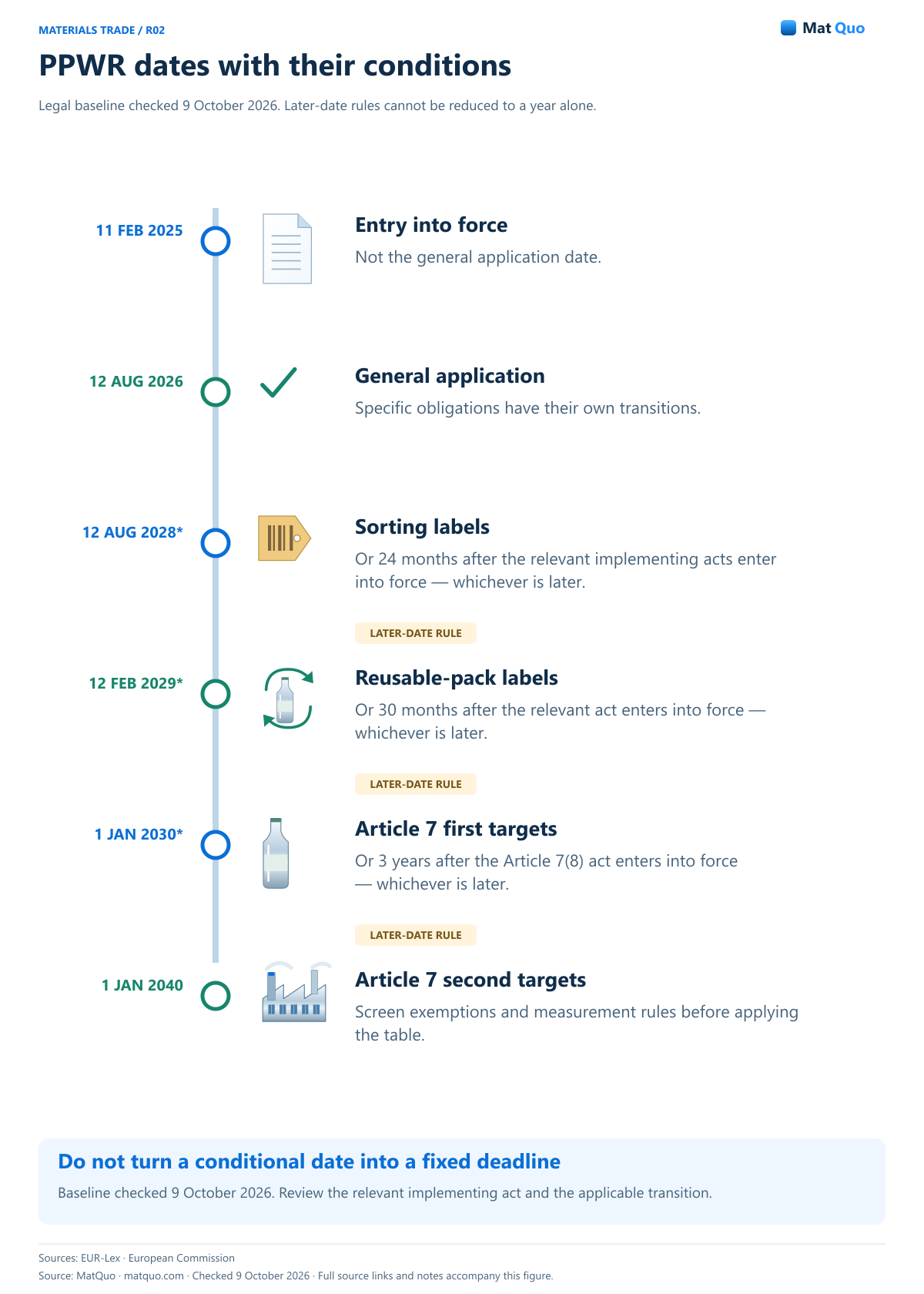
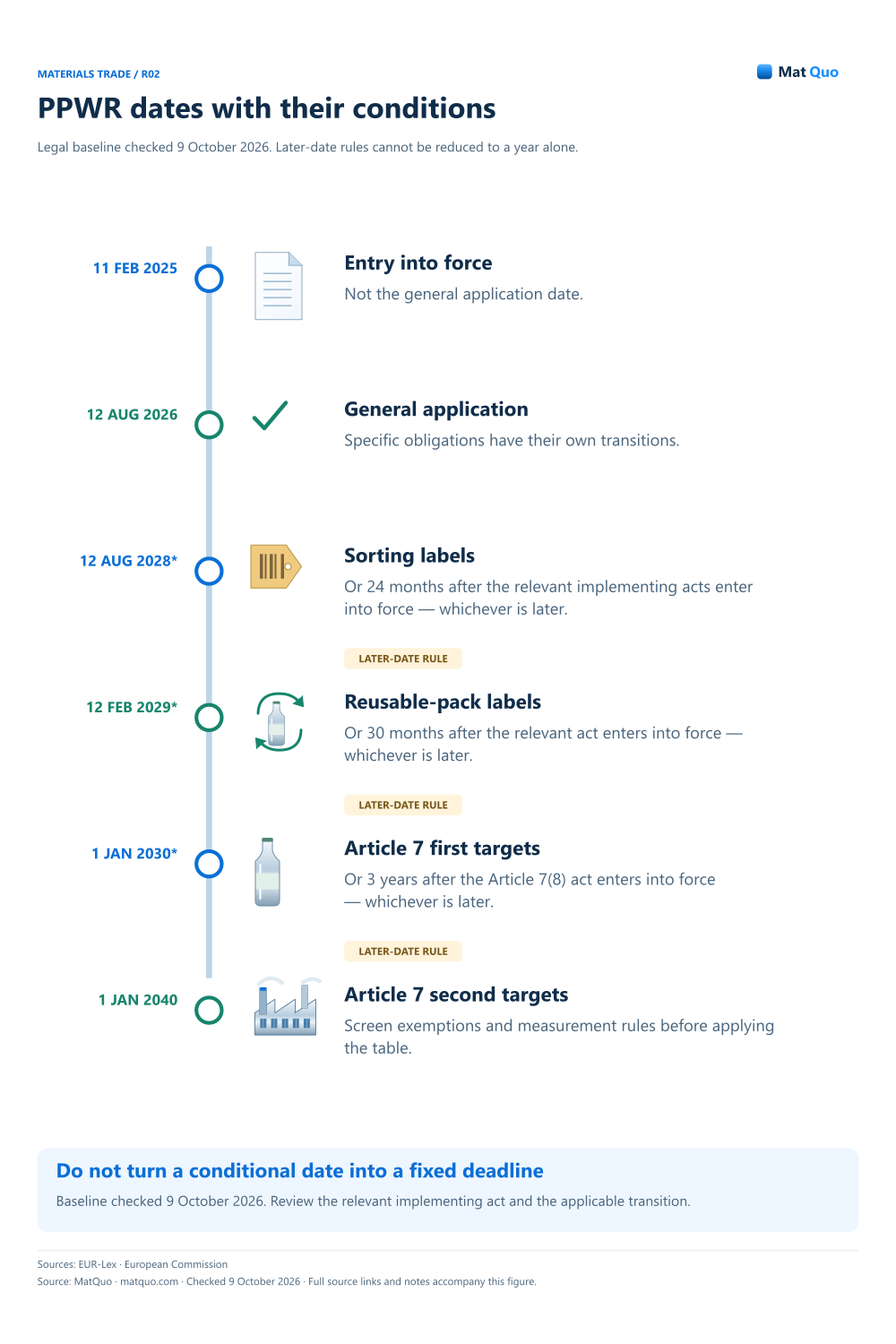
Detailed poster: scroll horizontally on a small screen, or open the full-size figure. The readable text equivalent is below.
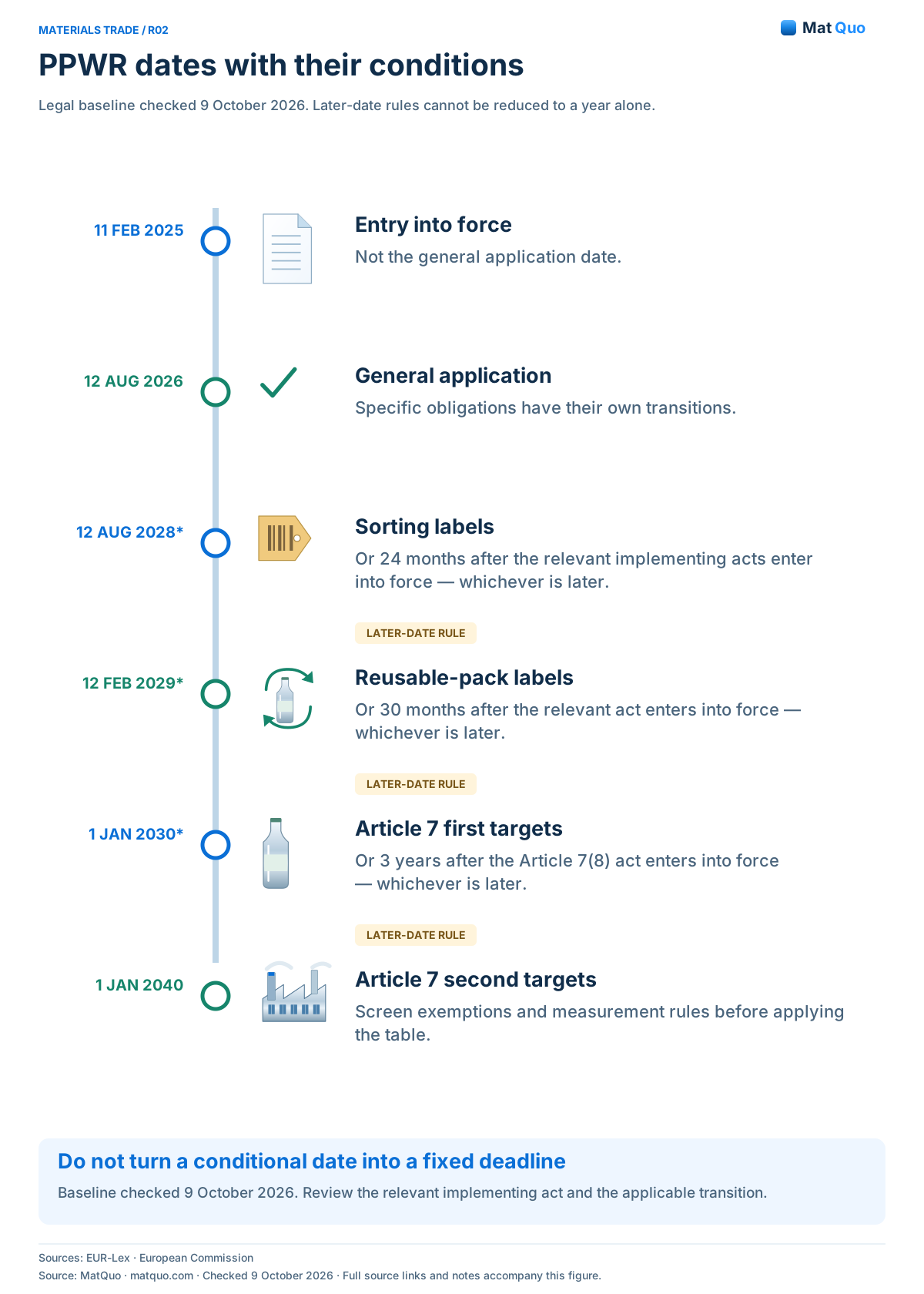
EUR-Lex • Regulation (EU) 2025/40 · European Commission • PPWR implementation · Checked
Text equivalent and notes
- 11 Feb 2025
- Entry into force.. This was not the general. application date.
- 12 Aug 2026
- General application begins.. Specific obligations can have. separate dates and transitions.
- Sorting labels
- 12 Aug 2028 OR 24 months after. relevant implementing acts enter. force, whichever is later.
- Reusable-pack labels
- 12 Feb 2029 OR 30 months after. the relevant act enters force,. whichever is later.
- 2030 • Article 7
- 1 Jan 2030 OR 3 years after. Article 7(8) act enters force,. whichever is later.
- 2040 • Article 7
- 1 Jan 2040: second target table.. Exemptions and measurement. rules still need checking.
Embed with credit
Common mistakes
- Publishing a fictional act date as though it were confirmed law.
- Using the Commission’s adoption deadline as the operator’s application deadline.
- Dropping “whichever is later” from a timeline label.
Questions and answers
Why is 2030 shown with an asterisk?
Article 7’s first target table is tied to the later of 1 January 2030 and three years after the relevant methodology act enters into force. The asterisk preserves that dependency. Until the act date is verified for the review, the table should be read as a conditional statutory target rather than an unconditional start date.
Does an adoption deadline prove an act is already in force?
No. A deadline in the parent regulation and the actual adoption, publication and entry-into-force record answer different questions. Check the official act and its own provisions before assigning a dependent application date. If that evidence is not verified, retain the condition visibly and leave the exact derived date unresolved.
Does the wrapping decision exempt all pallet film?
No blanket exemption is stated here. The Commission decision concerns specified operators and the pallet-wrapping or strap obligations under Article 29(2) and (3). Review its scope against the actual operation, while continuing to assess other relevant packaging requirements. Do not extend that change to every article affecting film.
Sources and review scope
- EUR-Lex • Regulation (EU) 2025/40 — Articles 3, 6, 7, 12, 29, 44–45 and 71.
- European Commission • PPWR implementation — Implementation status checked; act-dependent dates remain conditional.
- European Commission • Pallet wrapping decision — Exemption concerns Article 29(2) and (3), not all packaging obligations.