Pallets and loading for materials shipments
A usable pallet load must fit the footprint, stay within the permitted height and gross mass, and remain stable during handling. Start with measured packed dimensions, then count complete layers and include every bag, pallet and restraint in the tare. A geometric fit is a planning result that still needs physical validation.
Measure the packed unit
Use filled bag or closed box dimensions rather than an empty packaging drawing. Record orientation, bulging, overhang restrictions and the height of the pallet itself. Agree whether the height limit describes product only or the complete unit, because the two definitions can produce different layer counts.
Move through the decisions in order
Choose the footprint, check the specific pallet design, and validate a bag pattern. Then enter the measured values in the pallet calculator. Use the lowest applicable load limit from the pallet, packaging, handling and transport arrangements.
Comparison at a glance
| Constraint | Input to confirm | What can fail |
|---|---|---|
| Footprint | Packed length and width | Overhang or unusable gaps |
| Height | Overall limit and pallet height | Too many layers |
| Mass | Gross limit and tare | Product-only calculation |
| Handling | Stack stability and securing | A mathematically valid but unstable load |
Worked example
Fictional box load: eight boxes per layer and six layers gives 48 boxes. At 8 kg per box, product mass is 384 kg; with a 25 kg pallet it is 409 kg gross. If a customer instead allows seven layers, the result becomes 56 boxes, 448 kg product and 473 kg gross. The height assumption explains the difference.
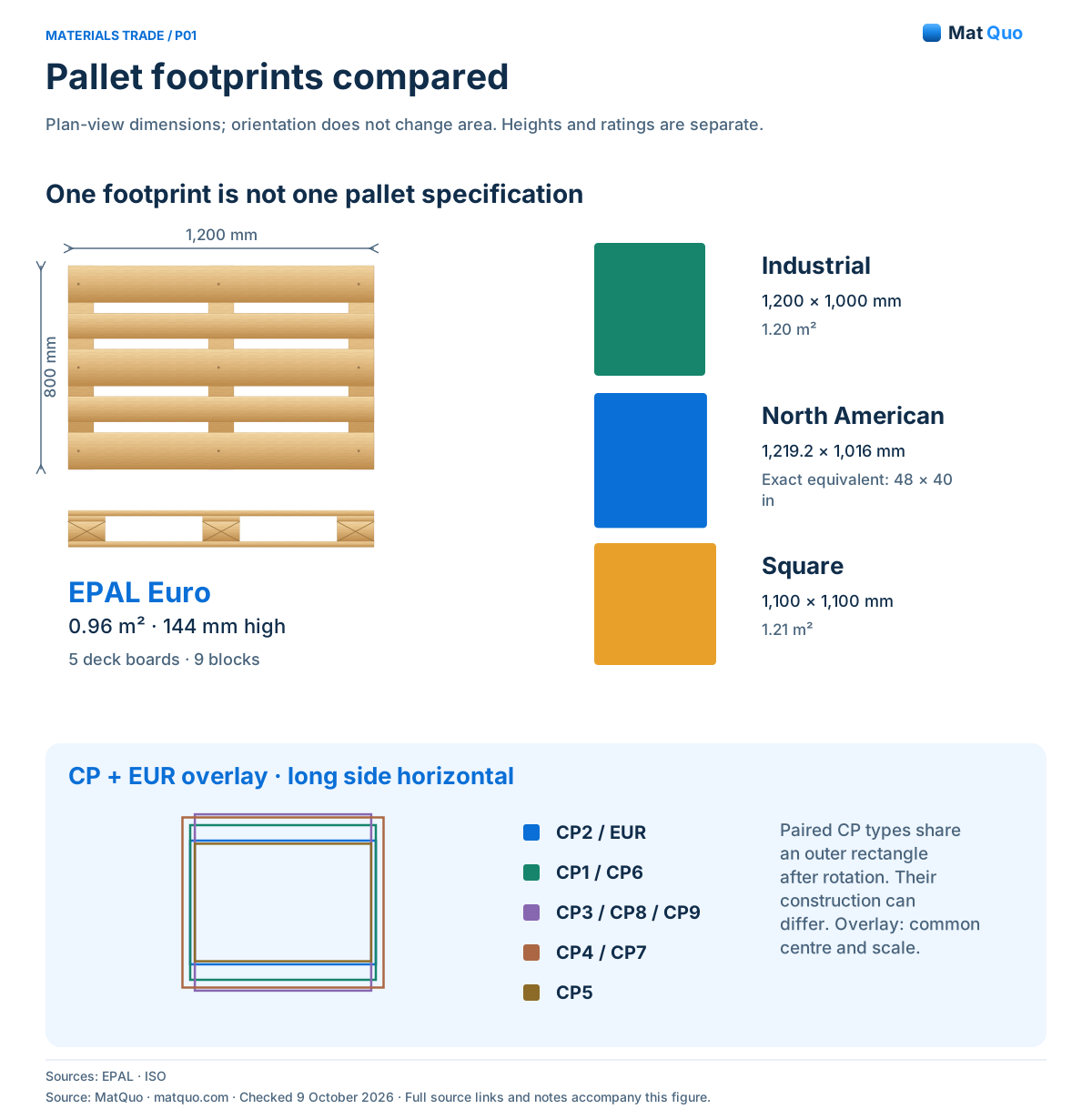
Pallet footprints compared
Plan-view dimensions; orientation does not change area. Heights and ratings are separate.
Detailed poster: scroll horizontally on a small screen, or open the full-size figure. The readable text equivalent is below.
EPAL • Euro pallet · ISO • Public pallet dimensions overview · EPAL • CP1 technical sheet · EPAL • CP2 technical sheet · EPAL • CP3 technical sheet · EPAL • CP4 technical sheet · EPAL • CP5 technical sheet · EPAL • CP6 technical sheet · EPAL • CP7 technical sheet · EPAL • CP8 technical sheet · EPAL • CP9 technical sheet · Checked
Text equivalent and notes
- EPAL Euro
- 800 × 1,200 mm. Area: 0.96 m² • height: 144 mm
- Industrial footprint
- 1,200 × 1,000 mm. Area: 1.20 m² • specify design
- 1,219.2 × 1,016 mm footprint (48 × 40 in)
- 1,219.2 × 1,016 mm. Exact inch conversion, not 1.2 m
- Square footprint
- 1,100 × 1,100 mm. Area: 1.21 m² • specify design
- CP and Euro footprint overlay
- Long side horizontal; common centre and scale.. CP2 and EUR: 800 × 1,200 mm. CP1 / CP6: 1,000 × 1,200 mm after rotation.. CP3 / CP8 / CP9: 1,140 × 1,140 mm. CP4 / CP7: 1,100 × 1,300 mm after rotation. CP5: 760 × 1,140 mm.. Shared footprints do not imply identical construction.
Embed with credit
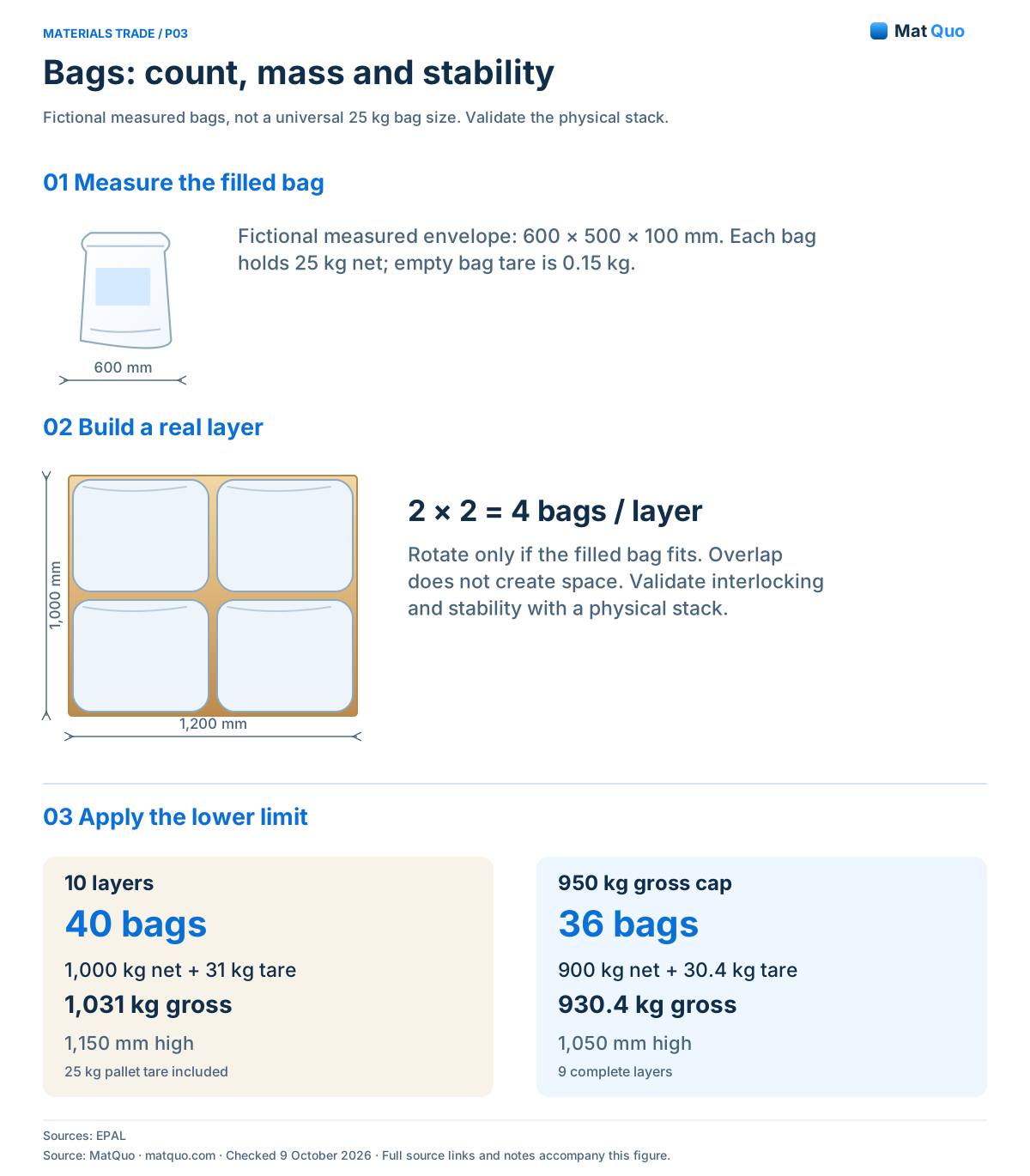
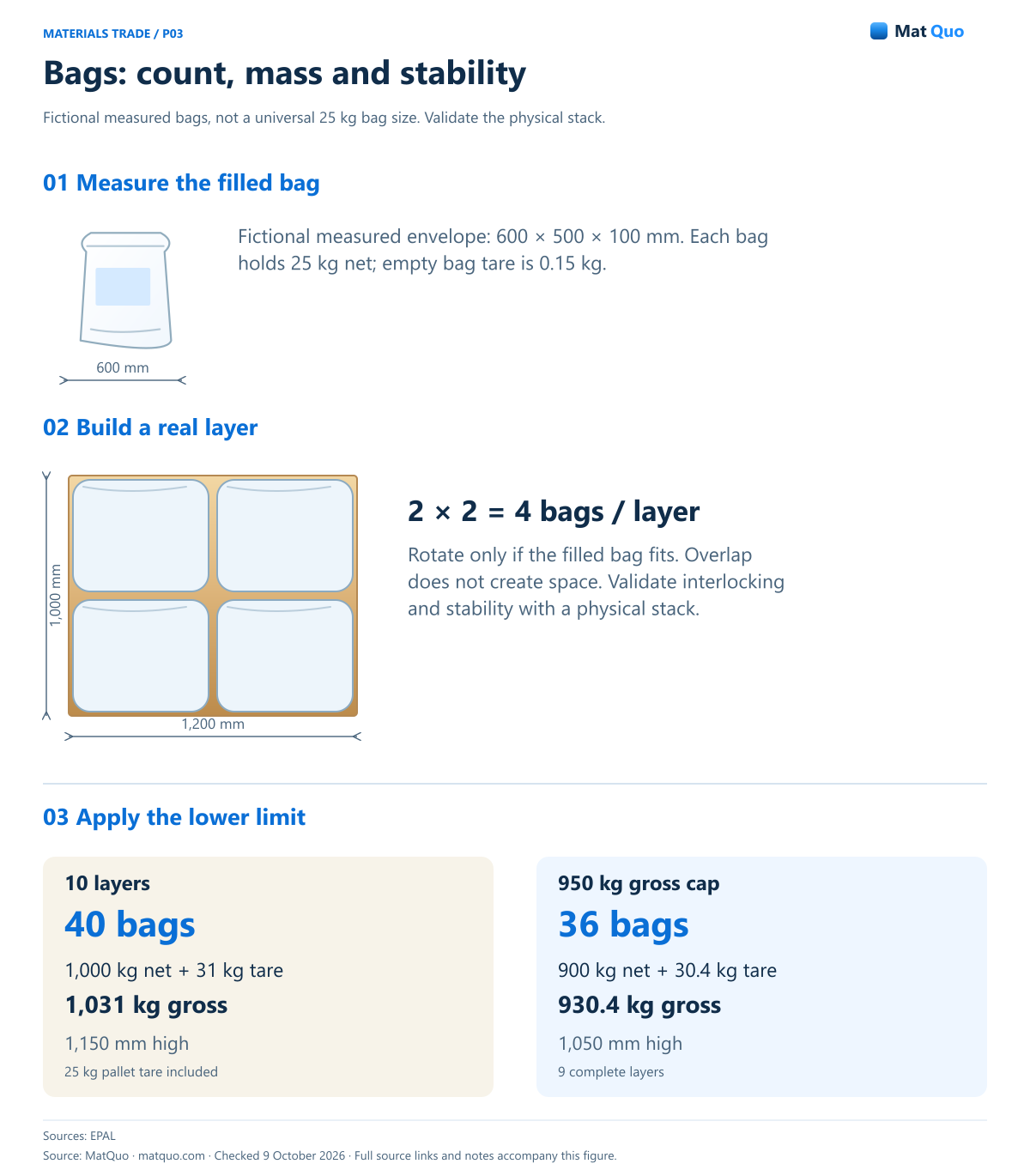
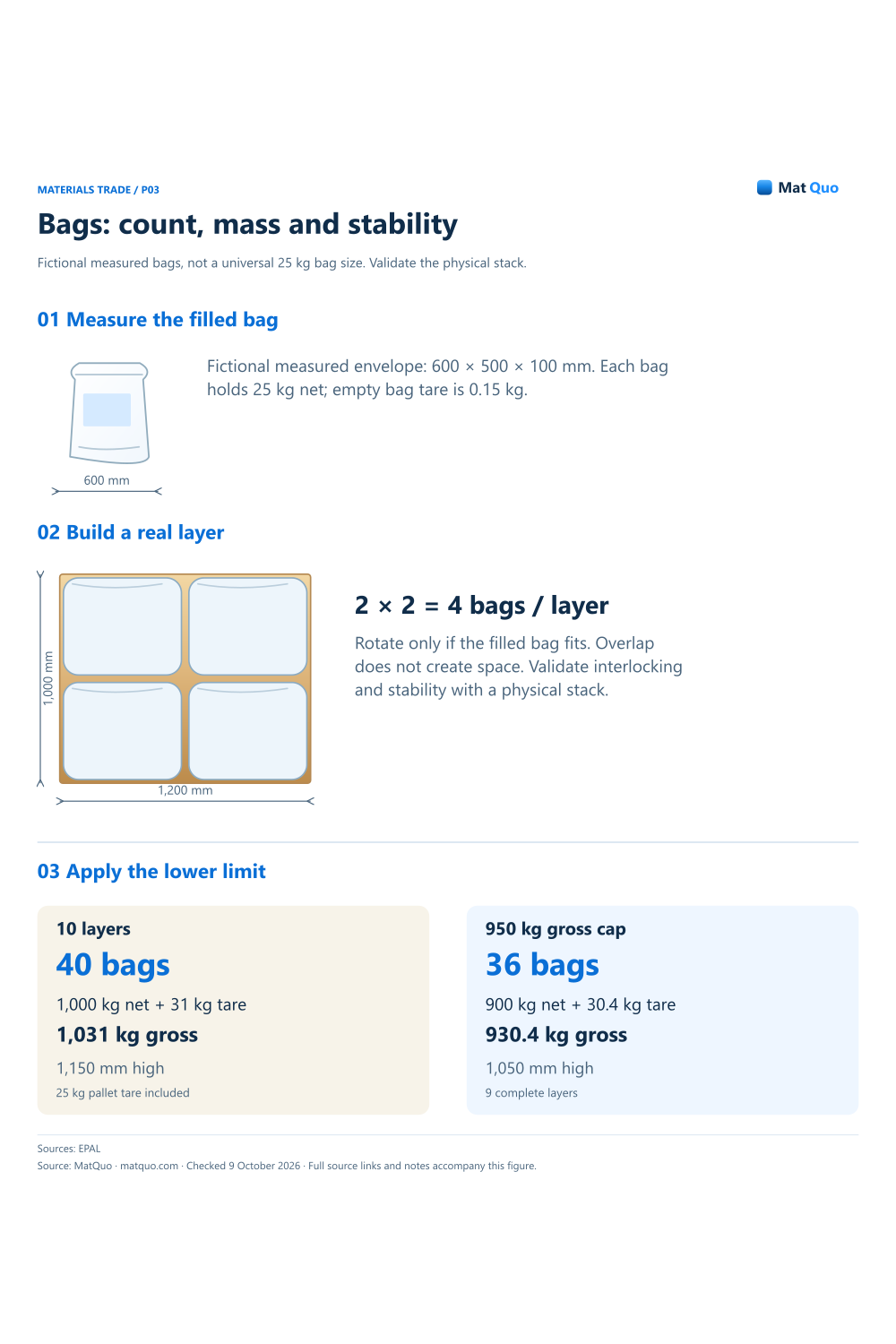
Bags: count, mass and stability
Fictional measured bags, not a universal 25 kg bag size. Validate the physical stack.
Detailed poster: scroll horizontally on a small screen, or open the full-size figure. The readable text equivalent is below.
EPAL • Euro pallet · EPAL • Chemical pallets · Checked
Text equivalent and notes
- Measured rectangle
- 600 × 500 mm on 1,200 × 1,000. 2 × 2 = 4 bags per layer. Aligned layers shown schematically.
- Alternate layers
- Rotate only if the filled bags fit.. Overlaps do not create free space.. Interlock needs a physical trial.
- Ten layers
- 40 × 25 kg = 1,000 kg net. 40 × 0.15 + 25 = 31 kg tare. 1,031 kg gross; 1,150 mm high
- 950 kg gross limit
- Full layers: 9 × 4 = 36 bags. 900 kg net + 30.4 kg tare. 930.4 kg gross; 1,050 mm high
Embed with credit
Common mistakes
- Using an empty bag width instead of its filled footprint.
- Counting product mass while omitting pallet and packaging tare.
- Assuming maximum geometric count is a tested shipping pattern.
Questions and answers
Why do two pallet calculators give different counts?
Compare their assumptions before comparing the totals. They may use different height definitions, allow different rotations or optimise mixed patterns rather than uniform rows. Enter the same dimensions and limits, then check the diagram. A higher theoretical count is not automatically a more usable or stable transport arrangement.
Should the pallet height be included?
Include it when the customer or carrier specifies a maximum overall loaded height. Subtract the actual pallet height before calculating complete product layers. If the input instead means product stacking height, state that clearly. Mixing those definitions can add a layer that the receiving door or storage position cannot accept.
Does a pallet rating establish the truck payload?
No. The pallet’s load capability and the vehicle’s allowable cargo mass are separate checks. Packaging compression, handling conditions and route-specific vehicle limits can impose additional constraints. Keep each confirmed limit in the load record and use the governing one without replacing missing information with a generic industry allowance.
Sources and review scope
- EPAL • Euro pallet — 800 × 1200 × 144 mm; source gives approximately 25 kg tare and 1500 kg safe working load.
- EPAL • Chemical pallets — Nine named CP models; dimensions reproduced from individual product pages.
- ISO • Public pallet dimensions overview — Public 2007 explanation lists 1200 × 1000, 800 × 1200, 1,219.2 × 1,016 mm (48 × 40 in) and 1100 × 1100 mm.
- EPAL • CP1 technical sheet — PBCP 05/2025 EN, page 2: nominal construction drawing; page 1: board and block count.
- EPAL • CP2 technical sheet — PBCP 05/2025 EN, page 2: nominal construction drawing; page 1: board and block count.
- EPAL • CP3 technical sheet — PBCP 05/2025 EN, page 2: nominal construction drawing; page 1: board and block count.
- EPAL • CP4 technical sheet — PBCP 05/2025 EN, page 2: nominal construction drawing; page 1: board and block count.
- EPAL • CP5 technical sheet — PBCP 05/2025 EN, page 2: nominal construction drawing; page 1: board and block count.
- EPAL • CP6 technical sheet — PBCP 05/2025 EN, page 2: nominal construction drawing; page 1: board and block count.
- EPAL • CP7 technical sheet — PBCP 05/2025 EN, page 2: nominal construction drawing; page 1: board and block count.
- EPAL • CP8 technical sheet — PBCP 05/2025 EN, page 2: nominal construction drawing; page 1: board and block count.
- EPAL • CP9 technical sheet — PBCP 05/2025 EN, page 2: nominal construction drawing; page 1: board and block count.