How many 25 kg bags fit on a pallet?
The number of 25 kg bags per pallet depends on the filled bag footprint, permitted pattern, complete layers and gross load limit. Twenty-five kilograms describes contents, not bag dimensions. Measure a representative filled bag, include packaging and pallet tare, and validate stability before using the calculated count as a dispatch instruction.
Start with a physical pattern trial
Lay out one layer using the actual filled bags and allowed clearance. Record whether the next layer is aligned, rotated or interlocked. A staggered drawing can look compact while hiding overhang or pressure points. The calculator compares simple horizontal orientations; it does not certify compression resistance, restraint design or a mixed-pattern optimum.
Keep product and packaging separate
Use net contents for the sales quantity and net plus bag tare for cargo mass. Add the pallet, sheet, hood or restraint tare separately. If only complete layers are permitted, round the mass-limited count down to a whole layer after calculating the number of packages that the gross limit could support.
Comparison at a glance
| Pattern | What it can show | What still needs validation |
|---|---|---|
| Aligned | Repeatable uniform rows | Stability and restraint |
| Alternating | Different permitted layer orientation | Actual fit of filled bags |
| Interlocked | A proposed overlapping pattern | No overhang, support and handling trials |
Worked example
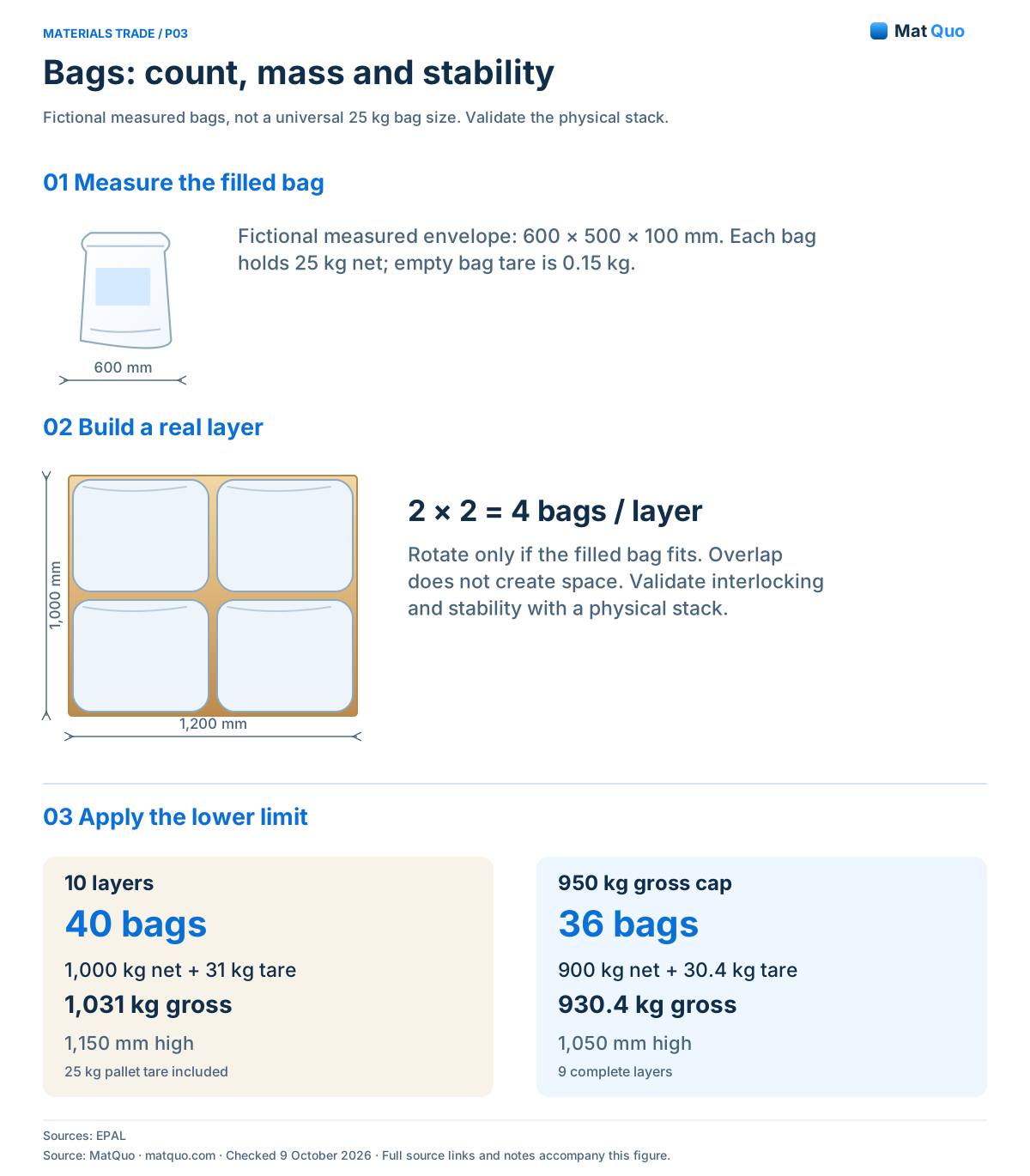
Fictional filled bags measure 600 × 500 × 100 mm, each with 25 kg product and 0.15 kg bag tare. On a 1,200 × 1,000 mm pallet, four fit per layer. Ten layers give 40 bags, 1,000 kg net and 1,031 kg gross with a 25 kg pallet. With a 150 mm pallet, overall height is 1,150 mm. At a 950 kg gross limit, complete layers reduce this to 36 bags and 930.4 kg gross.
Bags: count, mass and stability
Fictional measured bags, not a universal 25 kg bag size. Validate the physical stack.
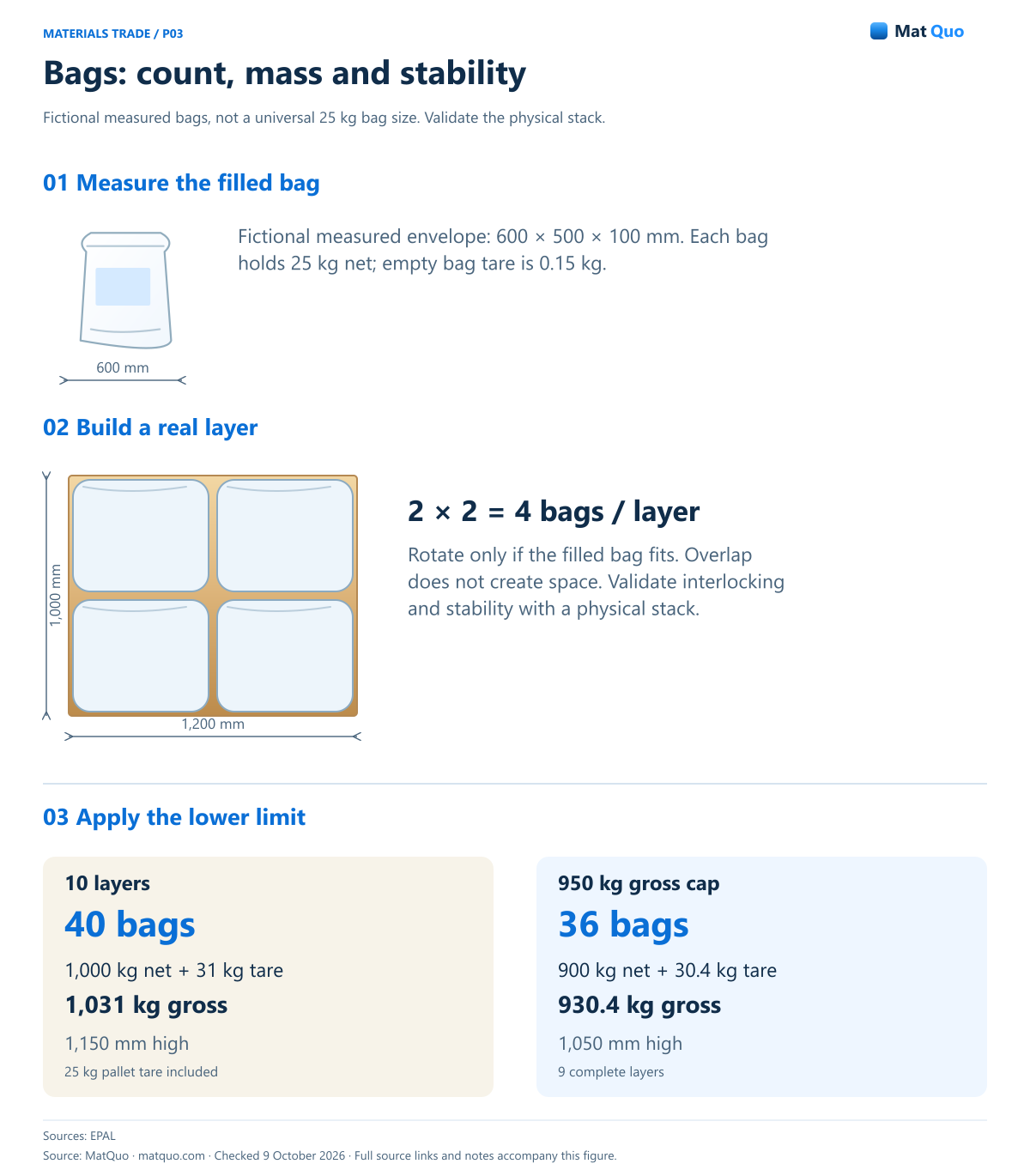
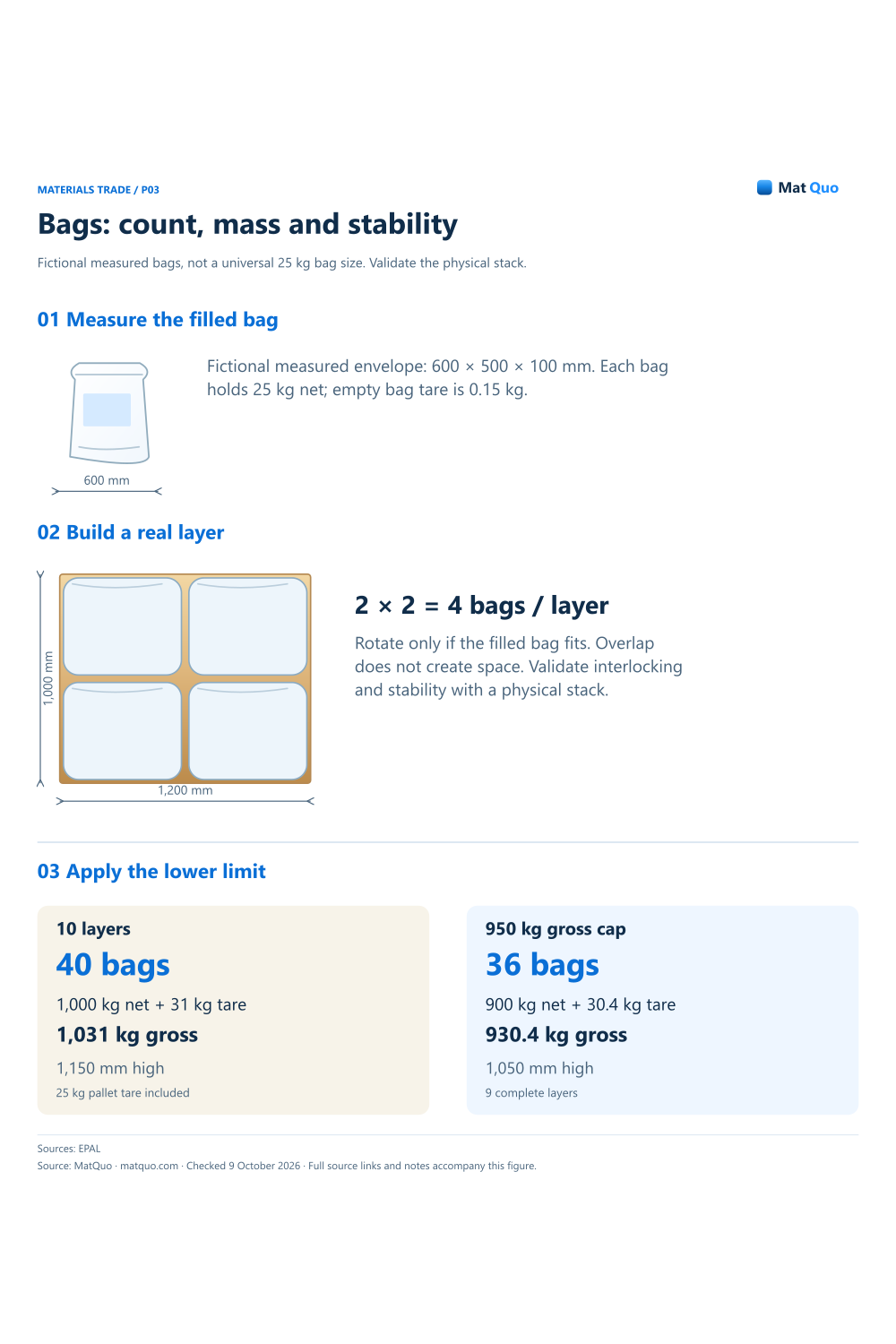
Detailed poster: scroll horizontally on a small screen, or open the full-size figure. The readable text equivalent is below.
EPAL • Euro pallet · EPAL • Chemical pallets · Checked
Text equivalent and notes
- Measured rectangle
- 600 × 500 mm on 1,200 × 1,000. 2 × 2 = 4 bags per layer. Aligned layers shown schematically.
- Alternate layers
- Rotate only if the filled bags fit.. Overlaps do not create free space.. Interlock needs a physical trial.
- Ten layers
- 40 × 25 kg = 1,000 kg net. 40 × 0.15 + 25 = 31 kg tare. 1,031 kg gross; 1,150 mm high
- 950 kg gross limit
- Full layers: 9 × 4 = 36 bags. 900 kg net + 30.4 kg tare. 930.4 kg gross; 1,050 mm high
Embed with credit
Common mistakes
- Assuming every 25 kg resin bag has the same filled dimensions.
- Rounding a 36.7-bag weight allowance up to 37 bags.
- Using partial layers when the agreed packing instruction requires complete layers.
Questions and answers
Are forty bags always one tonne per pallet?
Forty bags containing exactly 25 kg each total one tonne of net product. The gross cargo mass is higher because it includes bags, pallet and other packaging. Whether forty bags physically fit and remain acceptable depends on measured dimensions, stack height, stability and the applicable gross load limit for that shipment.
Why does the example fall to thirty-six bags?
The 950 kg gross limit cannot accept ten complete four-bag layers in the fictional example. Nine layers contain 900 kg product, 5.4 kg bag tare and a 25 kg pallet, giving 930.4 kg gross. Complete-layer rounding leaves capacity unused rather than silently changing the agreed pattern to a partial layer.
Can interlocking always add more bags?
No. Interlocking describes how layers relate, not a guaranteed increase in count. It may change support and stability without creating extra footprint area. Build a trial with filled bags, inspect overhang and compression, and obtain the necessary handling acceptance before treating a proposed interlocked drawing as a usable transport pattern.
Sources and review scope
- EPAL • Euro pallet — 800 × 1200 × 144 mm; source gives approximately 25 kg tare and 1500 kg safe working load.
- EPAL • Chemical pallets — Nine named CP models; dimensions reproduced from individual product pages.