Pallet sizes: EUR, EPAL and ISO dimensions
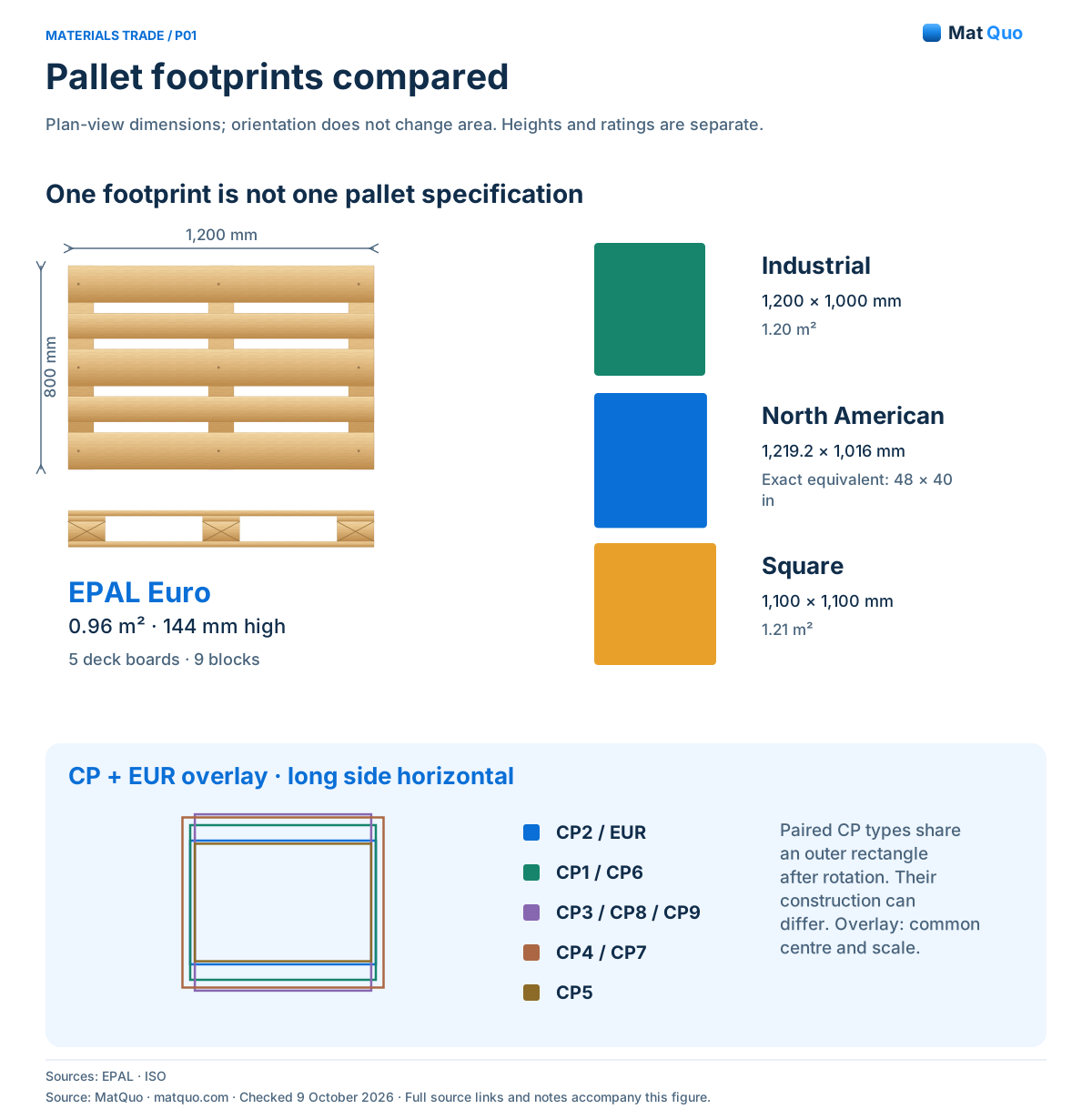
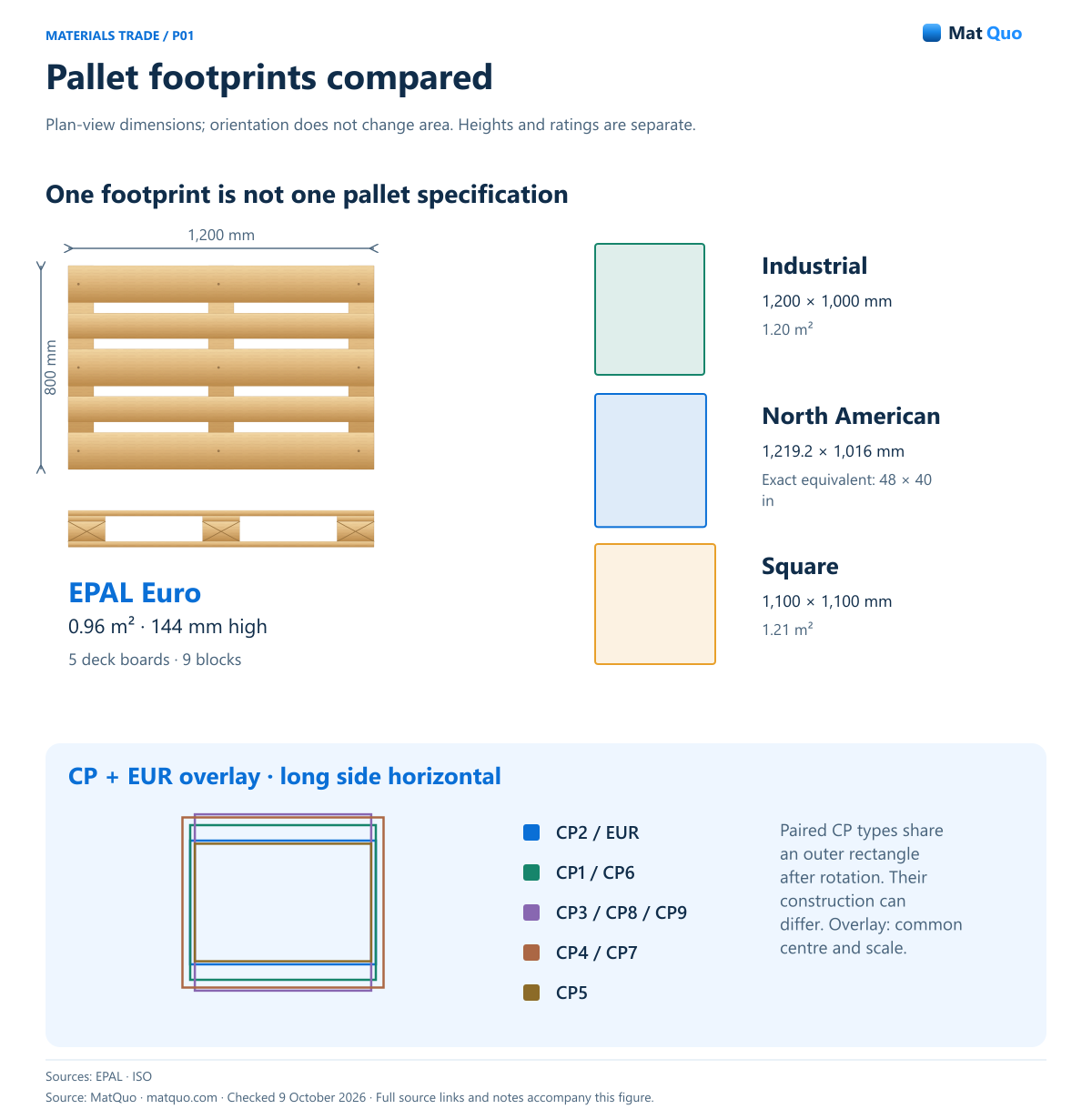
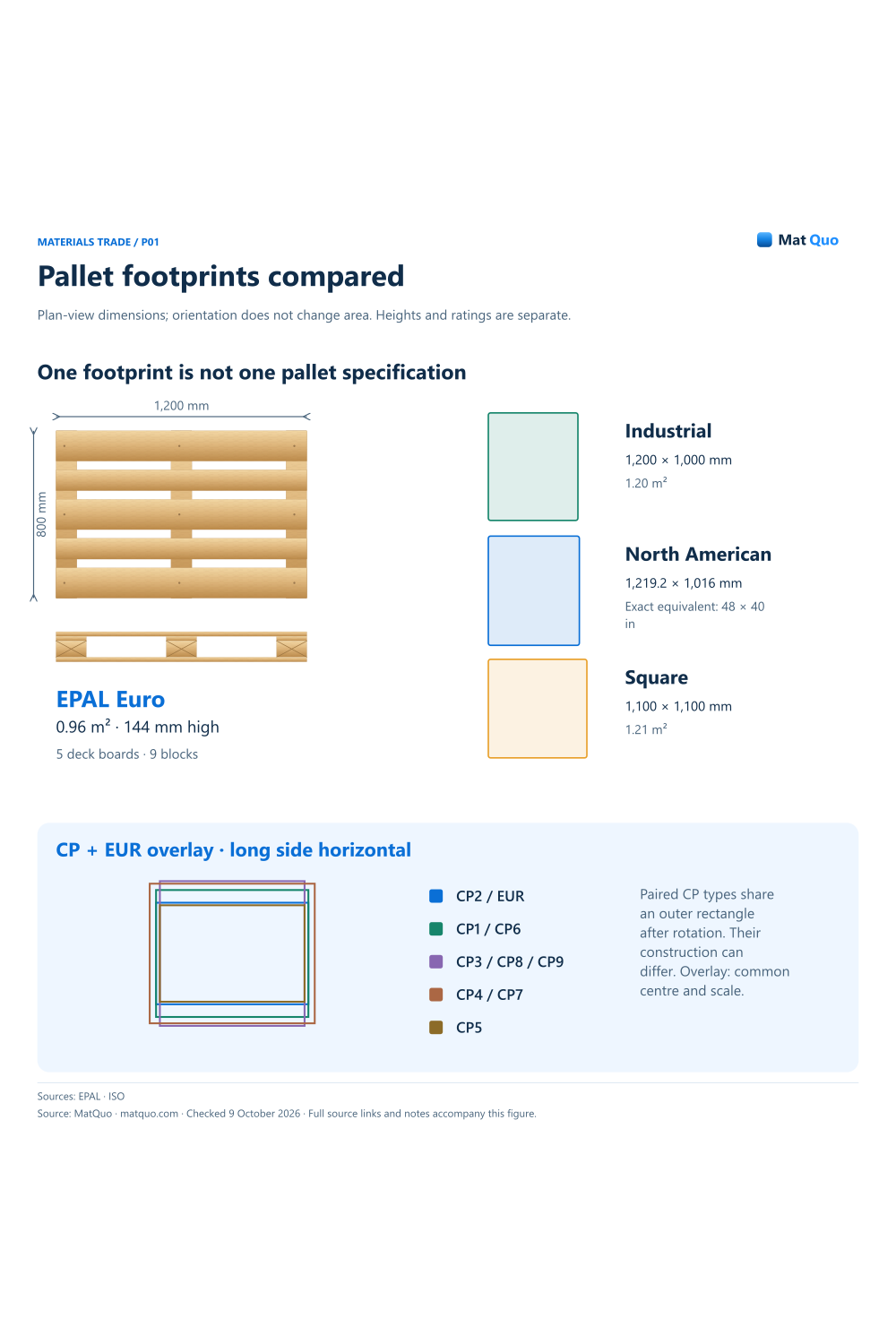
Pallet footprint identifies floor space, not load capacity or construction. The EPAL Euro pallet is 800 by 1,200 mm, while other commonly specified footprints include 1,200 by 1,000 mm and 1,219.2 by 1,016 mm (48 by 40 inches). Match exact dimensions, pallet design and receiving equipment before turning a nominal size into a loading assumption.
Separate dimensions from certification
EPAL specifies its Euro pallet at 800 × 1,200 × 144 mm, approximately 25 kg tare and 1,500 kg safe working load under its stated conditions. The approximate tare is a source-published reference; use the actual pallet mass for a shipment. A similarly sized unmarked platform does not acquire those specifications merely by sharing the footprint.
Use standards precisely
ISO 6780:2003 is the current catalogue edition confirmed in 2026. ISO’s public overview identifies several footprint examples, but the full dimensional standard is not reproduced here. The dimensions in the graphic are verified public examples, not a claim that every worldwide pallet falls into those four choices.
Comparison at a glance
| Footprint | Floor area | Important distinction |
|---|---|---|
| 800 × 1,200 mm | 0.96 m² | EPAL Euro is a specific design |
| 1,200 × 1,000 mm | 1.20 m² | Specify construction separately |
| 48 × 40 in | 1.2387072 m² | Exact conversion: 1,219.2 × 1,016 mm |
| 1,100 × 1,100 mm | 1.21 m² | Square footprint; rating still separate |
Worked example
Fictional 1,200 × 800 mm platform with 400 × 300 mm boxes: one uniform orientation gives floor(1,200/400) × floor(800/300) = 3 × 2 = 6. Rotating the boxes gives floor(1,200/300) × floor(800/400) = 4 × 2 = 8. The same footprint can therefore produce different counts before mixed-pattern optimisation is considered.
Pallet footprints compared
Plan-view dimensions; orientation does not change area. Heights and ratings are separate.
Detailed poster: scroll horizontally on a small screen, or open the full-size figure. The readable text equivalent is below.
EPAL • Euro pallet · ISO • Public pallet dimensions overview · EPAL • CP1 technical sheet · EPAL • CP2 technical sheet · EPAL • CP3 technical sheet · EPAL • CP4 technical sheet · EPAL • CP5 technical sheet · EPAL • CP6 technical sheet · EPAL • CP7 technical sheet · EPAL • CP8 technical sheet · EPAL • CP9 technical sheet · Checked
Text equivalent and notes
- EPAL Euro
- 800 × 1,200 mm. Area: 0.96 m² • height: 144 mm
- Industrial footprint
- 1,200 × 1,000 mm. Area: 1.20 m² • specify design
- 1,219.2 × 1,016 mm footprint (48 × 40 in)
- 1,219.2 × 1,016 mm. Exact inch conversion, not 1.2 m
- Square footprint
- 1,100 × 1,100 mm. Area: 1.21 m² • specify design
- CP and Euro footprint overlay
- Long side horizontal; common centre and scale.. CP2 and EUR: 800 × 1,200 mm. CP1 / CP6: 1,000 × 1,200 mm after rotation.. CP3 / CP8 / CP9: 1,140 × 1,140 mm. CP4 / CP7: 1,100 × 1,300 mm after rotation. CP5: 760 × 1,140 mm.. Shared footprints do not imply identical construction.
Embed with credit
Common mistakes
- Rounding 48 inches down to 1,200 mm in a tight loading plan.
- Applying an EPAL rating to any pallet of the same dimensions.
- Comparing pallet area while ignoring whether the boxes tile the shape.
Questions and answers
Is a 1,200 by 1,000 mm pallet exactly 48 by 40 inches?
No. Using the exact conversion of 25.4 mm per inch gives 1,219.2 by 1,016 mm. The difference matters near a door, rack or trailer boundary. Keep the source units or exact conversion in the planning record, and measure the actual loaded unit including any packaging bulge or overhang.
Can footprint area predict boxes per layer?
Area gives a useful upper bound, but it does not show whether rectangles fit without crossing the edge. Divide each pallet dimension by the corresponding box dimension, round down and compare permitted orientations. Then inspect the layout and validate the physical packing arrangement before committing to a shipment count.
Which pallet mass should I enter?
Use a measured or supplier-confirmed tare for the actual pallet. A published approximate mass is a reference, not a promise about every unit. Add other packaging separately so that the final result distinguishes net product from total cargo mass and can be reconciled with the carrier’s booking or scale record.
Sources and review scope
- EPAL • Euro pallet — 800 × 1200 × 144 mm; source gives approximately 25 kg tare and 1500 kg safe working load.
- ISO • ISO 6780:2003 — Current standard confirmed in 2026. Full proprietary dimensional table not reproduced.
- ISO • Public pallet dimensions overview — Public 2007 explanation lists 1200 × 1000, 800 × 1200, 1,219.2 × 1,016 mm (48 × 40 in) and 1100 × 1100 mm.
- EPAL • CP1 technical sheet — PBCP 05/2025 EN, page 2: nominal construction drawing; page 1: board and block count.
- EPAL • CP2 technical sheet — PBCP 05/2025 EN, page 2: nominal construction drawing; page 1: board and block count.
- EPAL • CP3 technical sheet — PBCP 05/2025 EN, page 2: nominal construction drawing; page 1: board and block count.
- EPAL • CP4 technical sheet — PBCP 05/2025 EN, page 2: nominal construction drawing; page 1: board and block count.
- EPAL • CP5 technical sheet — PBCP 05/2025 EN, page 2: nominal construction drawing; page 1: board and block count.
- EPAL • CP6 technical sheet — PBCP 05/2025 EN, page 2: nominal construction drawing; page 1: board and block count.
- EPAL • CP7 technical sheet — PBCP 05/2025 EN, page 2: nominal construction drawing; page 1: board and block count.
- EPAL • CP8 technical sheet — PBCP 05/2025 EN, page 2: nominal construction drawing; page 1: board and block count.
- EPAL • CP9 technical sheet — PBCP 05/2025 EN, page 2: nominal construction drawing; page 1: board and block count.