Container loading calculator: pellets, bags and pallets
Keep the original box-loading calculation or use the additional modes for upright packed units and bulk-density planning. Check inside space, door access, packaging tare and confirmed cargo allowance independently. Named container presets are sourced examples; the assigned unit can differ, and a calculated fit does not approve handling, securing or the inland route.
See how many of your boxes fit a 6.058 m nominal (20 ft), 40ft or 40ft high-cube container — by volume and by weight, with the limiting factor. Updates as you type.
Box
Container
Preset dimensions are examples only. Select Custom and enter the actual equipment specification for planning.
How container loading is estimated
The calculator tests your box in every orientation and keeps the one that packs the most into the user-entered or preset internal length, width and height, then caps the total by the entered payload. Container series, door openings, liners, tolerances and carrier limits vary, so confirm the actual unit specification. The estimate assumes one box size in a clean block; pallets, bracing, dunnage and safe weight distribution normally reduce the usable count.
Related tools
Handy equipment for this job
Links open Amazon. As an Amazon Associate, MatQuo earns from qualifying purchases — at no extra cost to you.
Additional mode: bulk-density exercise
Fictional defaults illustrate volume and mass constraints; no material density or specialist-container rating is assumed.
Additional mode: upright packed units
Current named-model dimensions are separate from the preserved original examples. Packed-unit dimensions and mass defaults are fictional. Confirm the assigned container, allowance and door.
Preserve the original box model
The established box calculator keeps its controls, dimensions and six-orientation calculation unchanged. Those retained example dimensions are not silently replaced with a different fleet specification. The additional packed-unit mode uses current named Hapag-Lloyd examples and permits horizontal rotation while keeping the unit upright.
Use bulk density for loose material
For a bulk-volume exercise, enter measured bulk density including the spaces between particles, usable volume, fill percentage and packaging tare. Solid polymer density is a different property and must not be substituted. The result is limited by both volume-derived mass and the confirmed cargo allowance after packaging.
Read the door and mass results
An upright unit must fit the selected opening before its floor count is useful. Stacking needs explicit permission. Review the container specifications and retain actual unit identification with the loading record. No tank or other unverified specialist capacity preset is supplied.
Comparison at a glance
| Mode | Primary calculation | Independent constraint |
|---|---|---|
| Original boxes | Six orthogonal box rotations | Existing payload input |
| Upright packed units | Two horizontal layouts; optional stacking | Door dimensions and gross unit mass |
| Bulk exercise | Usable volume × fill × measured bulk density | Cargo allowance minus liner / packaging tare |
Worked example
Fictional bulk exercise: 20 m³ × 90% × 600 kg/m³ = 10,800 kg net. With a 15,000 kg cargo allowance and 100 kg liner, it is volume limited and totals 10,900 kg gross. At 40 m³, volume would allow 21,600 kg, but payload limits product to 14,900 kg; adding the liner reaches 15,000 kg gross.
Dry containers: inside versus door
Named Hapag-Lloyd examples, mm. Verify the assigned unit; fleet dimensions vary.
Detailed poster: scroll horizontally on a small screen, or open the full-size figure. The readable text equivalent is below.
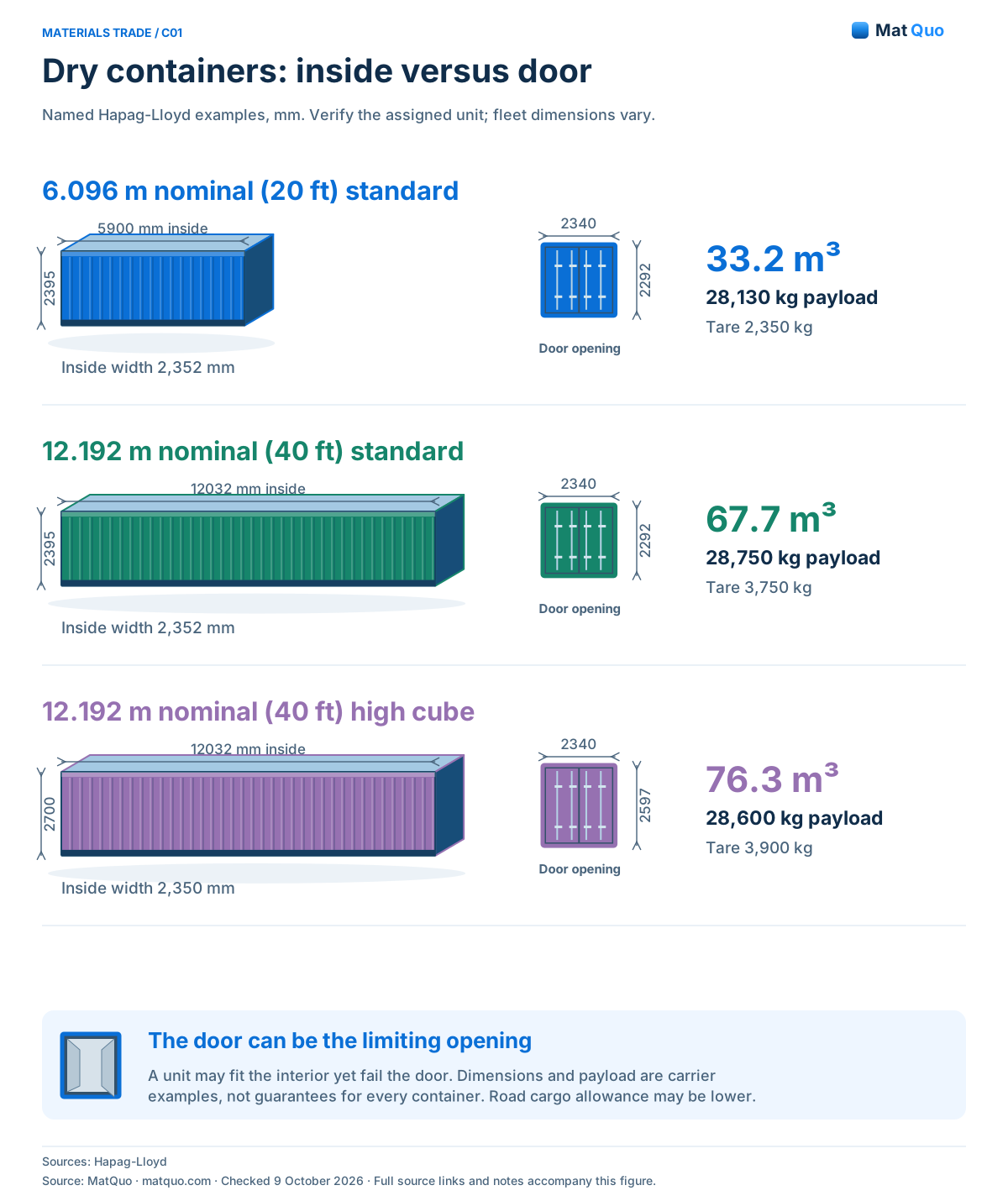
Hapag-Lloyd • 6.096 m nominal (20 ft) standard · Hapag-Lloyd • 12.192 m nominal (40 ft) standard · Hapag-Lloyd • 12.192 m nominal (40 ft) high cube · Checked
Text equivalent and notes
- 6.096 m nominal (20 ft) standard
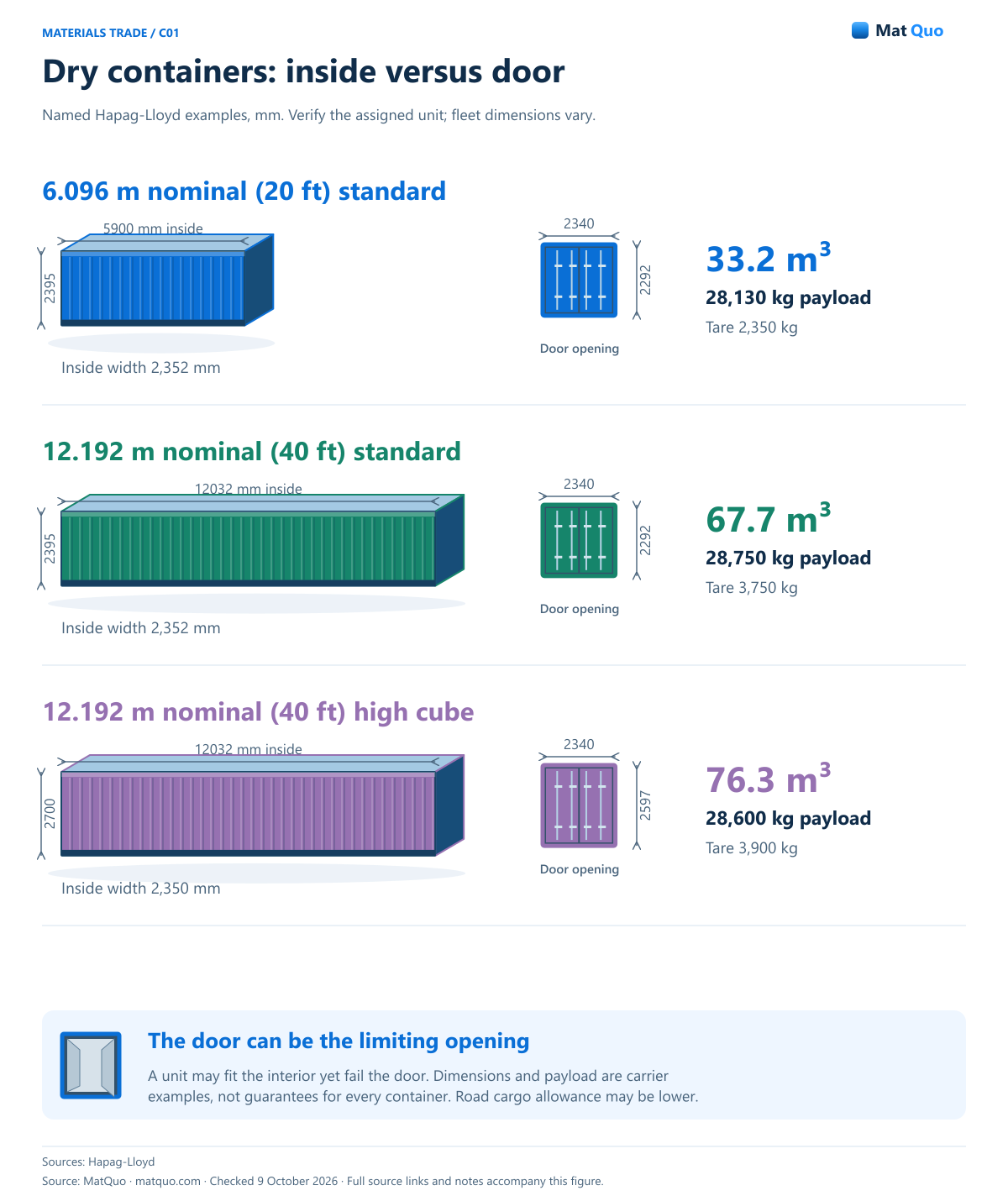
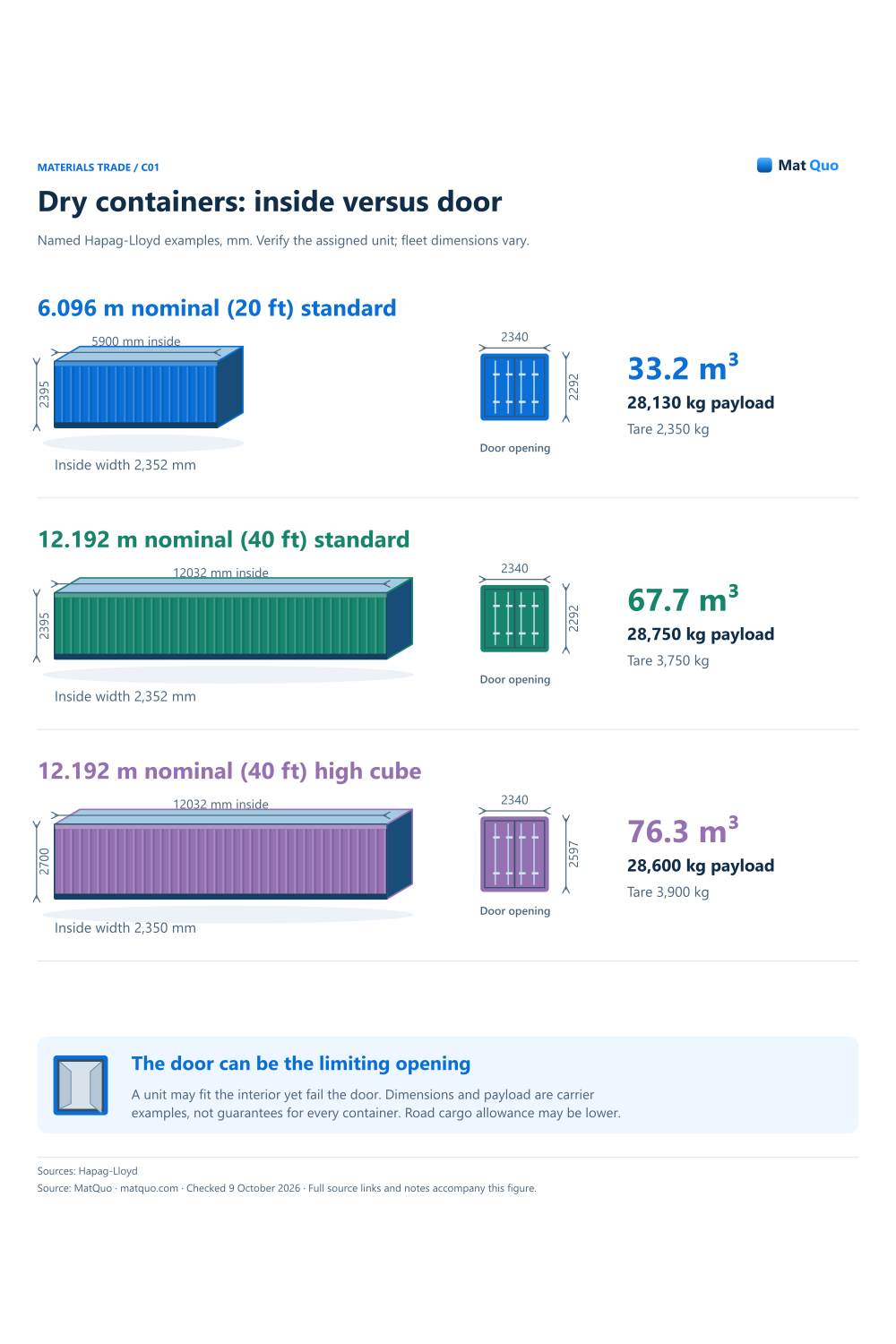
- Inside: 5,900 × 2,352 × 2,395. Door: 2,340 × 2,292. Tare: 2,350 kg • payload: 28,130 kg. Volume: 33.2 m³.
- 12.192 m nominal (40 ft) standard
- Inside: 12,032 × 2,352 × 2,395. Door: 2,340 × 2,292. Tare: 3,750 kg • payload: 28,750 kg. Volume: 67.7 m³.
- 12.192 m nominal (40 ft) high cube
- Inside: 12,032 × 2,350 × 2,700. Door: 2,340 × 2,597. Tare: 3,900 kg • payload: 28,600 kg. Volume: 76.3 m³.
- Two independent limits
- A tall unit can fail the door test. while fitting inside the box.. Road cargo allowance may be lower.
Embed with credit
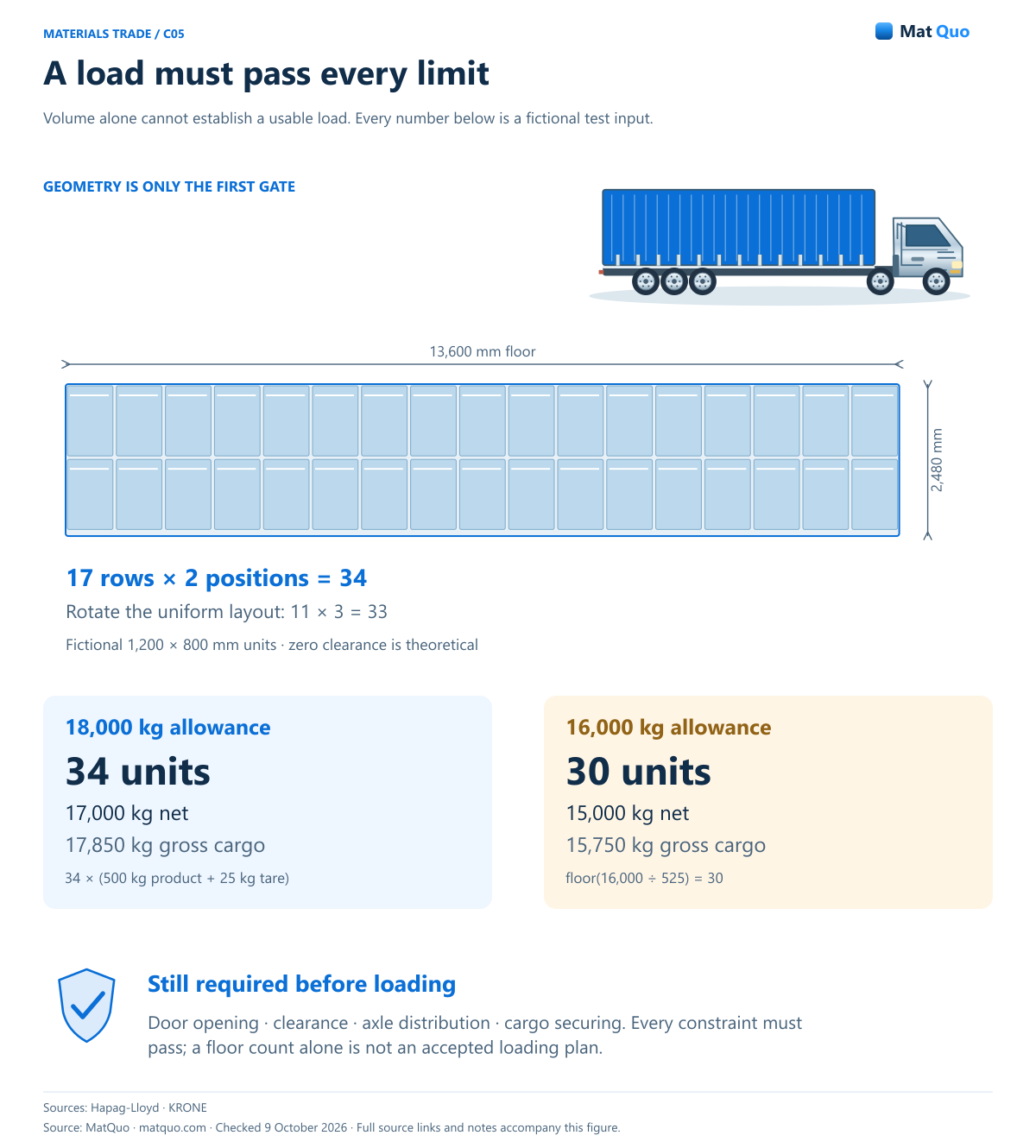
A load must pass every limit
Volume alone cannot establish a usable load. Every number below is a fictional test input.
Detailed poster: scroll horizontally on a small screen, or open the full-size figure. The readable text equivalent is below.
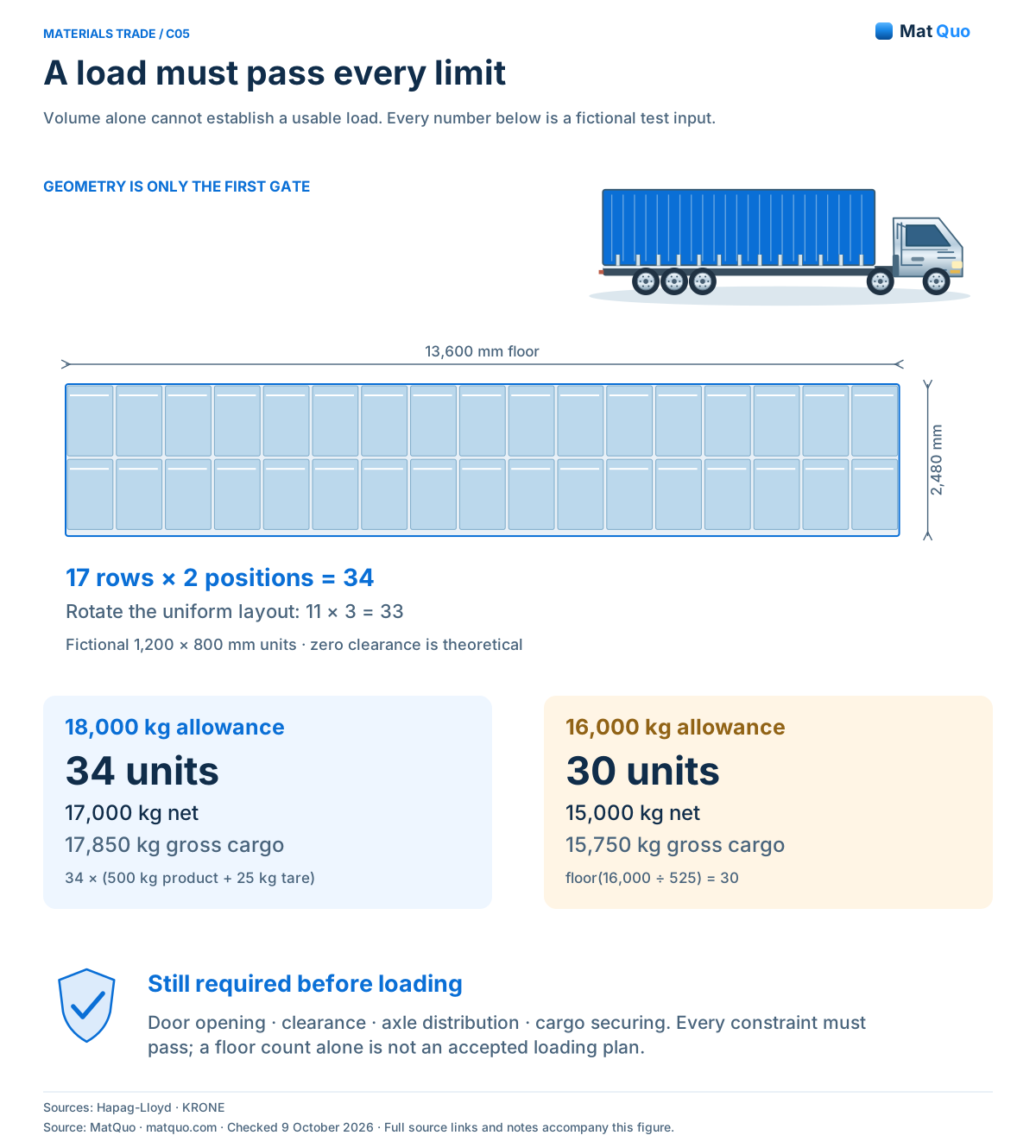
Hapag-Lloyd • Container fleet · KRONE • Profi Liner · Checked
Text equivalent and notes
- 1 • Geometry
- 13,600 × 2,480 mm floor. 1,200 × 800 mm pallets. Uniform rows: 33 or 34 positions
- 2 • Mass
- 34 × (500 + 25) kg. 17,000 kg net • 17,850 kg gross. Passes an 18,000 kg allowance
- 3 • Lower allowance
- At 16,000 kg: floor(16,000 / 525). 30 pallets • 15,000 kg net. 15,750 kg gross cargo
- 4 • Physical acceptance
- Door height, clearance, axles. and securing still need checking.. Zero clearance is theoretical.
Embed with credit
Common mistakes
- Using solid resin density instead of measured bulk density.
- Letting a packed pallet tip through the door without permission.
- Changing a legacy preset silently and presenting the new output as the same example.
Questions and answers
Why do the original and new container presets differ?
The original calculator’s example dimensions are retained for existing users. The additional mode identifies current sourced fleet examples by name instead of silently changing that established model. Select the mode deliberately, read its assumptions and replace example values with the actual assigned equipment specification when planning a real shipment.
What density belongs in the bulk calculation?
Use measured bulk density for the material in its relevant packed or loose condition, including the spaces between particles. Do not substitute the solid polymer density used in film-weight calculations. Keep the measurement basis with the shipment record, because a precise multiplication cannot correct a density value taken from the wrong physical boundary.
Does a low calculated volume guarantee door access?
No. Door width and height constrain the shape of each upright packed unit independently of total volume. A tall pallet can occupy little cubic space and still fail the opening check. Confirm the measured loaded dimensions, required clearance and handling method before accepting a geometric loading result for the assigned container.
Sources and review scope
- Hapag-Lloyd • Container fleet — Dimensions vary by manufacturer and equipment. Named examples only.
- Hapag-Lloyd • 6.096 m nominal (20 ft) standard — Inside 5900 × 2352 × 2395 mm; door 2340 × 2292; tare 2350 kg; payload 28130 kg.
- Hapag-Lloyd • 12.192 m nominal (40 ft) standard — Inside 12032 × 2352 × 2395 mm; door 2340 × 2292; tare 3750 kg; payload 28750 kg.
- Hapag-Lloyd • 12.192 m nominal (40 ft) high cube — Table: inside 12032 × 2350 × 2700 mm; door 2340 × 2597; tare 3900 kg; payload 28600 kg.
- KRONE • Profi Liner — Model SDP 27 eLB50-CS: internal length 13620 mm, width 2480 mm; technical rating is not road cargo allowance.