Container types, dimensions and payload
Container type determines access and cargo systems, while the actual unit’s inside dimensions, door opening and payload determine usable capacity. Standard dry, high-cube, open-top, flat-rack, reefer, tank and other specialist equipment are not interchangeable. Use the sourced model examples below for screening, then confirm the assigned container before loading.
Check the smallest opening first
Measure the complete packed unit, including pallet, bulging and clearance. A container can have sufficient inside height yet reject the cargo at its door. The new packed-cargo mode keeps upright units upright and checks the selected opening; it does not silently tip a pallet to improve the result.
Treat specialist specifications as incomplete until confirmed
Current Hapag-Lloyd examples support the dry, high-cube, reefer, open-top and flat-rack dimensions shown here. BSL supports the open-side access description. Detailed tank, dry-bulk and ventilated ratings are not yet verified and are intentionally omitted. No historical brochure value is substituted as a current preset.
Comparison at a glance
| Named Hapag example | Inside L × W × H, mm | Door W × H, mm | Volume, m³ / gross / tare / payload, kg |
|---|---|---|---|
| 6.096 m nominal (20 ft) standard | 5,900 × 2,352 × 2,395 | 2,340 × 2,292 | 33.2 / 30,480 / 2,350 / 28,130 |
| 12.192 m nominal (40 ft) standard | 12,032 × 2,352 × 2,395 | 2,340 × 2,292 | 67.7 / 32,500 / 3,750 / 28,750 |
| 12.192 m nominal (40 ft) high cube | 12,032 × 2,350 × 2,700 | 2,340 × 2,597 | 76.3 / 32,500 / 3,900 / 28,600 |
Worked example
Using the sourced 6.096 m nominal (20 ft) standard example, a fictional upright pallet 2,300 mm high fits below the 2,395 mm inside height but exceeds the 2,292 mm door opening by 8 mm. It fails the upright door check even if its total volume is small. No tipping or dismantling is assumed to rescue the fit.
Dry containers: inside versus door
Named Hapag-Lloyd examples, mm. Verify the assigned unit; fleet dimensions vary.
Detailed poster: scroll horizontally on a small screen, or open the full-size figure. The readable text equivalent is below.
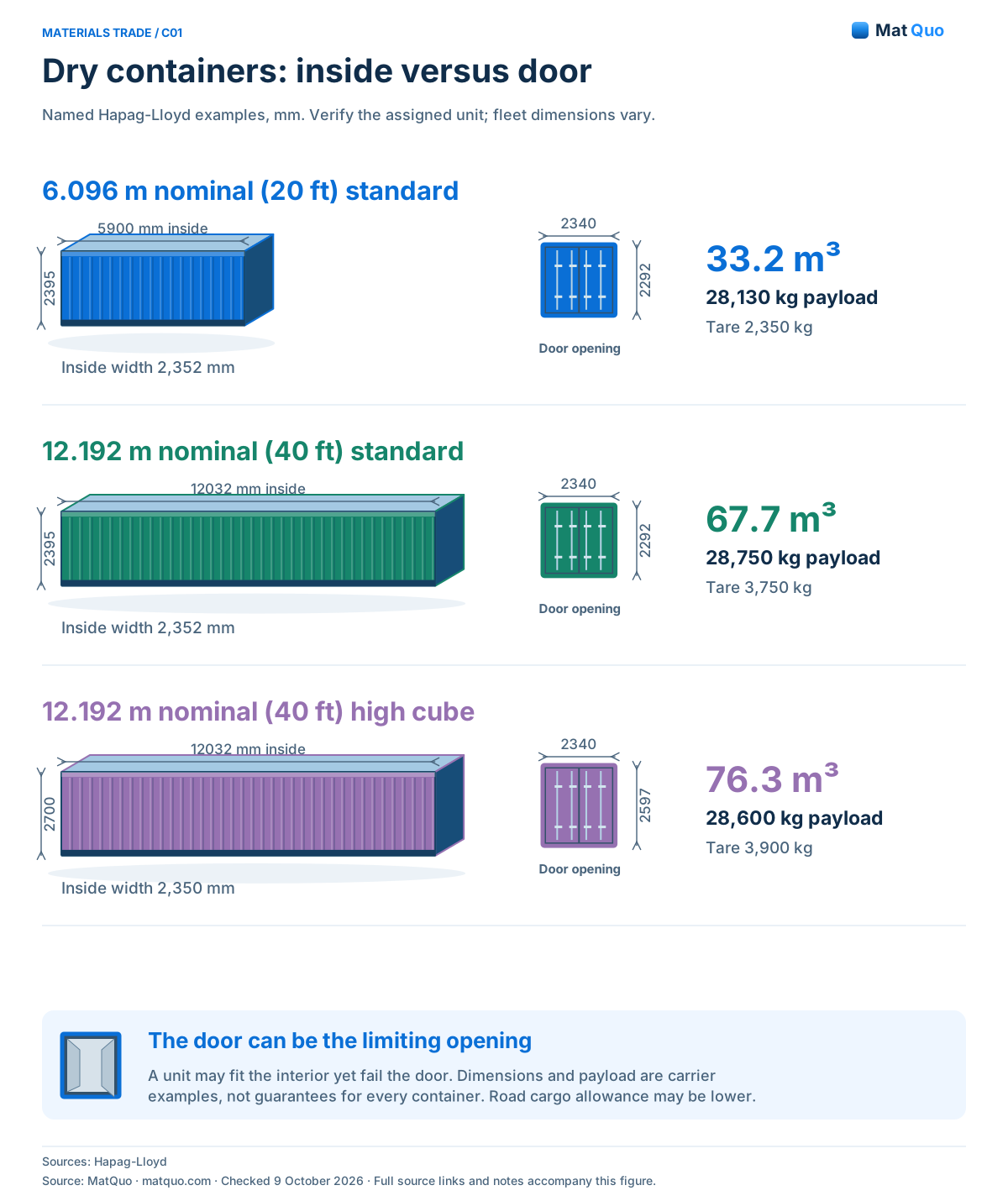
Hapag-Lloyd • 6.096 m nominal (20 ft) standard · Hapag-Lloyd • 12.192 m nominal (40 ft) standard · Hapag-Lloyd • 12.192 m nominal (40 ft) high cube · Checked
Text equivalent and notes
- 6.096 m nominal (20 ft) standard
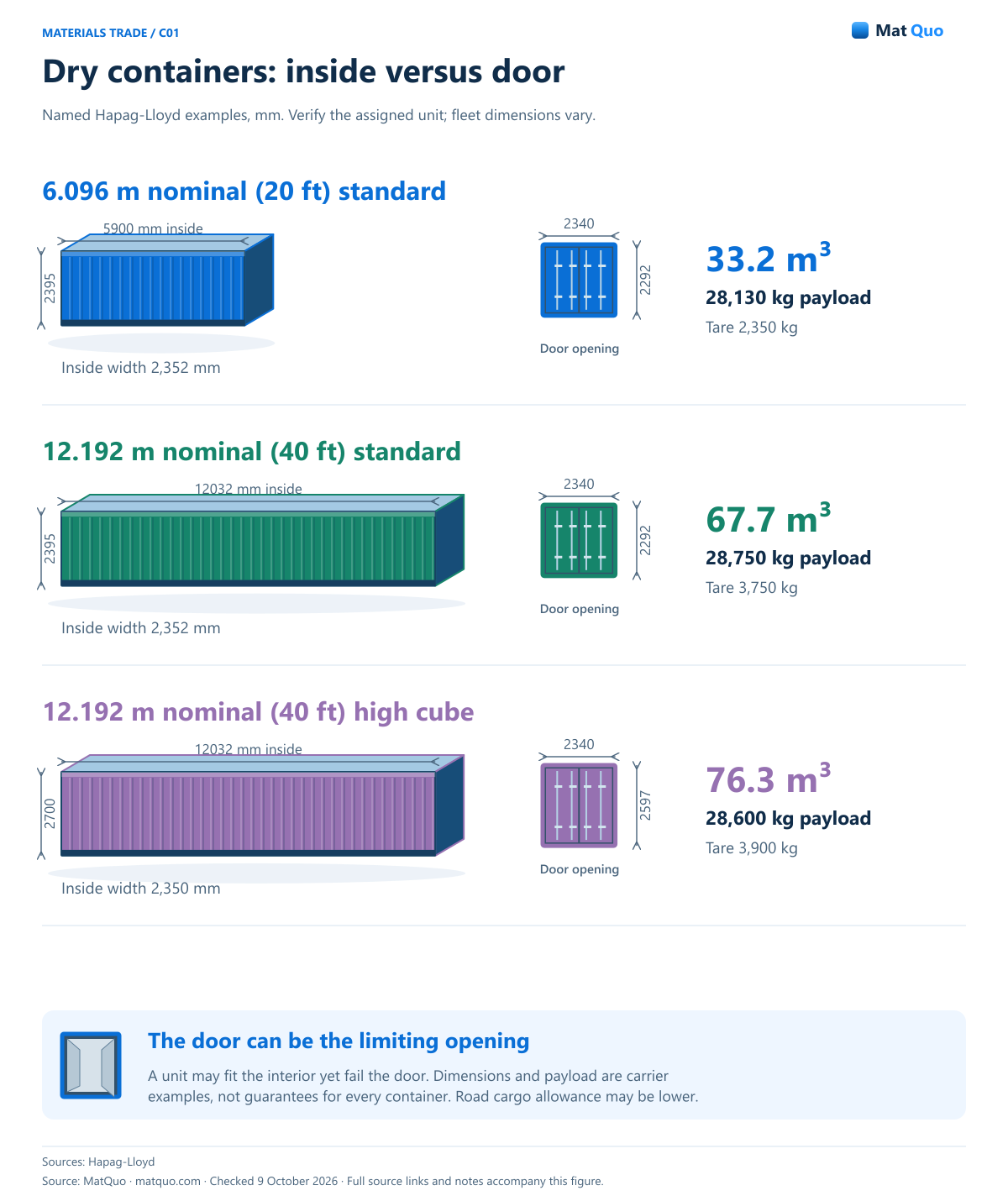
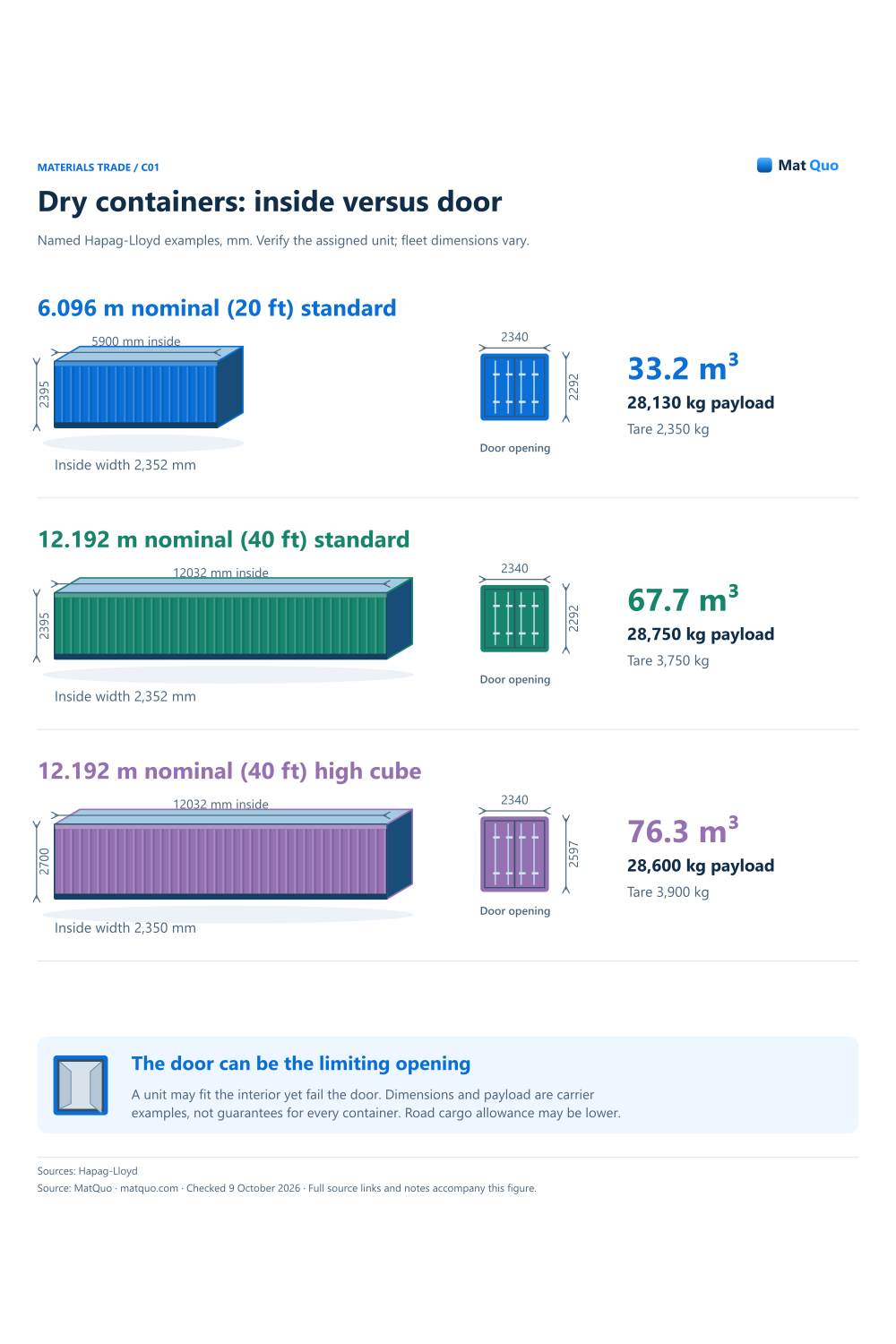
- Inside: 5,900 × 2,352 × 2,395. Door: 2,340 × 2,292. Tare: 2,350 kg • payload: 28,130 kg. Volume: 33.2 m³.
- 12.192 m nominal (40 ft) standard
- Inside: 12,032 × 2,352 × 2,395. Door: 2,340 × 2,292. Tare: 3,750 kg • payload: 28,750 kg. Volume: 67.7 m³.
- 12.192 m nominal (40 ft) high cube
- Inside: 12,032 × 2,350 × 2,700. Door: 2,340 × 2,597. Tare: 3,900 kg • payload: 28,600 kg. Volume: 76.3 m³.
- Two independent limits
- A tall unit can fail the door test. while fitting inside the box.. Road cargo allowance may be lower.
Embed with credit
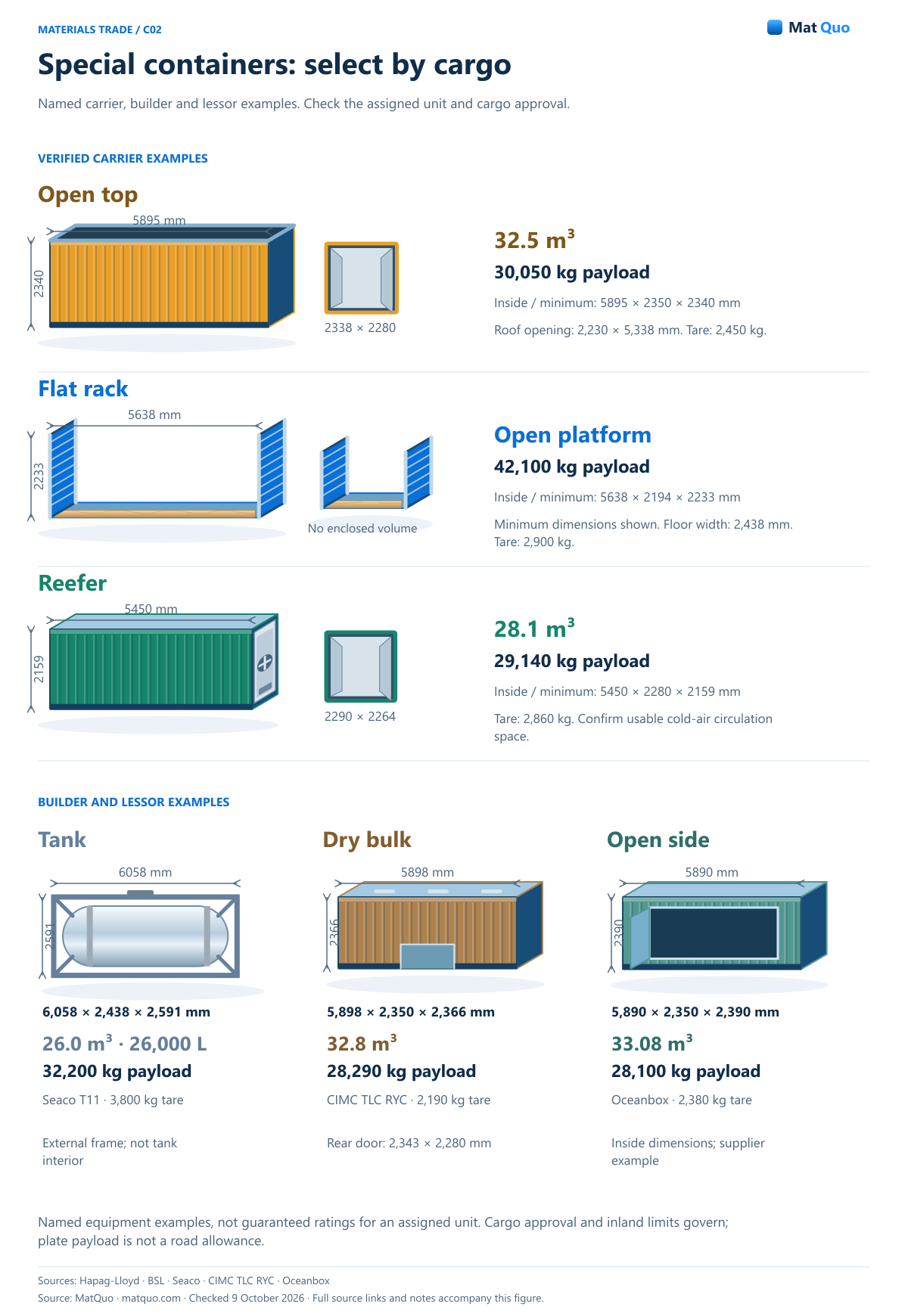
Special containers: select by cargo
Named carrier, builder and lessor examples. Check the assigned unit and cargo approval.
Detailed poster: scroll horizontally on a small screen, or open the full-size figure. The readable text equivalent is below.
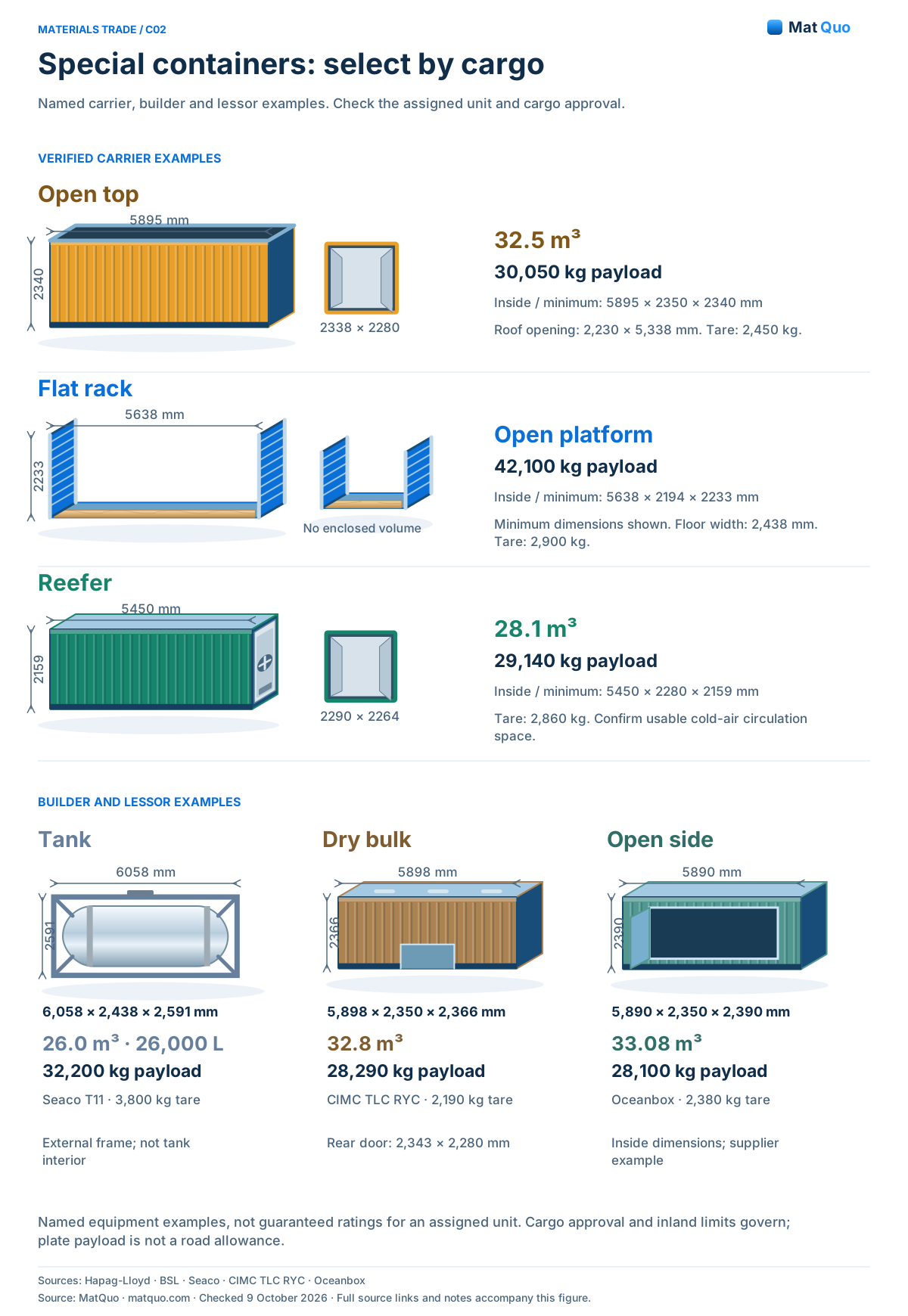
Container sizes and ratings vary by builder; check the assigned unit, ventilation specification and side-door opening with the carrier.
Hapag-Lloyd • 6.096 m nominal (20 ft) open top · Hapag-Lloyd • 6.096 m nominal (20 ft) flatrack · Hapag-Lloyd • 6.096 m nominal (20 ft) reefer · BSL • 6.096 m nominal (20 ft) open side model · Hapag-Lloyd • Container type groups · Hapag-Lloyd • Bulk packing guidance · Seaco • standard T11 tank specification · CIMC TLC RYC • bulk container data sheet · Oceanbox • side-opening container specification · Checked
Text equivalent and notes
- Open top
- Top access for suitable cargo.. Hapag 6.096 m nominal (20 ft) roof opening:. 2,230 × 5,338 mm.. Inside: 5,895 × 2,350 × 2,340 mm; door: 2,338 × 2,280 mm; volume 32.5 m³; tare 2,450 kg; payload 30,050 kg.
- Flat rack
- No enclosed cargo volume.. Check lashing and out-of-gauge. approval for the actual unit.. Minimum inside: 5,638 × 2,194 × 2,233 mm; floor width 2,438 mm; tare 2,900 kg; payload 42,100 kg. Not a road allowance.
- Reefer
- Temperature-controlled equipment.. Hapag 6.096 m nominal (20 ft) inside, mm:. 5,450 × 2,280 × 2,159.. Door: 2,290 × 2,264 mm; volume 28.1 m³; tare 2,860 kg; payload 29,140 kg.
- Tank
- Seaco T11: 26,000 L (26.0 m³) nominal capacity.. External frame: 6,058 × 2,438 × 2,591 mm; not tank interior.. Tare: 3,800 kg; maximum payload: 32,200 kg.. Cargo compatibility, tank approval and actual plate remain controlling.
- Dry bulk
- CIMC TLC RYC first data-sheet variant.. Inside: 5,898 × 2,350 × 2,366 mm; rear door: 2,343 × 2,280 mm.. Volume: 32.8 m³; tare: 2,190 kg; payload: 28,290 kg.. Do not mix ratings from the separate variant.
- Open side
- Oceanbox supplier example: inside 5.89 × 2.35 × 2.39 m.. Volume: 33.08 m³; tare: 2,380 kg; payload: 28,100 kg.. Confirm the clear side-door aperture on the assigned unit.
Embed with credit
Common mistakes
- Using exterior dimensions as available cargo space.
- Assuming a high cube always permits more cargo mass.
- Treating the container plate’s payload as the allowance for every inland road leg.
Questions and answers
Why does a high cube not automatically carry more tonnes?
Its additional height increases geometric possibilities, but mass remains constrained by the assigned unit’s rating and the transport route. Tare also differs between equipment examples. Compare usable dimensions and confirmed cargo allowance separately rather than multiplying nominal volume by an assumed density and treating the result as an authorised load.
Can a tank container use the packed-box calculator?
A tank needs a different cargo and compatibility assessment. Rectangular box geometry does not establish its usable liquid fill, approved product, cleaning condition or operating constraints. Detailed tank ratings are not yet verified in this guide, so no tank capacity preset is supplied. Obtain the actual tank documentation before calculating a shipment.
What does a failed door check mean?
It means the entered upright packed unit exceeds the selected clear door width or height under the stated clearance assumptions. It does not prove that an alternative handling method is approved. Confirm equipment, loading method and cargo integrity separately before changing the orientation, dismantling packaging or choosing another container type.
Sources and review scope
- Hapag-Lloyd • Container fleet — Dimensions vary by manufacturer and equipment. Named examples only.
- Hapag-Lloyd • 6.096 m nominal (20 ft) standard — Inside 5900 × 2352 × 2395 mm; door 2340 × 2292; tare 2350 kg; payload 28130 kg.
- Hapag-Lloyd • 12.192 m nominal (40 ft) standard — Inside 12032 × 2352 × 2395 mm; door 2340 × 2292; tare 3750 kg; payload 28750 kg.
- Hapag-Lloyd • 12.192 m nominal (40 ft) high cube — Table: inside 12032 × 2350 × 2700 mm; door 2340 × 2597; tare 3900 kg; payload 28600 kg.
- Hapag-Lloyd • 6.096 m nominal (20 ft) reefer — Inside 5450 × 2280 × 2159 mm; door 2290 × 2264; tare 2860 kg; payload 29140 kg.
- Hapag-Lloyd • 6.096 m nominal (20 ft) open top — Inside 5895 × 2350 × 2340 mm; door 2338 × 2280; roof 2230 × 5338; tare 2450 kg; payload 30050 kg.
- Hapag-Lloyd • 6.096 m nominal (20 ft) flatrack — Minimum length 5638 mm, floor width 2438 mm, minimum width 2194 mm. No enclosed volume.
- BSL • 6.096 m nominal (20 ft) open side model — Side access design; dimensions used in the poster come from the separate named Oceanbox example. Clear side-door aperture varies by assigned equipment.
- Hapag-Lloyd • Container type groups — Tank and ventilated equipment categories; no numerical presets.
- Hapag-Lloyd • Bulk packing guidance — Section 6.11: liner and door restraint for bulk cargo. Historical numerical ratings are not used as current presets.
- Seaco • standard T11 tank specification — 2022 published fleet example, page 9: 26,000 L capacity; external frame 6,058 × 2,438 × 2,591 mm; tare 3,800 kg; payload 32,200 kg. Frame dimensions are not tank interior dimensions.
- CIMC TLC RYC • bulk container data sheet — First published data-sheet variant: inside 5,898 × 2,350 × 2,366 mm; rear door 2,343 × 2,280 mm; 32.8 m³; tare 2,190 kg; payload 28,290 kg. Separate variants are not mixed.
- Oceanbox • side-opening container specification — Supplier example: inside 5.89 × 2.35 × 2.39 m; capacity 33.08 m³; tare 2,380 kg; payload 28,100 kg. The page does not establish a clear side-door aperture.