From oil and gas to plastics and packaging
Oil and gas become plastics through several distinct operations: feedstock preparation, chemical conversion to monomers, polymerisation and product conversion. Refining separates mixtures; cracking changes molecules; polymerisation builds chains. Follow the output and evidence at each boundary, including co-products and recycling losses, instead of treating every tonne of crude as a tonne of finished resin.
Begin beyond the introductory journey
The existing production-journey overview introduces the main stages. This guide goes deeper into what changes at each boundary and why a buyer cannot translate an upstream price or mass directly into a delivered polymer specification. Use the links below for grade architecture and conversion detail.
Distillation separates; conversion reacts
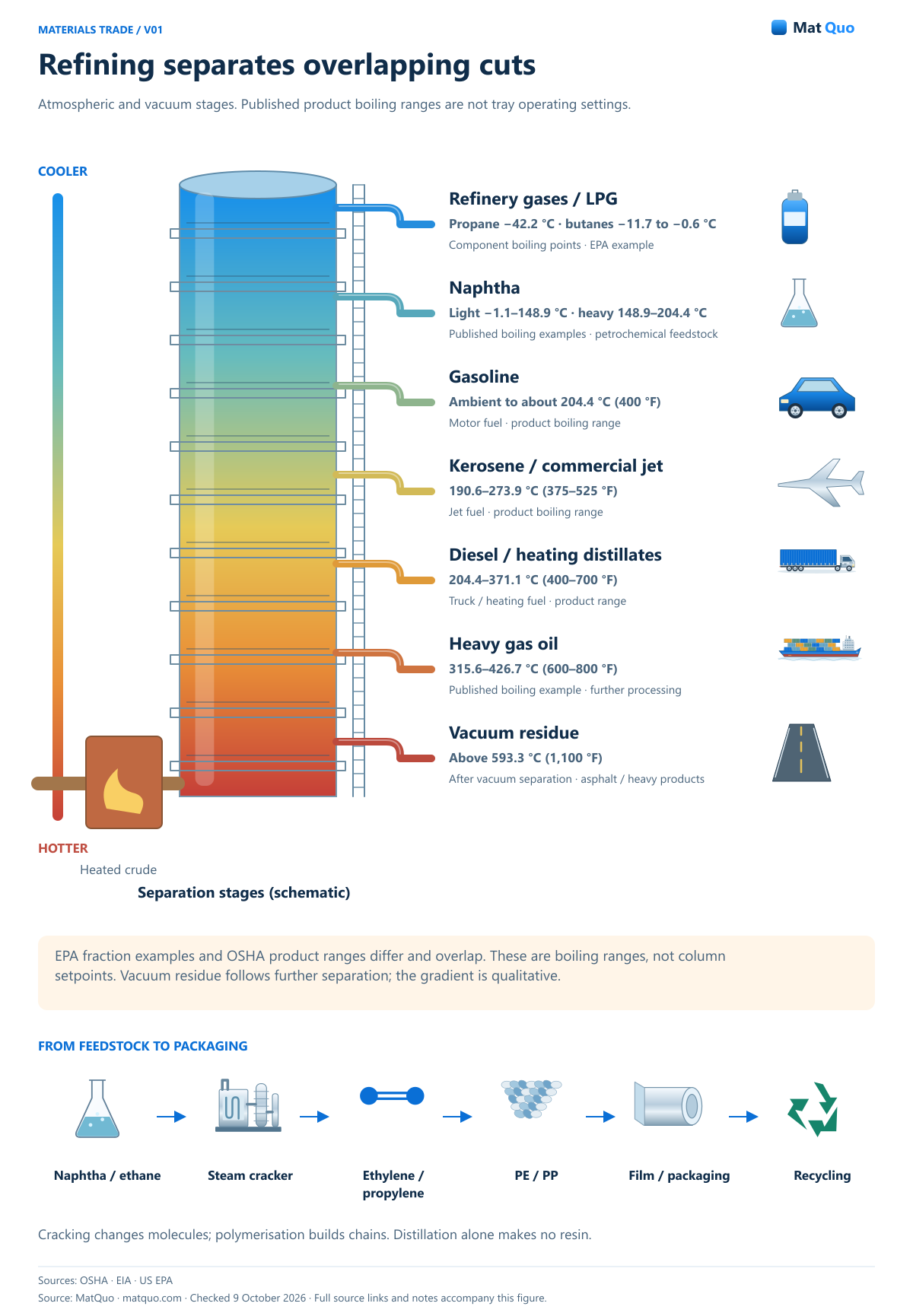
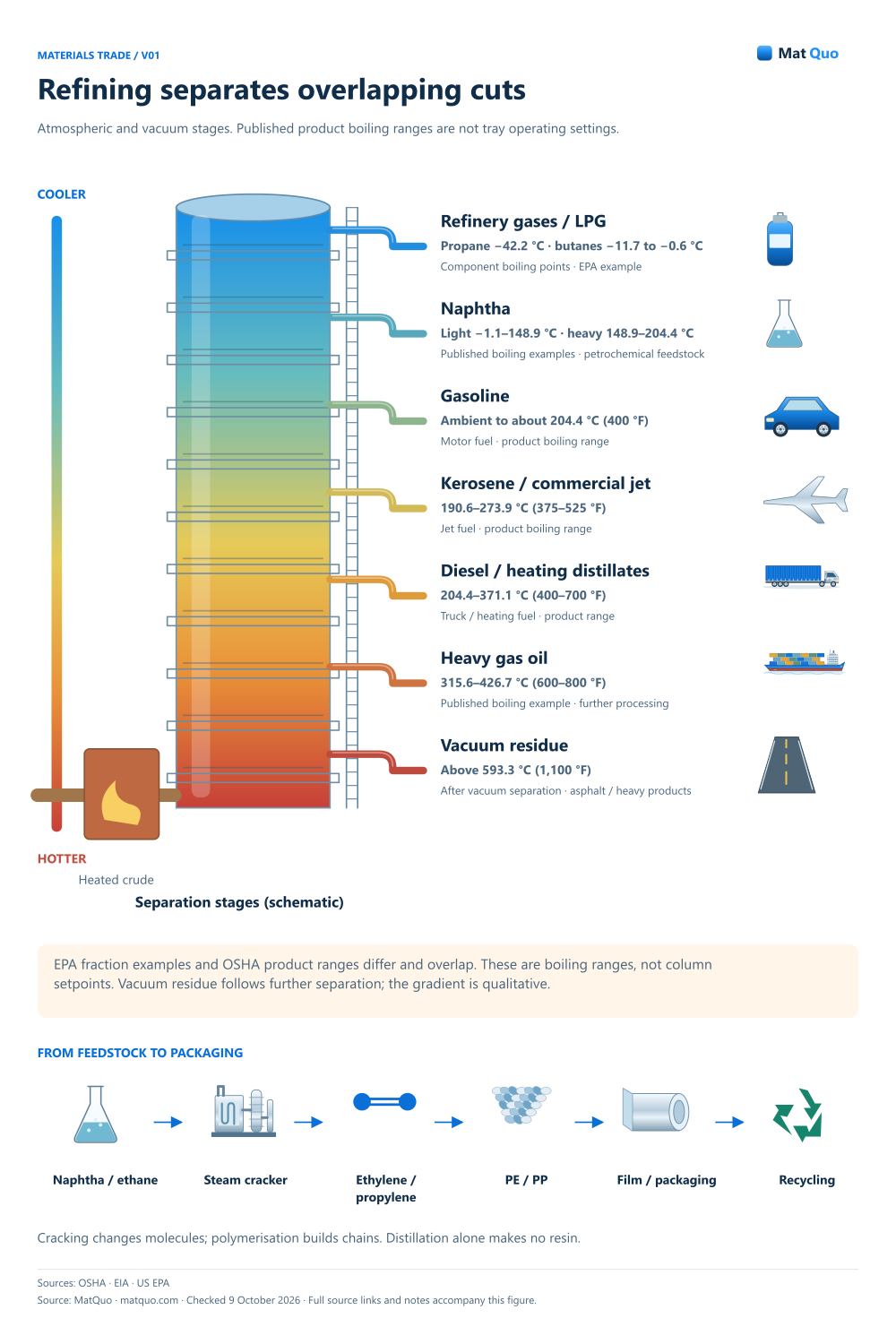
An atmospheric column separates overlapping boiling-range streams. Heavier residue may enter vacuum distillation, where reduced pressure supports separation without the same thermal-cracking exposure. These are process descriptions, not universal fraction cut points. The graphic distinguishes US EPA fraction-boiling examples from OSHA finished-product ranges. Neither sets refinery tray temperatures, and the residue example refers to the stream after vacuum separation.
A cracker produces an output basket
A feedstock route supplies more than one output. Naphtha and ethane crackers differ in that basket, so a simple feedstock-price comparison misses co-product credits and plant constraints. Ethylene and propylene then enter distinct polymer routes, described in the PE and PP guides.
Close the mass ledger before drawing a loop
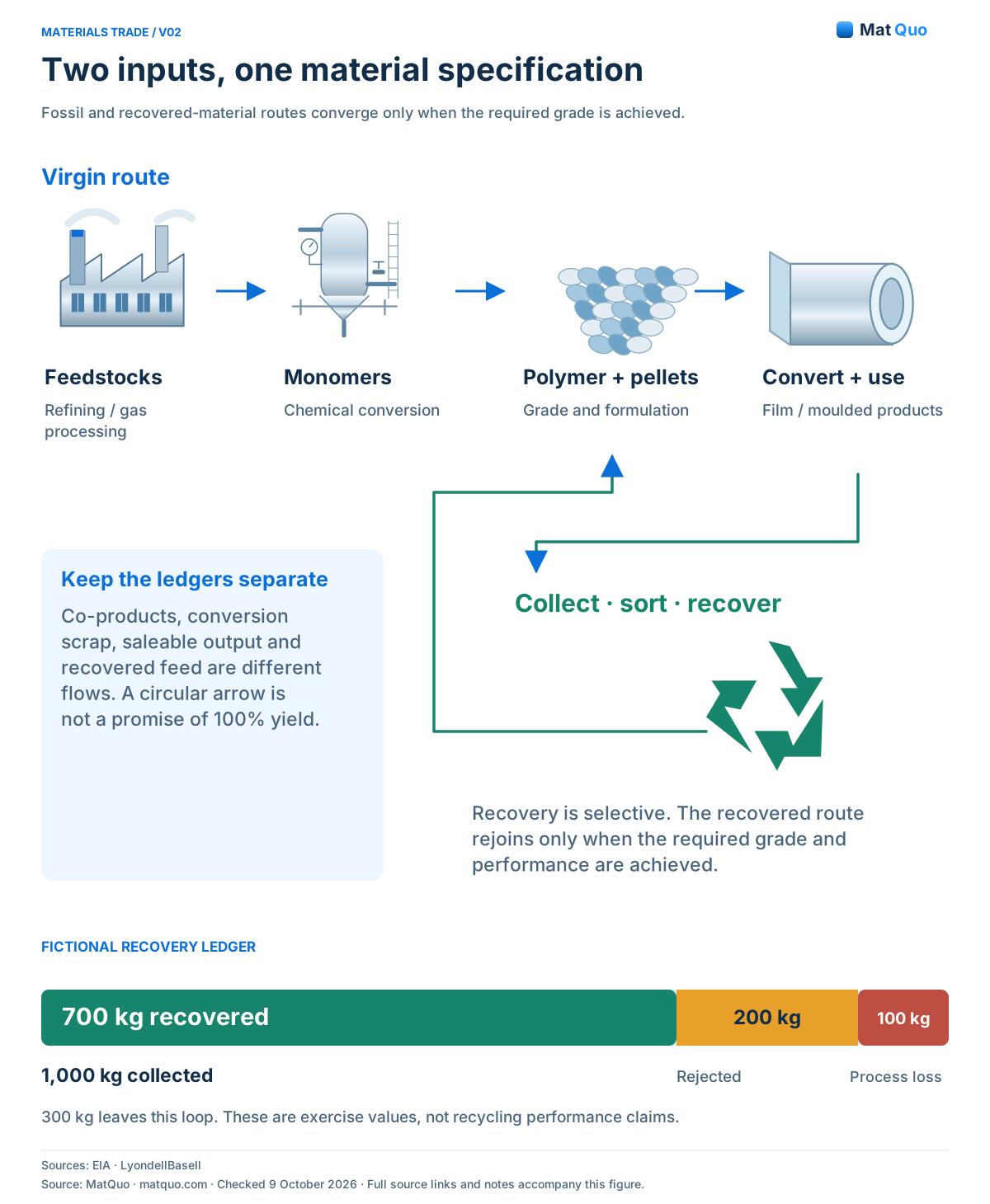
Recovered material must meet the next process and product requirements. Record collected input, rejects, processing losses and qualified output separately. The illustrated recovery ledger is a fictional accounting exercise, not a published recycling yield or a promise that every package returns to the same application. For film conversion, follow the saleable-output ledger.
Comparison at a glance
| Stage | What changes | Useful buyer evidence |
|---|---|---|
| Distillation | Mixture separated into fractions | Feedstock description |
| Cracking / conversion | Molecules converted into other chemicals | Monomer and co-product basis |
| Polymerisation | Monomers become polymer chains | Grade identity and specification |
| Conversion | Resin becomes a film or part | Finished-product test and yield record |
| Recovery | Selected material returns through a suitable route | Origin, losses and qualification evidence |
Worked example
Fictional recovery exercise: 1,000 kg collected input minus 200 kg rejected material and 100 kg processing losses gives 700 kg recovered output. Recovery yield on this stated boundary is 70%. If only 600 kg qualifies for a particular application, that application-qualified yield is 60%; it is not made 70% by ignoring the qualification step.
Refining separates overlapping cuts
Atmospheric and vacuum stages. Published product boiling ranges are not tray operating settings.
Detailed poster: scroll horizontally on a small screen, or open the full-size figure. The readable text equivalent is below.
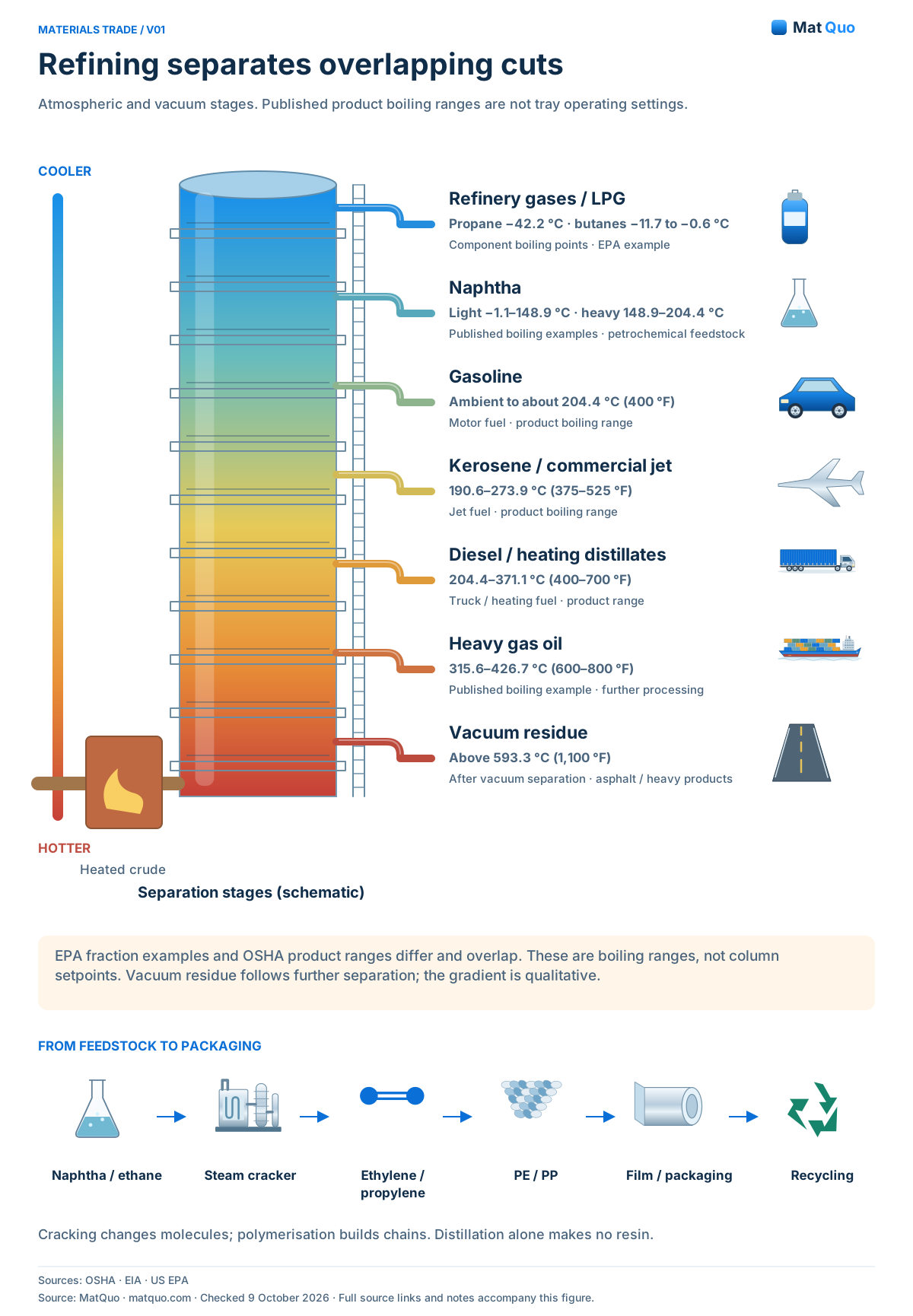
Boiling ranges and operating conditions vary by crude and refinery; confirm the relevant stream specification with the refinery or supplier.
OSHA • Petroleum refining · EIA • Refining process · US EPA • refinery engineering fraction examples · Checked
Text equivalent and notes
- Lighter overhead streams
- Refinery gas / LPG components. Naphtha is a cracking feedstock.. Component and fraction examples below.
- Middle distillates
- Kerosene, jet and diesel streams. have overlapping specifications.. Do not draw universal cut points.
- Heavier streams
- Gas oils and atmospheric residue. can enter further processing.. Residue is not finished plastic.
- Vacuum stage
- Reduced pressure helps separate. heavy material without the same. thermal-cracking exposure.
- OSHA range example
- Commercial jet: 190.6–273.9 °C (375–525 °F).. Published product boiling range, not column setpoint.
- Next: chemical conversion
- A steam cracker changes molecules.. Polymerisation then builds chains.. Distillation alone makes no resin.
- Other OSHA product ranges
- Gasoline: ambient to about 204.4 °C (400 °F).. Diesel / heating oil: 204.4–371.1 °C (400–700 °F).. Product boiling ranges, not tray operating settings.
- EPA fraction examples
- Table F3-4, 1979 engineering reference; Celsius values calculated from published Fahrenheit and rounded to 0.1 °C.. Propane: −42.2 °C; butanes: −11.7 to −0.6 °C; component boiling points rather than a single LPG cut range.. Light naphtha: −1.1–148.9 °C; heavy naphtha: 148.9–204.4 °C.. Heavy gas oil: 315.6–426.7 °C; vacuum residue: above 593.3 °C, after further separation.. Boiling examples do not prescribe refinery operating temperatures.
Embed with credit
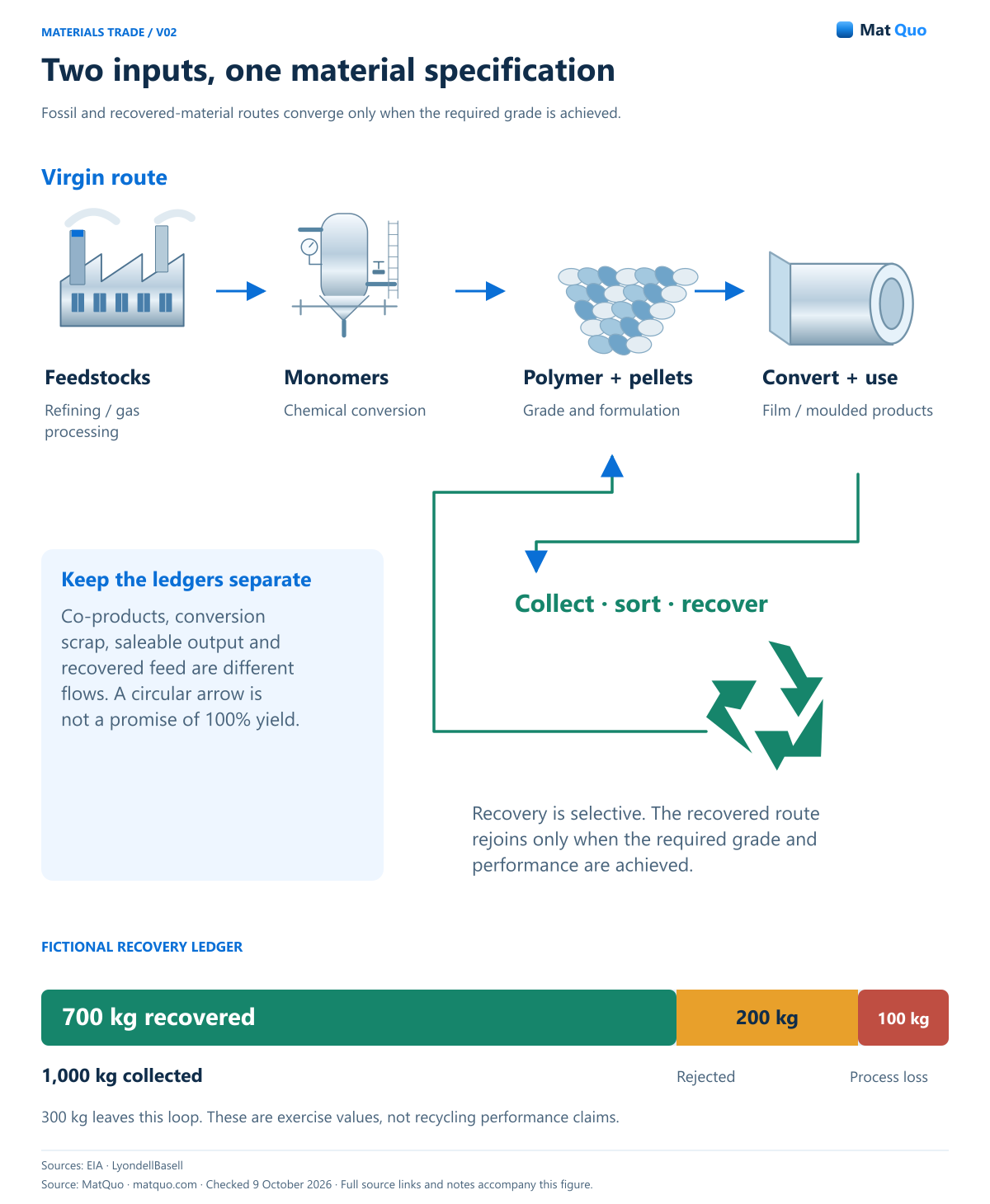
Two inputs, one material specification
Fossil and recovered-material routes converge only when the required grade is achieved.
Detailed poster: scroll horizontally on a small screen, or open the full-size figure. The readable text equivalent is below.
EIA • Refining process · LyondellBasell • PE technologies · LyondellBasell • PP grades · Checked
Text equivalent and notes
- 1 • Feedstock
- Refining / gas processing supplies. hydrocarbon feedstocks.. Not every fraction feeds plastics.
- 2 • Monomers
- Cracking or other conversion. produces chemical building blocks.. Separate co-products and losses.
- 3 • Polymer and pellets
- Polymerise, formulate and pelletise.. Grade identity follows composition. and verified performance.
- 4 • Convert and use
- Extrude, mould or make film.. Keep conversion scrap separate. from saleable packaged output.
- 5 • Recovery is selective
- Collected material needs sorting. and a suitable recycling route.. A loop is not a 100% yield promise.
- Fictional recovery ledger
- 1,000 kg collected − 200 rejected. − 100 processing loss = 700 kg. recovered; 300 kg leaves this loop.
Embed with credit
Common mistakes
- Drawing refinery fraction temperatures as universal operating setpoints.
- Assuming every cracker output becomes polyethylene.
- Showing a recycling arrow with no losses, sorting or product qualification.
Questions and answers
Does a refinery directly produce polyethylene pellets?
Not through distillation alone. Refining supplies streams that may feed further chemical conversion; polymer production then requires the relevant monomers and polymerisation process. Keep those stages distinct when explaining the value chain. A refinery fraction, a monomer and a finished polymer grade are different products with different specifications and commercial markets.
Are the boiling ranges refinery operating temperatures?
No. The US EPA engineering table gives component and fraction examples, while OSHA describes finished-product boiling ranges. These examples use different boundaries and can overlap. Celsius conversions are rounded to one decimal. Actual crude composition, pressure and refinery design determine separation conditions; the graphic does not prescribe tray temperatures.
Can a crude-price change predict the same resin-price change?
No fixed one-to-one relationship is established here. Feedstock route, conversion costs, co-products, grade demand and supply conditions all affect the commercial comparison. Use actual dated resin quotations or the site’s clearly labelled trade statistics, and do not treat an upstream price movement as a formula for a particular delivered grade.
Sources and review scope
- EIA • Refining process — Distillation separates fractions; conversion changes molecules.
- OSHA • Petroleum refining — Atmospheric/vacuum separation; product boiling ranges are overlapping reference ranges, not tray settings.
- US EPA • refinery engineering fraction examples — 1979 engineering reference, Table F3-4: component and fraction boiling examples. Propane −42.2 °C; butanes −11.7 to −0.6 °C; light naphtha −1.1–148.9 °C; heavy naphtha 148.9–204.4 °C; heavy gas oil 315.6–426.7 °C; residue above 593.3 °C. Converted from published Fahrenheit values, rounded to 0.1 °C; not refinery tray setpoints.
- EIA • Cracker feedstocks — 2022 technical discussion: naphtha co-products. Historical prices and forecasts excluded.
- LyondellBasell • PE technologies — High-pressure LDPE versus catalytic gas/slurry routes.
- LyondellBasell • PP grades — Homopolymer, random and impact grade distinction.