How polypropylene is made
Polypropylene is produced from propylene and supplied in families including homopolymer, random copolymer and impact copolymer. Their structures and performance priorities differ. Selecting a grade requires more than the family name or melt-flow number: compare the intended process, mechanical and optical requirements, additive package and supplier evidence under matching test conditions.
Start with the application hierarchy
LyondellBasell’s primary technical guidance separates process, appearance, mechanical function and additive requirements. Give these a priority order for the actual part or film. A clarity-led package and an impact-led component can require different trade-offs even when both purchasing requests say “PP”. Keep those priorities in the replacement-grade comparison.
Understand the three families
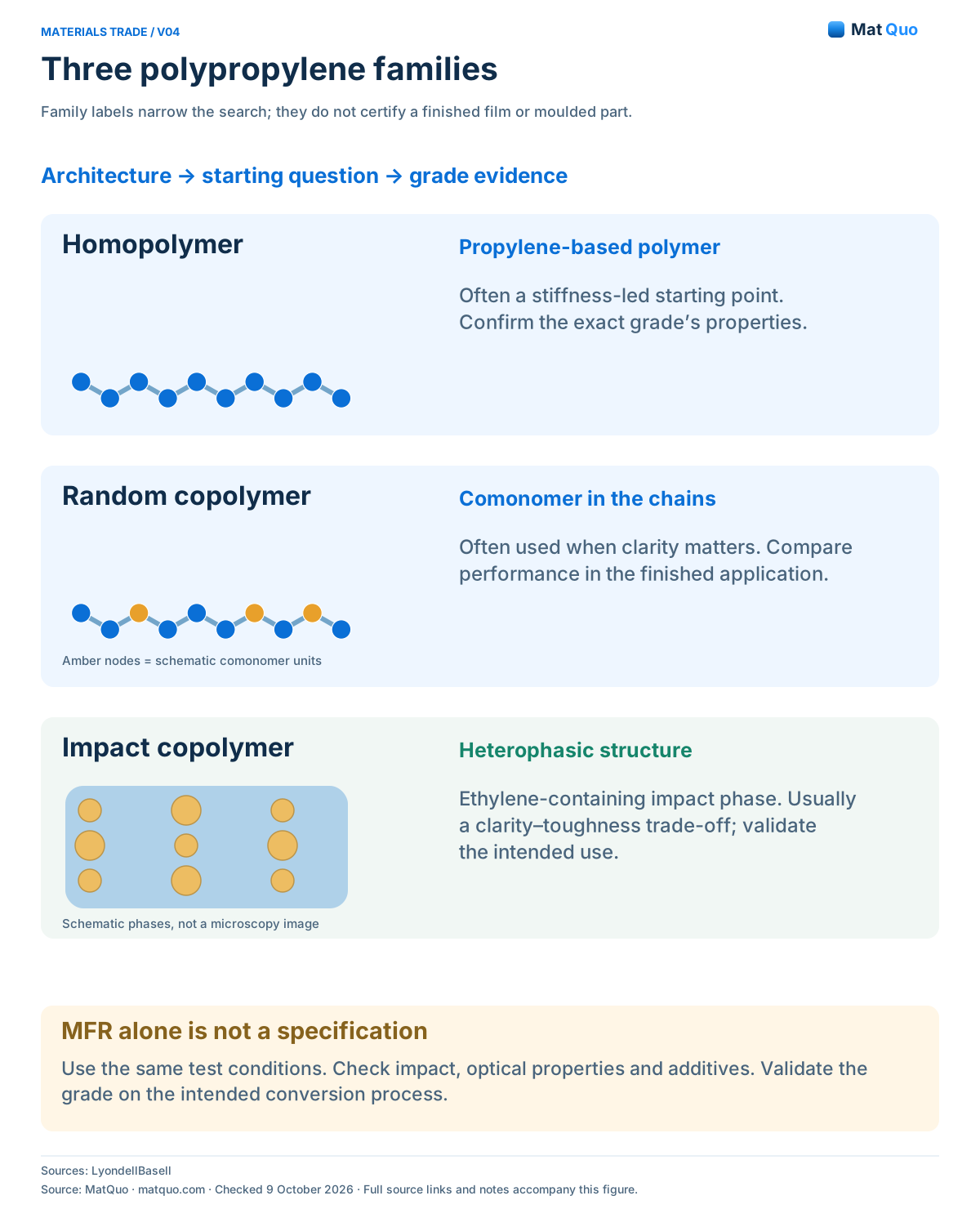
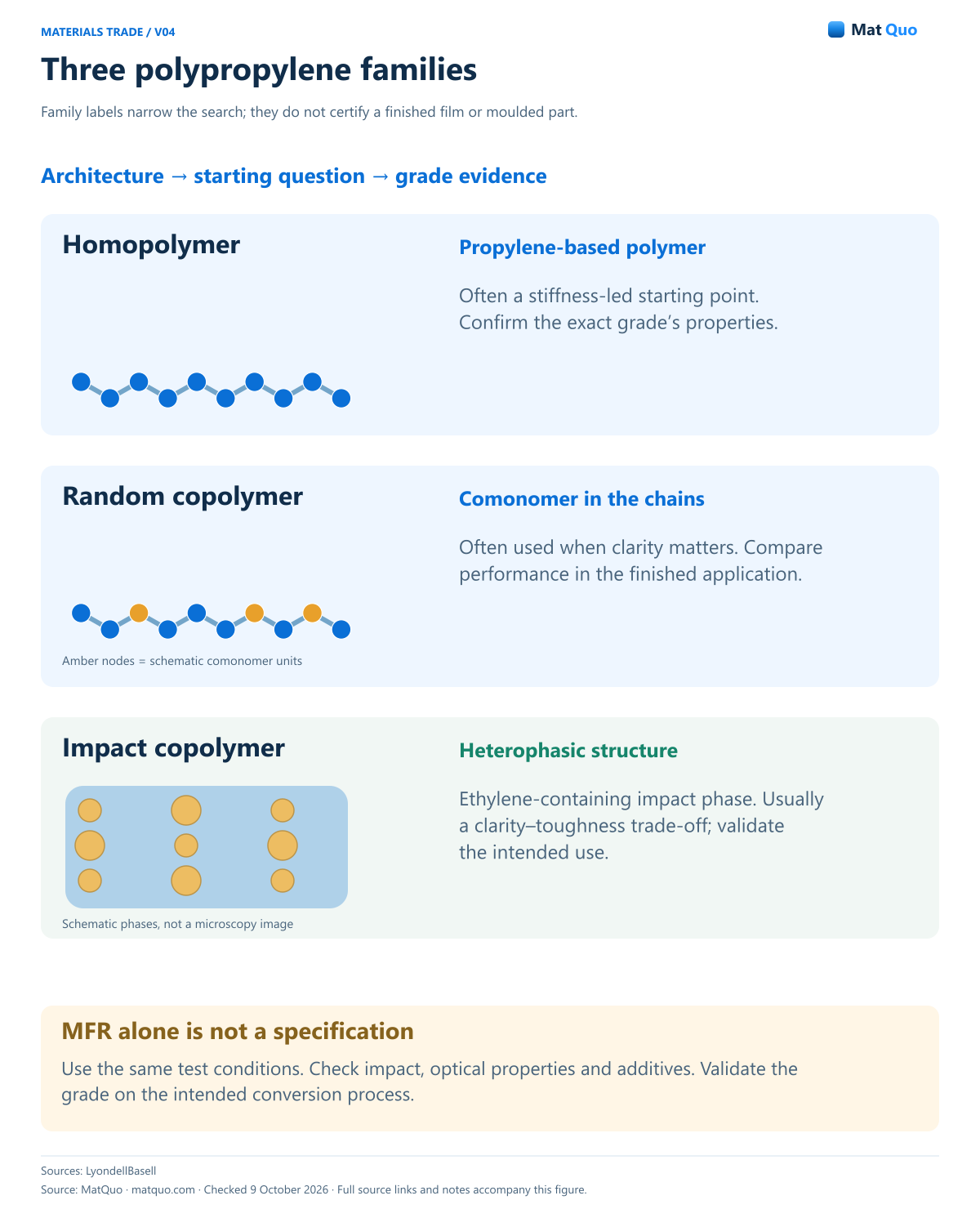
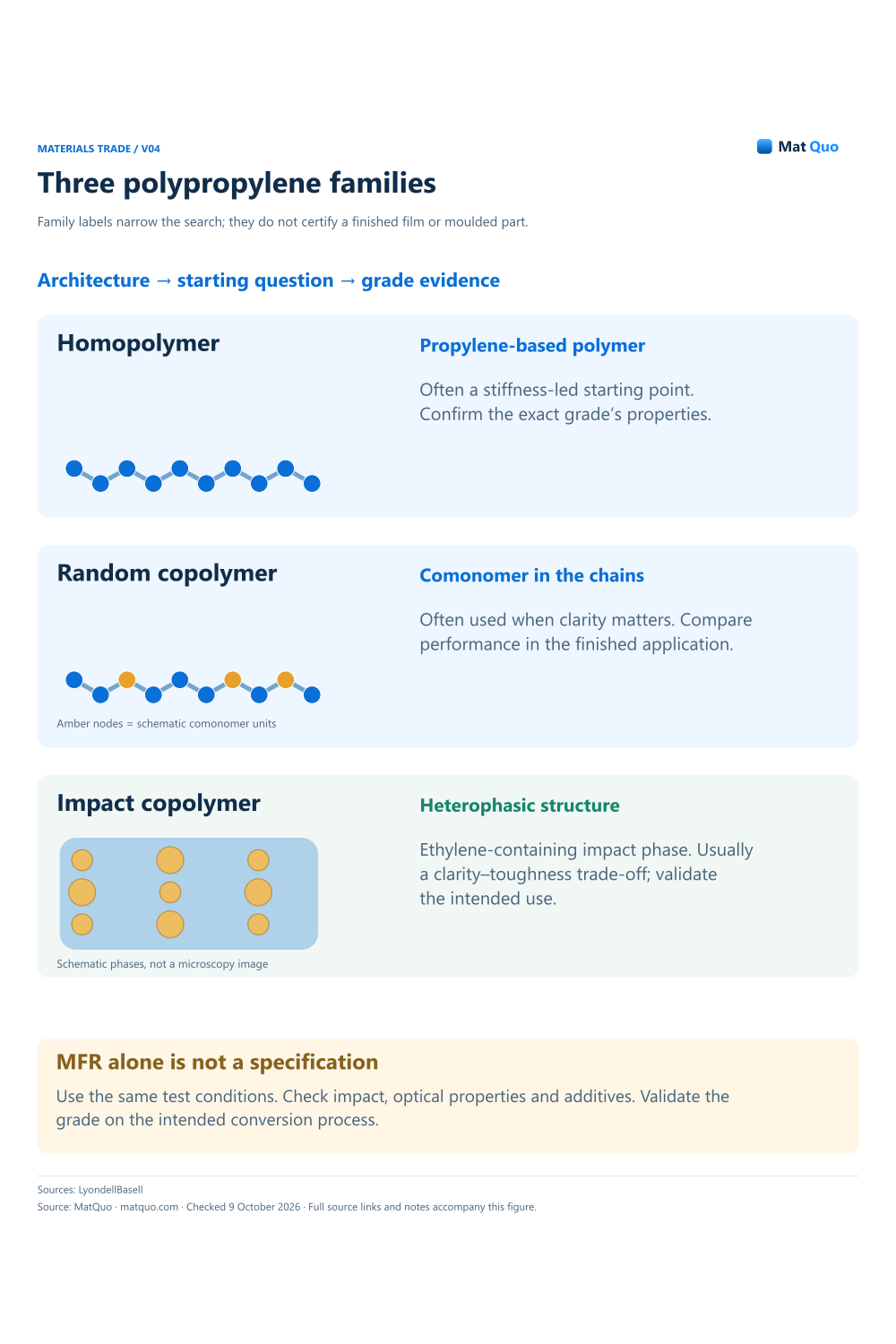
Homopolymer is a propylene-based starting point often considered for stiffness. Random copolymer introduces comonomer within the polymer chains and is often considered when clarity matters. Impact copolymer has a heterophasic structure with an ethylene-containing phase that supports toughness, generally with an optical trade-off. Exact behaviour belongs to the grade and test conditions, not the family label.
Treat melt flow as one coordinate
Melt-flow rate relates to processing selection, but it does not fully specify impact, stiffness, optics or additives. A comparison sheet should keep the measurement conditions beside the value and preserve other acceptance properties. Do not choose a substitute solely because two data sheets show the same numerical MFR.
Connect upstream and finished-product evidence
The existing production overview introduces polymer manufacture; this page focuses on selecting and verifying PP families. For conversion questions, continue to blown and cast film. The polypropylene page provides separate, labelled market context rather than grade qualification.
Comparison at a glance
| Family | Common selection emphasis | Evidence still needed |
|---|---|---|
| Homopolymer | Stiffness-led applications | Grade-specific process and mechanical tests |
| Random copolymer | Clarity-led applications | Finished thickness and optical test conditions |
| Impact copolymer | Toughness-led applications | Temperature, impact method and optical acceptance |
Worked example
Fictional trial: two lots each consume 1,000 kg. Lot A produces 970 kg accepted parts; lot B produces 940 kg. At the same hypothetical input cost of €1.20/kg, material cost per accepted kilogram is €1,200.00/970 = €1.24 for A and €1,200.00/940 = €1.28 for B. This is a trial-yield comparison, not a claim that either PP family always performs better.
Three polypropylene families
Family labels narrow the search; they do not certify a finished film or moulded part.
Detailed poster: scroll horizontally on a small screen, or open the full-size figure. The readable text equivalent is below.
LyondellBasell • PP grades · LyondellBasell • Impact copolymer · Checked
Text equivalent and notes
- Homopolymer
- Propylene-based polymer. Often a stiffness-led starting point. Confirm the exact grade data.
- Random copolymer
- Comonomer incorporated in chains. Often used when clarity matters. Compare the finished application.
- Impact copolymer
- Heterophasic structure. Ethylene-containing impact phase. Usually trades clarity for toughness.
- Do not select by MFR alone
- Use the same test conditions.. Check impact, optics and additives.. Validate on the intended process.
Embed with credit
Common mistakes
- Treating impact copolymer as universally superior to homopolymer.
- Selecting on MFR without checking its method or the required property set.
- Comparing resin price per kilogram while ignoring accepted production yield.
Questions and answers
Which PP family is best?
The answer depends on the intended process and the properties that matter for the finished application. Start by prioritising stiffness, impact, clarity and other requirements, then compare exact grades with matching test conditions. A family that suits one product may introduce an unacceptable trade-off in another, even when the nominal resin price is lower.
Can equal MFR values prove two grades are substitutes?
No. First confirm the test conditions, then compare the other required characteristics and additive packages. MFR is only one entry in a qualification record. Use a representative production trial and finished-product acceptance tests before concluding that a replacement grade gives equivalent processing and performance for the intended application.
Why compare cost per accepted kilogram?
It connects the purchased material cost to useful output within a stated trial boundary. Two grades with the same input price can produce different accepted quantities in a fictional or measured trial. Keep rejects, rework and recoverable material explicit, and avoid generalising one trial result into a universal ranking of polymer families.
Sources and review scope
- LyondellBasell • PP grades — Homopolymer, random and impact grade distinction.
- LyondellBasell • Impact copolymer — Heterophasic polypropylene and ethylene-containing phase.