From resin to film and flexible packaging
Blown film forms a tube through an annular die and cools a bubble; cast film leaves a flat die and contacts a cooled roll. These routes create different process-control questions. Compare the finished film’s required performance and saleable yield, while using the existing thickness-and-density guide for the separate calculation of dimensional film mass.
Follow how the web is formed and cooled
In blown film, bubble formation, air cooling, collapse and haul-off are linked control stages. In cast film, the flat die, casting-roll contact, trim and winding define a different route. These descriptions come from equipment-maker primary sources. No generic speed, output advantage or quality ranking is assumed for every machine and resin combination.
Specify the finished film before comparing lines
Write the construction, gauge profile, width, seal requirements, mechanical tests and optical requirements that matter to the application. Define the test conditions and acceptance limits before the trial. A line can produce high gross output without delivering an equally high quantity that meets the customer’s specification.
Reconcile new feed, internal return and saleable output
Keep fresh purchased input separate from material circulating within the process. Record startup waste, edge trim, rejected rolls and accepted rolls on a consistent boundary. If trim returns internally, do not count it as new feed each time around the loop. Internal recovery also does not automatically make the material post-consumer recycled content.
Use the formula guide without duplicating it
The existing film-weight guide explains dimensional mass and units. The film weight, film yield and line output tools each address a defined calculation. This guide adds process choice, trial evidence and saleable-yield accounting beyond the introductory production journey.
Comparison at a glance
| Control point | Blown film | Cast film |
|---|---|---|
| Forming | Annular die and bubble | Flat die and web |
| Cooling interface | Bubble air cooling | Cooled casting roll |
| Trial questions | Bubble stability, gauge and winding | Roll contact, edges, gauge and winding |
| Commercial comparison | Accepted output and measured properties | Accepted output and measured properties |
Worked example
Fictional trial: 1,000 kg of input produces 950 kg of accepted film and 50 kg of trim or rejects, giving 95% saleable yield on the stated boundary. At €1.40/kg input material, €1,400.00/950 = €1.47 per accepted kilogram before other costs. A 98% trial with the same input cost gives €1.43/kg. Neither figure includes energy, labour or an unverified scrap credit.
Blown and cast film: follow the web
The cooling and forming route changes the process questions; measured grade and film data decide.
Detailed poster: scroll horizontally on a small screen, or open the full-size figure. The readable text equivalent is below.
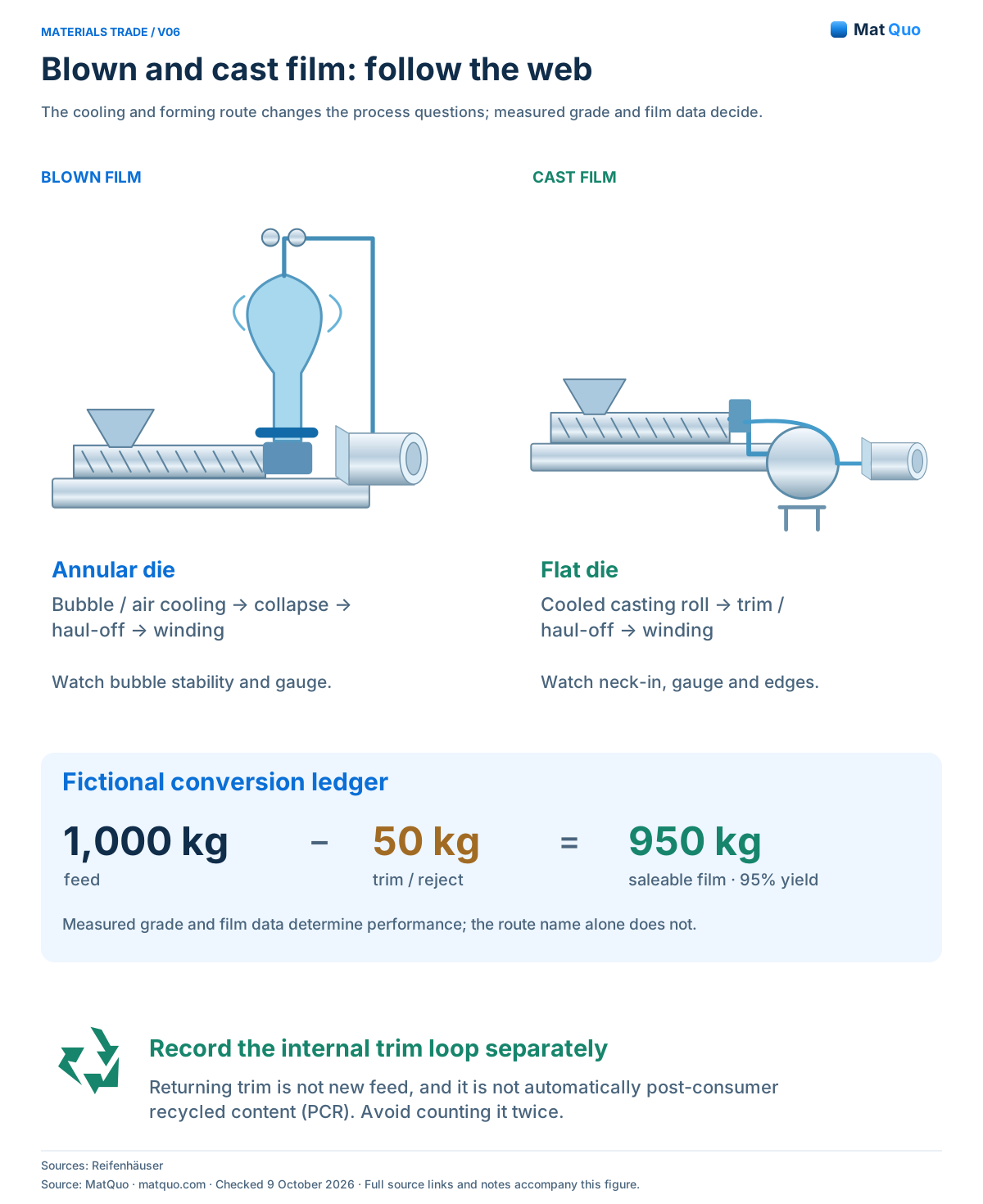
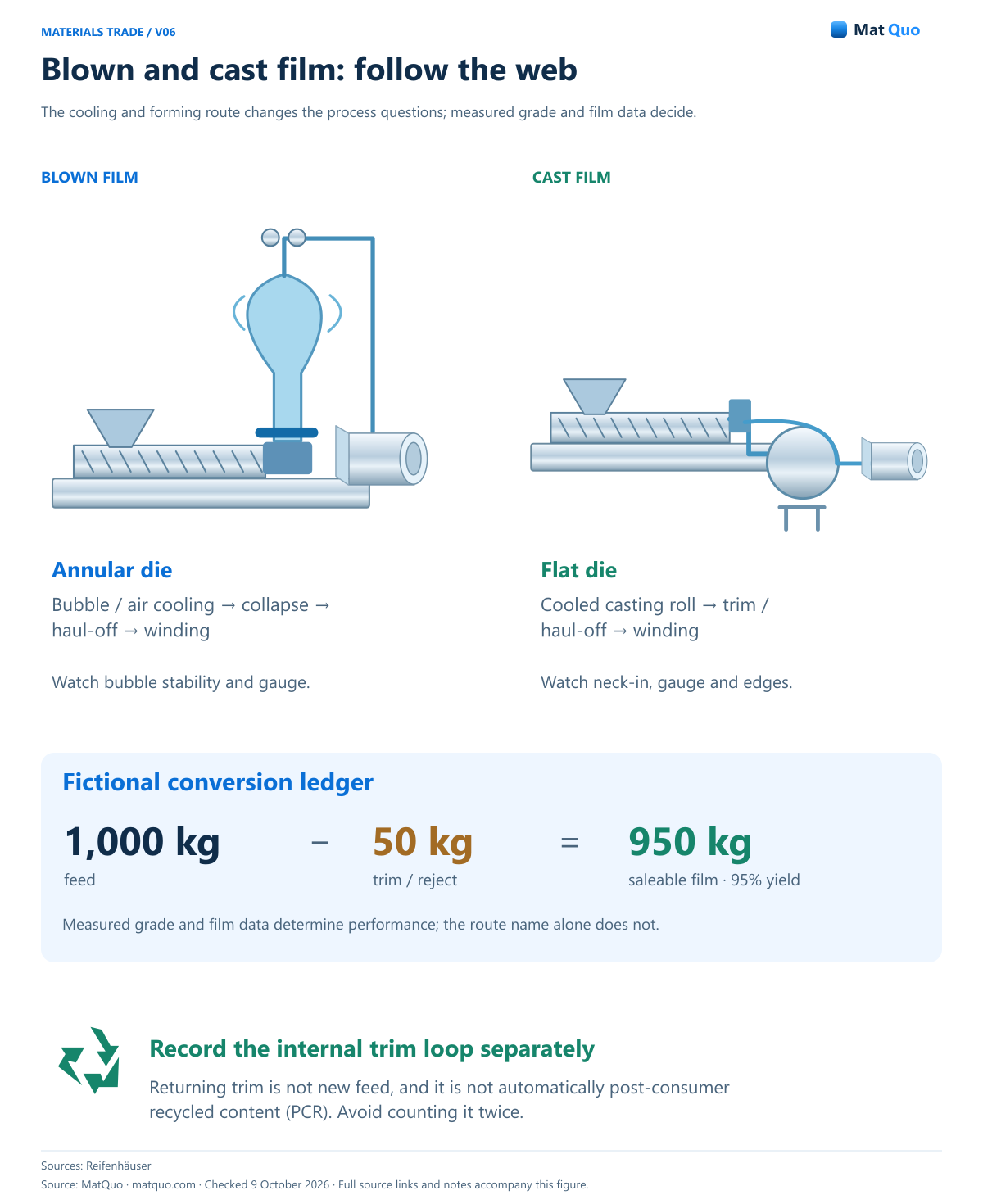
Reifenhäuser • Blown film · Reifenhäuser • Cast-film die · Checked
Text equivalent and notes
- Blown film
- Annular die → bubble / air cooling. Collapse → haul-off → winding. Watch bubble stability and gauge.
- Cast film
- Flat die → cooled casting roll. Trim / haul-off → winding. Watch neck-in, gauge and edges.
- Fictional output ledger
- 1,000 kg feed − 50 kg trim/reject. = 950 kg saleable film. Saleable yield: 95%
- Avoid double-counted recovery
- If trim returns internally, record. that loop separately from new feed.. Recovered trim is not automatically PCR.
Embed with credit
Common mistakes
- Confusing gross line output with accepted saleable output.
- Counting internally recirculated trim repeatedly as fresh input.
- Choosing a process from a universal “better film” claim without matched tests.
Questions and answers
Is cast film always better than blown film?
No universal ranking is established here. The appropriate route depends on the required construction, properties and production conditions. Compare representative trials using the same acceptance criteria and cost boundary. Equipment-maker performance claims for a specific line should not be extended to every resin, gauge, application or competing process without supporting evidence.
Does this page replace the film-weight formula guide?
No. The existing guide remains the place for dimensional mass and unit conversion, and it is linked directly here. This page covers forming and cooling routes, trial acceptance and material-yield accounting. Use the two together when a purchase decision needs both the theoretical roll mass and evidence of actual saleable production.
How should returned edge trim be recorded?
Record internal return separately from newly purchased input and from accepted output. Choose a clear accounting boundary so that repeated circulation does not inflate consumption or recovery figures. Also keep its origin classification separate: reuse within a production process does not by itself establish post-consumer recycled content for a regulatory or customer claim.
Sources and review scope
- Reifenhäuser • Blown film — Blown-film process equipment; no generic speed or yield claims.
- Reifenhäuser • Cast-film die — Flat die and casting roll arrangement.
- Reifenhäuser • Cast film — Cast-film extrusion equipment; process-specific performance must be measured.
- LyondellBasell • PE technologies — High-pressure LDPE versus catalytic gas/slurry routes.
- LyondellBasell • PP grades — Homopolymer, random and impact grade distinction.