How polyethylene is made
Polyethylene is made by polymerising ethylene, but LDPE, HDPE and LLDPE achieve different chain architectures through different process and catalyst choices. Those differences matter to grade selection and conversion. After the introductory production journey, compare architecture, test conditions and formulation evidence rather than assuming a density label alone identifies a suitable film resin.
Connect the process to architecture
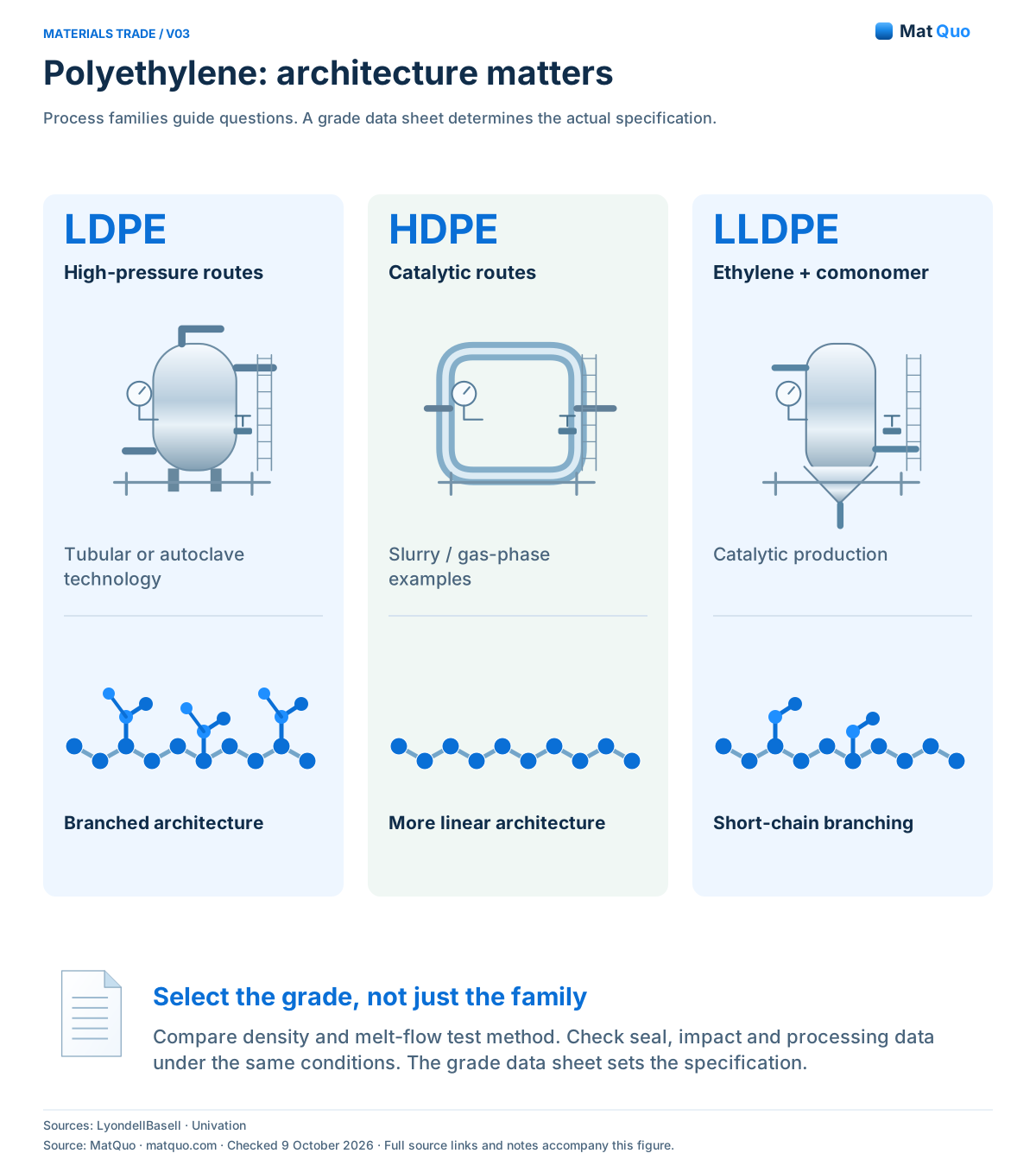
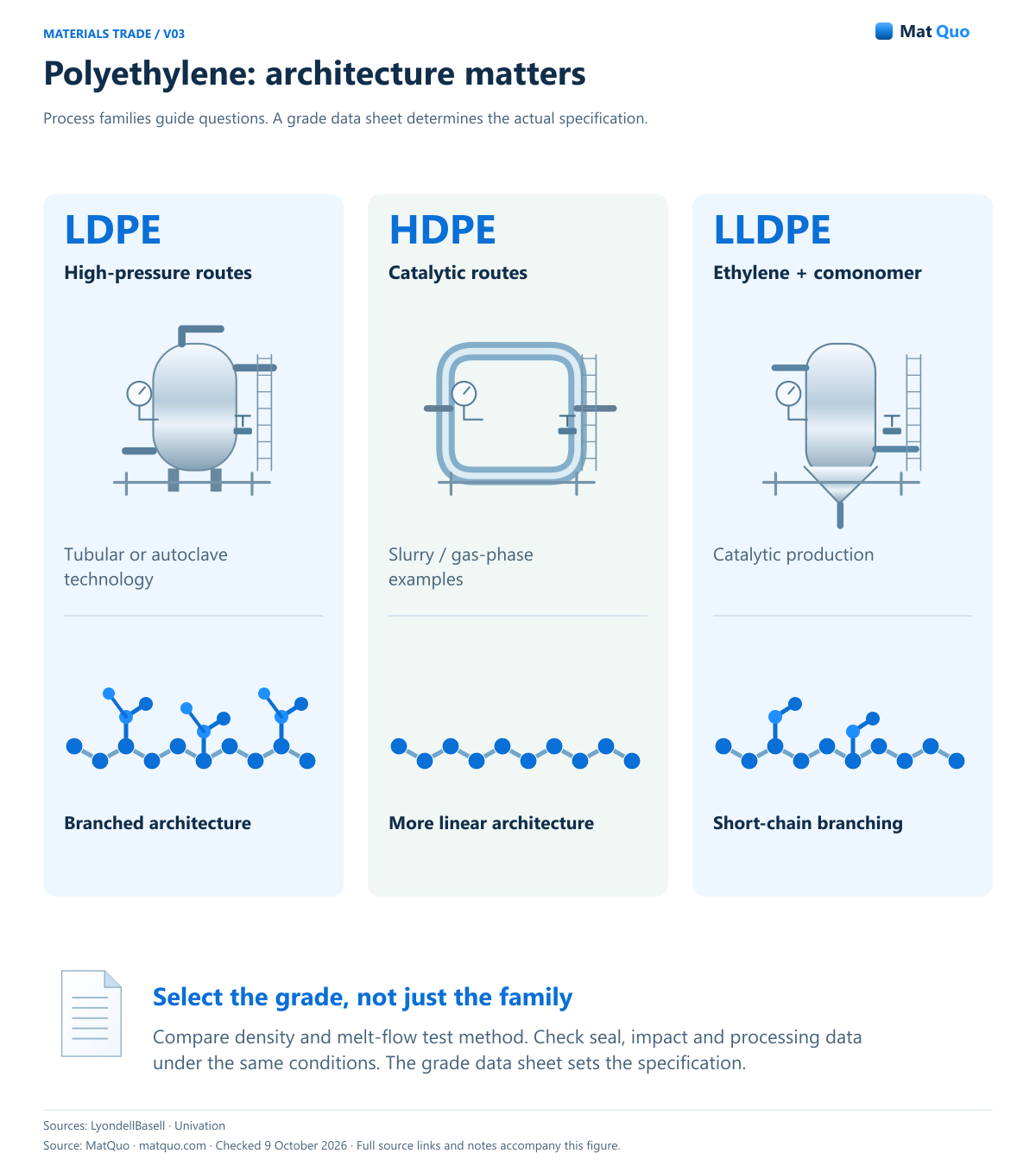
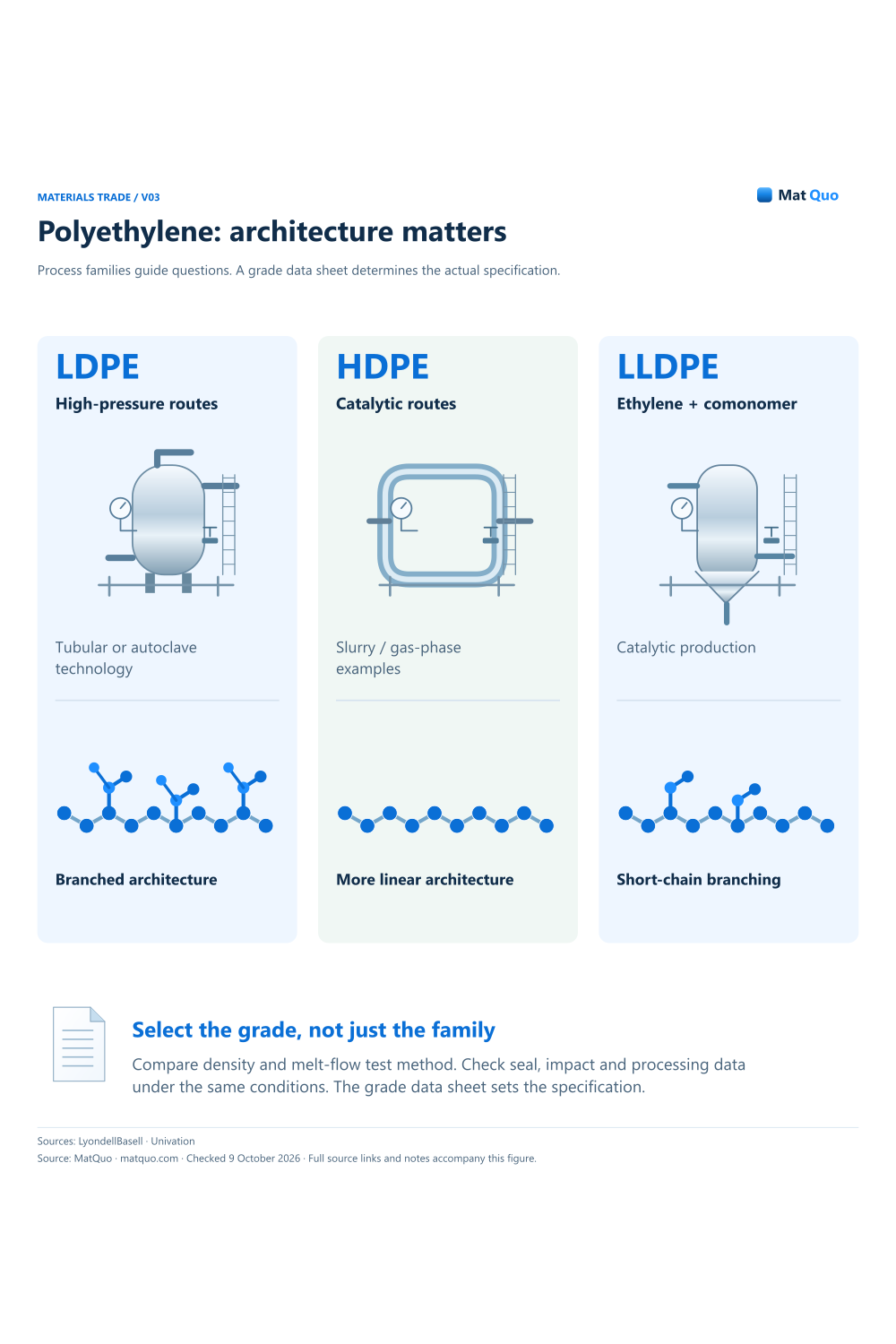
Current producer and technology-licensor sources distinguish high-pressure tubular or autoclave LDPE from catalytic PE routes, including slurry and gas-phase technologies. HDPE has a more linear architecture, while LLDPE uses comonomer to introduce controlled short-chain branching. These descriptions are process families, not a recipe or a guaranteed property range for every grade.
Distinguish a family from a purchasable grade
A purchase specification needs the exact grade identifier, supplier data-sheet revision and agreed acceptance tests. Compare density and melt-flow results only with their test conditions. Ask how additives, molecular architecture and intended application are represented in the supplied grade. A matching density number does not establish matching extrusion behaviour, seal response or mechanical performance.
Keep compounding and conversion visible
The polymer leaving its production process can be formulated with additives and supplied as pellets before conversion. A film converter then has another process window and a finished-product specification. Link the resin evidence to the film trial and yield record rather than describing pellet compliance as proof of final film performance.
Use the existing introduction and tools for their own jobs
Start with the introductory production journey if the stage names are unfamiliar. Use the polyethylene page for the site’s labelled market context and the blend-density calculator for its stated mass/volume model. Neither replaces grade qualification.
Comparison at a glance
| Family | Architecture / process distinction | Question for a film trial |
|---|---|---|
| LDPE | Branched architecture; high-pressure routes | Does the exact grade provide the required processing behaviour? |
| HDPE | More linear architecture; catalytic routes | Do the finished film stiffness and toughness meet specification? |
| LLDPE | Comonomer-controlled short branches | Do seal and mechanical results match the intended use? |
Worked example
Fictional batch reconciliation: 850 kg grade A plus 150 kg grade B gives a 1,000 kg resin blend, with B at 15% by mass. Adding 20 kg additive masterbatch on top produces 1,020 kg total input; B is now 150/1,020 = 14.7059% of that total. State the denominator before comparing blend recipes. These are not recommended resin proportions.
Polyethylene: architecture matters
Process families guide questions. A grade data sheet determines the actual specification.
Detailed poster: scroll horizontally on a small screen, or open the full-size figure. The readable text equivalent is below.
LyondellBasell • PE technologies · Univation • PE catalysts · Checked
Text equivalent and notes
- LDPE
- High-pressure routes. Tubular or autoclave technology. Branched polymer architecture
- HDPE
- Catalytic production routes. Slurry or gas-phase examples. More linear architecture
- LLDPE
- Ethylene plus comonomer. Catalytic production. Controlled short-chain branching
- Grade selection
- Check density and melt-flow method.. Compare seal, impact and process. data under the same test conditions.
Embed with credit
Common mistakes
- Selecting a replacement resin using density alone.
- Comparing melt-flow numbers measured under different conditions.
- Calling a pellet-family label proof that the finished film meets a specification.
Questions and answers
Are LDPE and LLDPE interchangeable because both can make film?
No automatic interchangeability is established by their family names. They have different architectures, and individual grades target different processing and performance needs. Compare the exact supplier specifications and test conditions, then run an appropriate conversion trial. Keep the finished film acceptance criteria separate from the decision that a resin belongs to a familiar family.
Does a catalyst name guarantee better film?
No. It identifies part of a technology route, not a universal ranking of finished-product quality. Ask which measurable property or processing requirement matters for the application and compare qualified grade data on that basis. Confirm the result on the intended line and construction rather than relying on a technology label alone.
Why should blend percentages name their denominator?
A percentage of base resin differs from a percentage of total formulated input when additives are added on top. Record every component mass and calculate the final total before reporting proportions. This prevents two apparently identical recipes from describing different compositions and makes the production ledger easier to reconcile with purchased and consumed materials.
Sources and review scope
- LyondellBasell • PE technologies — High-pressure LDPE versus catalytic gas/slurry routes.
- Univation • PE catalysts — Catalyst and polymer architecture choices; no invented performance specifications.