Truck loading calculator for a 13.6 m trailer
Compare two uniform pallet orientations in a trailer, then limit the result by cargo mass, height and door access. Enter the actual equipment dimensions and a route-confirmed cargo allowance. The default worked example is theoretical with zero clearance; the result is a planning screen, not an axle-distribution, mixed-packing or securing approval.
Plan a trailer load
Compare two uniform orientations. Manufacturer presets provide verified dimensions only; confirm missing values, actual equipment and the route allowance.
Keep the input boundary consistent
Enter the total loaded pallet dimensions and its complete packaging tare. Clearance is reserved at each end and between adjacent units. Stacking is disabled unless explicitly permitted, and the loaded unit must pass the stated door opening. A named equipment preset supplies only verified dimensions; missing opening values need confirmation.
Understand what the layout shows
The tool compares uniform rectangular rows in two horizontal orientations. It does not search mixed patterns or certify a practical maximum. The mass limit can reduce the usable count below floor positions. Read the trailer guide before applying a technical equipment value to a road shipment.
Comparison at a glance
| Result | Meaning |
|---|---|
| Geometric positions | Uniform floor layout and permitted layers |
| Usable count | Count after door and gross cargo limits |
| Net product | Usable count multiplied by product mass |
| Gross cargo | Product plus pallet and packaging tare |
Worked example
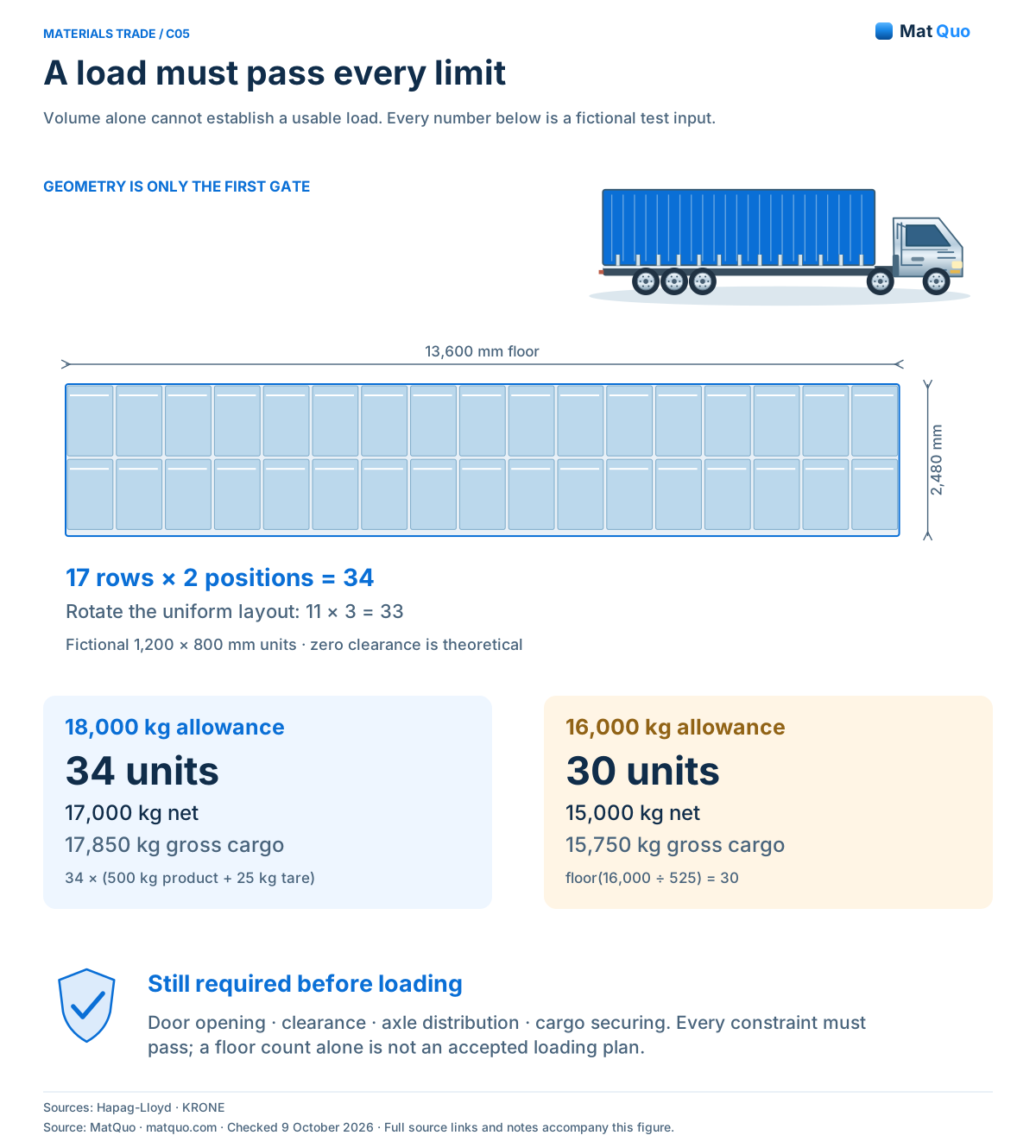
Fictional 13,600 × 2,480 mm floor, zero clearance and 1,200 × 800 mm pallets: orientations give 33 and 34 positions. At 500 kg net plus 25 kg tare per pallet and an 18,000 kg allowance, 34 pallets give 17,000 kg net and 17,850 kg gross. Reducing the allowance to 16,000 kg gives 30 pallets, 15,000 kg net and 15,750 kg gross.
A load must pass every limit
Volume alone cannot establish a usable load. Every number below is a fictional test input.
Detailed poster: scroll horizontally on a small screen, or open the full-size figure. The readable text equivalent is below.
Hapag-Lloyd • Container fleet · KRONE • Profi Liner · Checked
Text equivalent and notes
- 1 • Geometry
- 13,600 × 2,480 mm floor. 1,200 × 800 mm pallets. Uniform rows: 33 or 34 positions
- 2 • Mass
- 34 × (500 + 25) kg. 17,000 kg net • 17,850 kg gross. Passes an 18,000 kg allowance
- 3 • Lower allowance
- At 16,000 kg: floor(16,000 / 525). 30 pallets • 15,000 kg net. 15,750 kg gross cargo
- 4 • Physical acceptance
- Door height, clearance, axles. and securing still need checking.. Zero clearance is theoretical.
Embed with credit
Common mistakes
- Entering vehicle gross weight as the cargo allowance.
- Treating zero clearance as a verified physical loading plan.
- Enabling stacking without permission and a suitable loaded unit.
Questions and answers
Does the highest count guarantee a workable load?
No. It is the best of two uniform geometric orientations under the entered limits. Actual tolerances, loading sequence, axle distribution and securing can reduce the accepted count. Confirm those operational conditions separately, and treat a zero-clearance calculation as theoretical until the actual packed units and equipment have been checked.
What does the clearance field reserve?
It reserves the entered gap at the ends and between adjacent units within each geometric dimension. Increasing it can remove a row or column abruptly rather than reducing count smoothly. Use a measured or agreed handling allowance, and do not assume that zero clearance is practical merely because the rectangles fit mathematically.
Why are some preset values left blank?
Only verified named-model dimensions are populated. A missing opening dimension or operating allowance must be supplied from the actual equipment and route information. Leaving that field unresolved is deliberate: the calculator should not invent a measurement or treat a technical manufacturer rating as a confirmed legal cargo allowance for your shipment.
Sources and review scope
- KRONE • Profi Liner — Model SDP 27 eLB50-CS: internal length 13620 mm, width 2480 mm; technical rating is not road cargo allowance.
- KRONE • Dry Liner — Model SDK 27 eLB41-STG: inside 13620 × 2480 × 2715 mm; rear opening height 2650 mm.
- EPAL • Euro pallet — 800 × 1200 × 144 mm; source gives approximately 25 kg tare and 1500 kg safe working load.
- Hapag-Lloyd • Container fleet — Dimensions vary by manufacturer and equipment. Named examples only.