CPT and CIP: carriage paid, risk transferred
CPT and CIP suit any transport mode, including multimodal container movements. The seller pays carriage to the named destination, but risk passes when delivery is made to the carrier at the agreed point. CIP adds a seller insurance obligation. Keep the delivery point and paid destination separate in the contract and shipment file.
Use two location fields
In the order record, create one field for the named destination and another for delivery to the carrier. If several carriers participate, agree the initial delivery event precisely. The documents should let the buyer connect a specific consignment to that event instead of inferring risk transfer from the final proof of delivery.
Specify insurance evidence
CIP normally calls for Institute Cargo Clauses A or equivalent cover and at least 110% of the contract price, subject to the parties’ agreement. Coverage has exclusions and conditions. Check the insured party, period, value and claim route. CPT does not impose the same seller insurance obligation; a buyer should still decide how its exposure will be covered.
Comparison at a glance
| Issue | CPT | CIP |
|---|---|---|
| Transport modes | Any mode | Any mode |
| Risk event | Carrier delivery | Carrier delivery |
| Carriage to destination | Seller pays | Seller pays |
| Required seller cover | No | Default Clauses A or equivalent |
Worked example
Fictional CIP contract price: €22,000.00. A 110% insured-value basis is €22,000.00 × 1.10 = €24,200.00; this is not an insurance premium. If carrier acceptance occurs on day 1 and arrival on day 8, the insurance file must address the buyer’s exposure after the agreed delivery event. Seven days of transit do not shift that event to arrival.
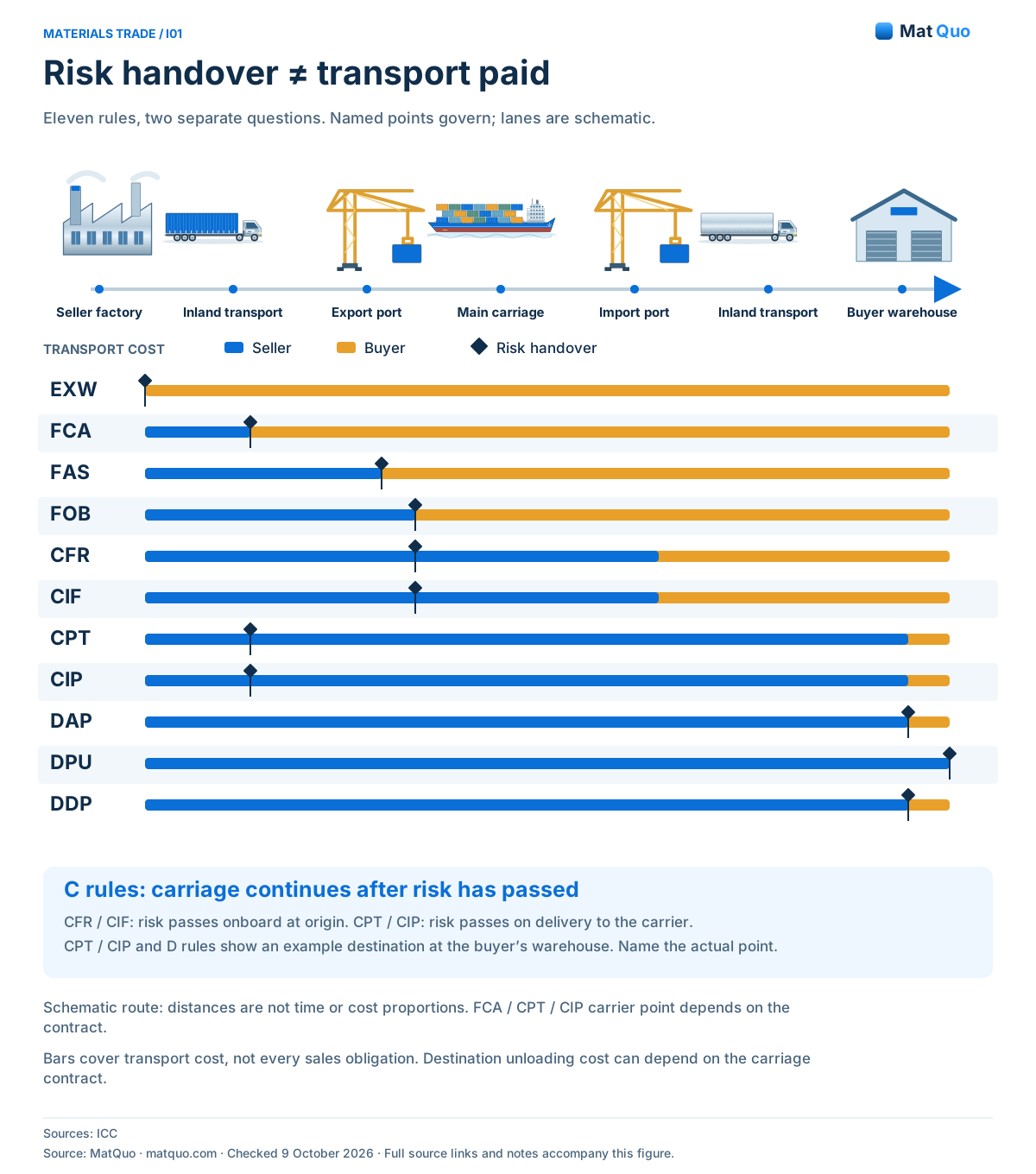
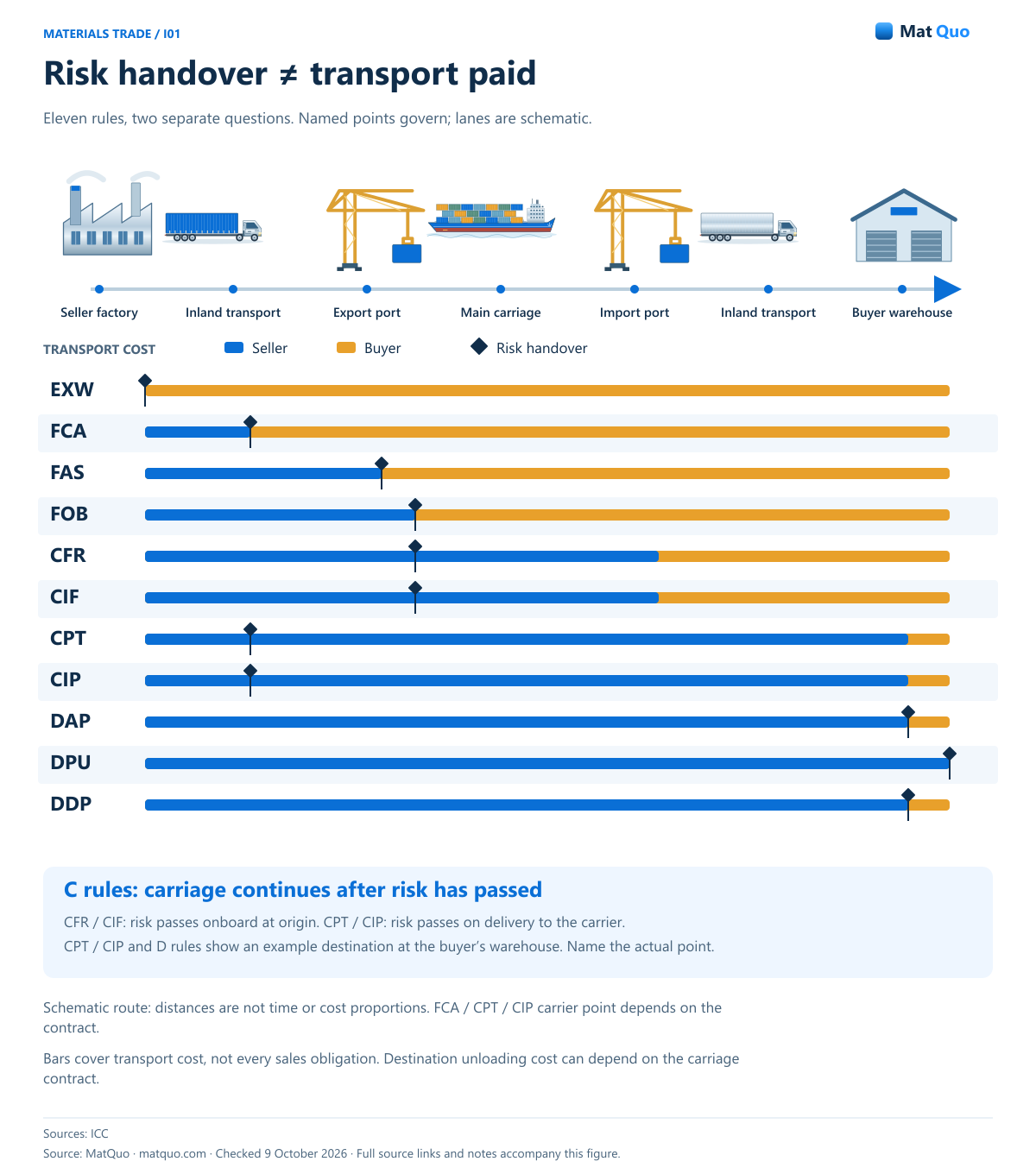
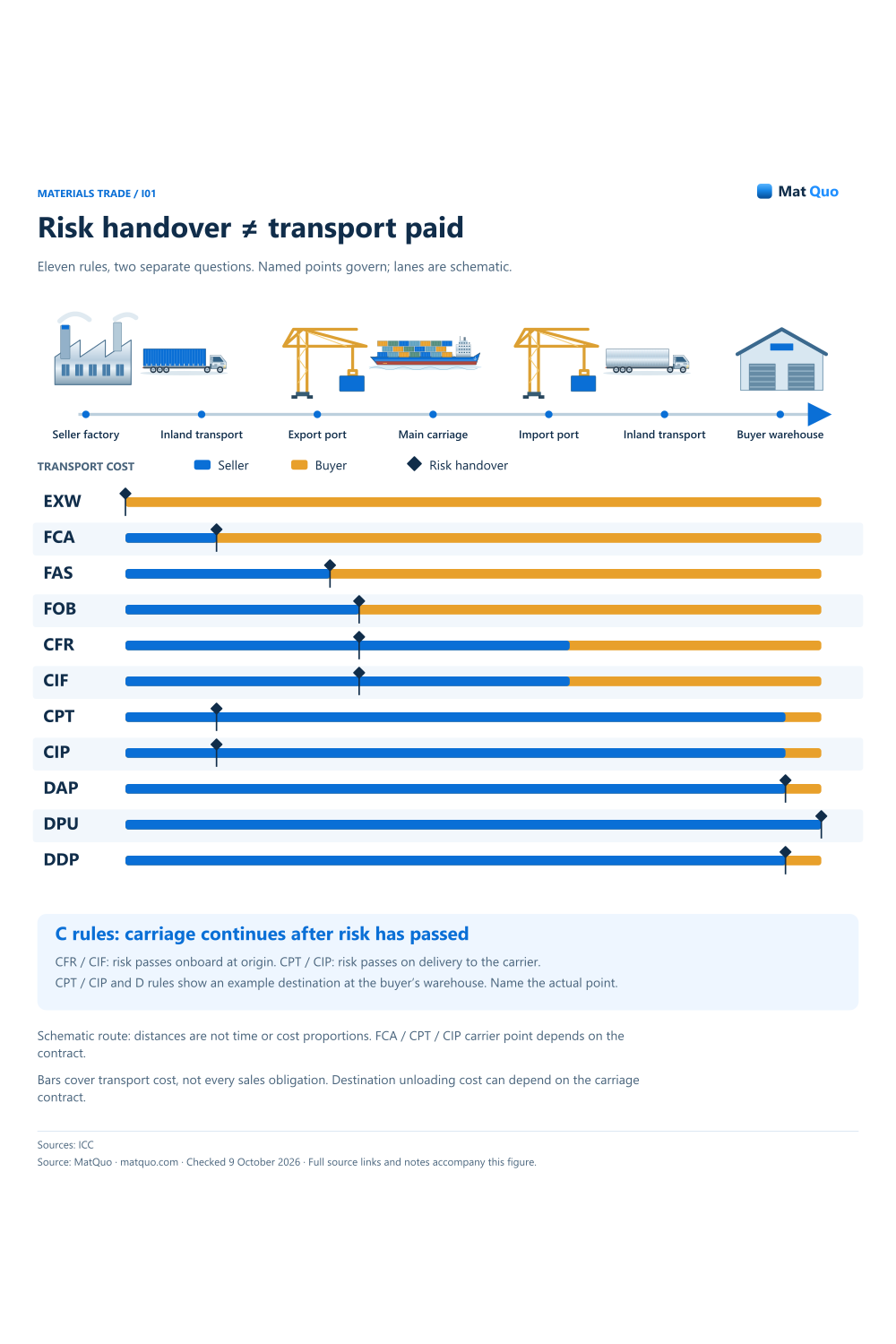
Risk handover ≠ transport paid
Eleven rules, two separate questions. Named points govern; lanes are schematic.
Detailed poster: scroll horizontally on a small screen, or open the full-size figure. The readable text equivalent is below.
ICC • Incoterms 2020 · ICC • 2024 checklist · Checked
Text equivalent and notes
- EXW
- Goods available, not loaded. Buyer arranges carriage
- FCA
- Carrier at named delivery point. Buyer arranges main carriage
- FAS
- Alongside vessel at origin. Buyer arranges main carriage
- FOB
- Onboard vessel at origin. Buyer arranges main carriage
- CFR
- Onboard vessel at origin. Seller pays to destination port
- CIF
- Onboard vessel at origin. Seller pays to destination port
- CPT
- Carrier at agreed delivery point. Seller pays to named destination
- CIP
- Carrier at agreed delivery point. Seller pays to named destination
- DAP
- Destination, ready to unload. Seller pays to named destination
- DPU
- Destination, after unloading. Seller pays through unloading
- DDP
- Destination, ready to unload. Seller pays; import duty/tax
Embed with credit
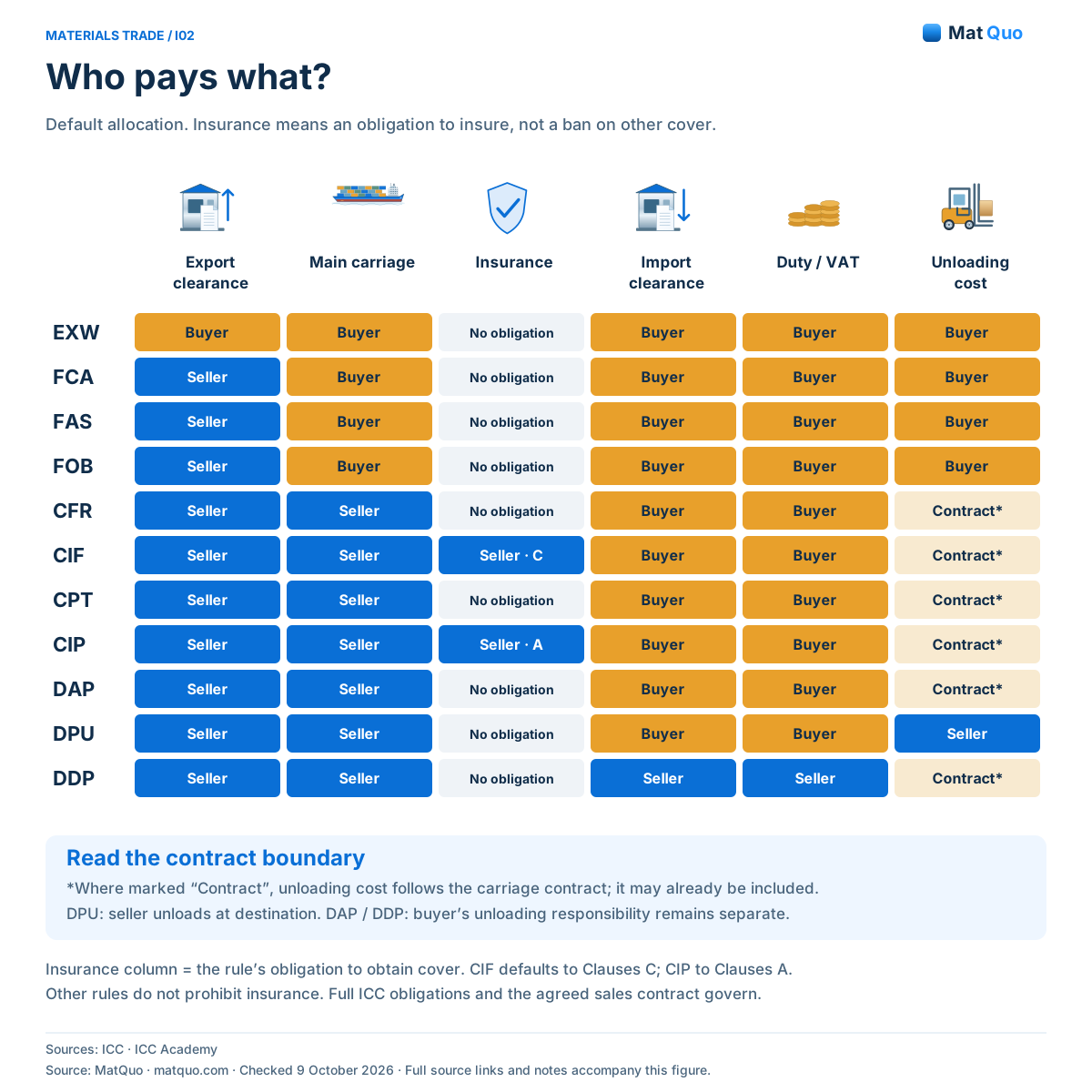
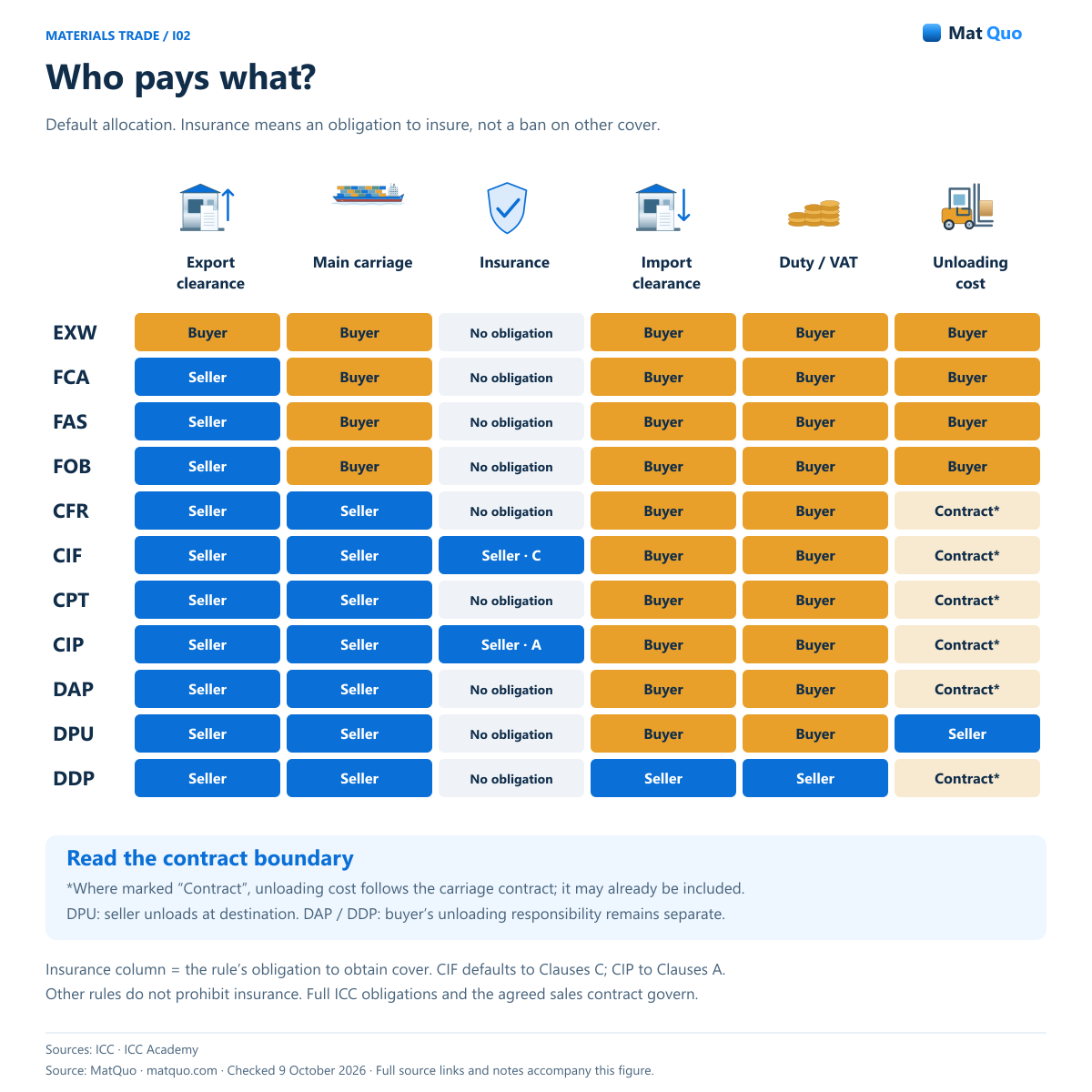
Who pays what?
Default allocation. Insurance means an obligation to insure, not a ban on other cover.
Detailed poster: scroll horizontally on a small screen, or open the full-size figure. The readable text equivalent is below.
ICC • Incoterms 2020 · ICC Academy • CPT and CIP · ICC Academy • DAP and DDP · Checked
Text equivalent and notes
- EXW
- Export: Buyer • Import: Buyer. Import duty / tax: buyer. Insurance: None. Main carriage: buyer. Unload: buyer at destination
- FCA
- Export: Seller • Import: Buyer. Import duty / tax: buyer. Insurance: None. Main carriage: buyer. Unload: buyer at destination
- FAS
- Export: Seller • Import: Buyer. Import duty / tax: buyer. Insurance: None. Main carriage: buyer. Unload: buyer at destination
- FOB
- Export: Seller • Import: Buyer. Import duty / tax: buyer. Insurance: None. Main carriage: buyer. Unload: buyer at destination
- CFR
- Export: Seller • Import: Buyer. Import duty / tax: buyer. Insurance: None. Main carriage: seller. Unload: check carriage contract
- CIF
- Export: Seller • Import: Buyer. Import duty / tax: buyer. Insurance: Seller • Clauses C. Main carriage: seller. Unload: check carriage contract
- CPT
- Export: Seller • Import: Buyer. Import duty / tax: buyer. Insurance: None. Main carriage: seller. Unload: check carriage contract
- CIP
- Export: Seller • Import: Buyer. Import duty / tax: buyer. Insurance: Seller • Clauses A. Main carriage: seller. Unload: check carriage contract
- DAP
- Export: Seller • Import: Buyer. Import duty / tax: buyer. Insurance: None. Main carriage: seller. Unload: check carriage contract
- DPU
- Export: Seller • Import: Buyer. Import duty / tax: buyer. Insurance: None. Main carriage: seller. Unload: seller at destination
- DDP
- Export: Seller • Import: Seller. Import duty / tax: seller. Insurance: None. Main carriage: seller. Unload: check carriage contract
Embed with credit
Common mistakes
- Confusing insured value with the cost of the insurance policy.
- Naming the destination without agreeing the carrier-delivery point.
- Treating broad cover as insurance against every possible cause of loss.
Questions and answers
Does CIP keep risk with the seller until arrival?
No. Delivery to the carrier at the agreed point is the key event, even though the seller pays onward carriage and insurance. Keep the carrier acceptance record with the policy or certificate. Together they help identify when the buyer’s exposure begins and which insurance evidence is available for a claim.
Does the 110% figure mean a ten-percent premium?
No. It describes an insured-value basis, not the premium charged by an insurer. For a fictional €22,000.00 contract, 110% is €24,200.00 of insured value. The actual premium is separately quoted and depends on the policy. Enter only that quoted premium as an expense in a cost comparison.
When is CPT useful for a materials buyer?
CPT can be considered when the seller will arrange carriage but the buyer wants to organise its own insurance. First agree the delivery point, paid destination and documentary evidence. Then compare the offered transport services and buyer-arranged cover with an equivalent CIP offer on the same shipment and currency basis.
Sources and review scope
- ICC Academy • CPT and CIP — Carrier delivery, destination carriage, CIP insurance.
- ICC • 2024 checklist — Choice of delivery point; FCA for container terminals. No source artwork reproduced.
- ICC • Incoterms 2020 — Current edition; 11 rules; CIF/CIP insurance distinction.
- ICC Academy • DAP and DDP — Destination delivery and import obligations.