EXW and FCA: collection and export clearance
EXW and FCA can describe an early handover, but loading and export responsibilities differ. Under EXW the goods are made available without seller loading; FCA includes seller export clearance and a defined carrier handover. Identify whether FCA delivery occurs at the seller’s premises or another named place before booking collection.
Make loading responsibility visible
At the seller’s premises, FCA delivery includes loading onto the collecting vehicle. At another named place, the delivery arrangement differs: goods arrive on the seller’s vehicle ready for unloading. Describe the location in enough detail that the dispatch team can identify the event. Avoid a vague instruction such as “FCA factory area”.
Check the collection file
For bagged resin, prepare a packing list with pallet count, net mass, packaging tare and pickup reference. Ask the collecting carrier how acceptance is recorded and who receives a copy. If the buyer proposes EXW for an export movement, review whether the buyer can perform the required export formalities in practice.
Comparison at a glance
| Issue | EXW | FCA at seller premises |
|---|---|---|
| Loading | Buyer responsibility | Seller loads |
| Export clearance | Buyer | Seller |
| Handover record | Goods made available | Loaded carrier acceptance |
Worked example
Fictional purchase: 20 pallets cost €20,000.00. Collection is €600.00 and a separately quoted loading service is €100.00. An EXW offer excluding both becomes €20,700.00 before other charges; an FCA-premises offer of €20,100.00 including loading plus €600.00 collection reaches the same amount. This comparison does not assign a market price to loading.
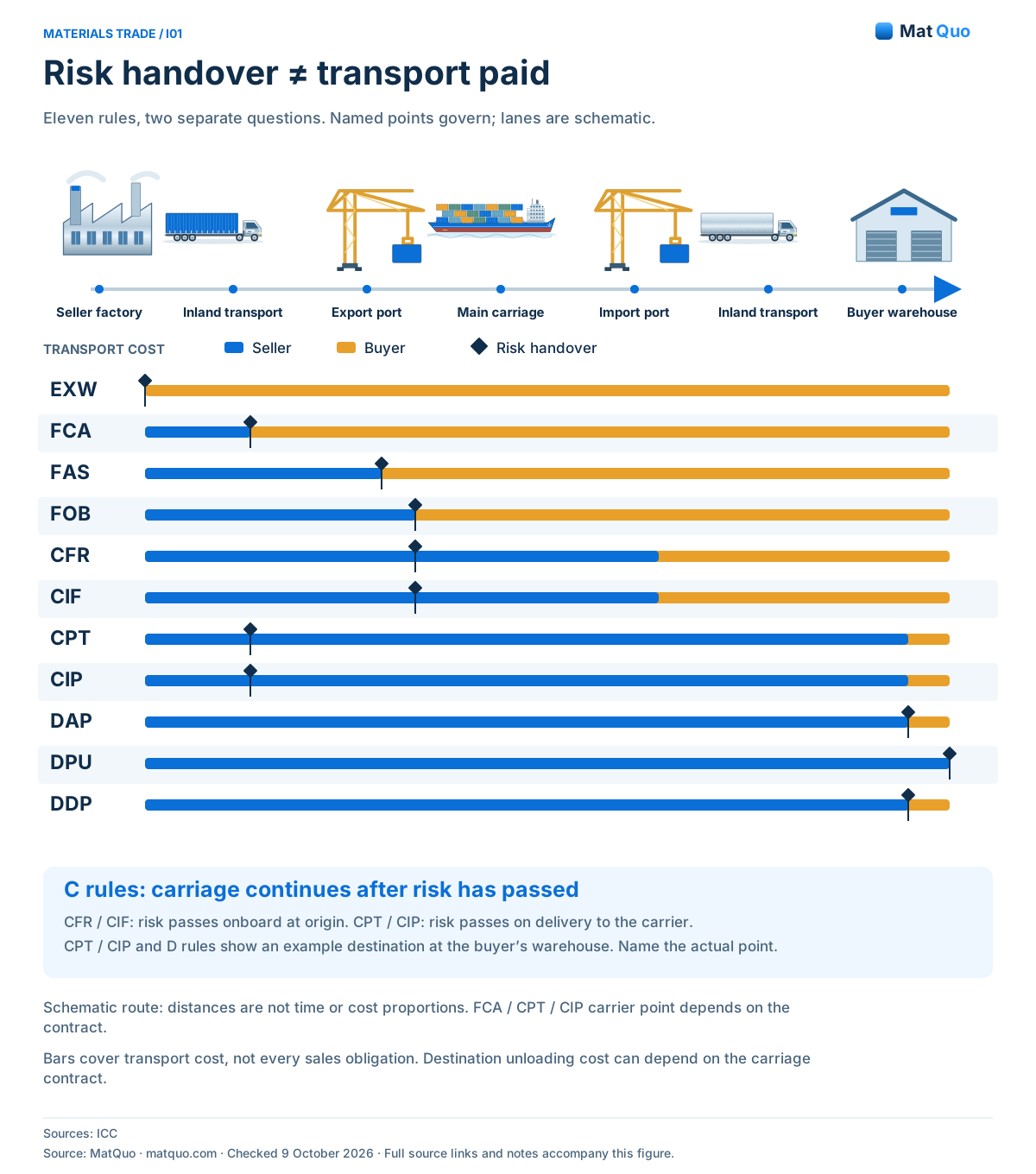
Risk handover ≠ transport paid
Eleven rules, two separate questions. Named points govern; lanes are schematic.
Detailed poster: scroll horizontally on a small screen, or open the full-size figure. The readable text equivalent is below.
ICC • Incoterms 2020 · ICC • 2024 checklist · Checked
Text equivalent and notes
- EXW
- Goods available, not loaded. Buyer arranges carriage
- FCA
- Carrier at named delivery point. Buyer arranges main carriage
- FAS
- Alongside vessel at origin. Buyer arranges main carriage
- FOB
- Onboard vessel at origin. Buyer arranges main carriage
- CFR
- Onboard vessel at origin. Seller pays to destination port
- CIF
- Onboard vessel at origin. Seller pays to destination port
- CPT
- Carrier at agreed delivery point. Seller pays to named destination
- CIP
- Carrier at agreed delivery point. Seller pays to named destination
- DAP
- Destination, ready to unload. Seller pays to named destination
- DPU
- Destination, after unloading. Seller pays through unloading
- DDP
- Destination, ready to unload. Seller pays; import duty/tax
Embed with credit
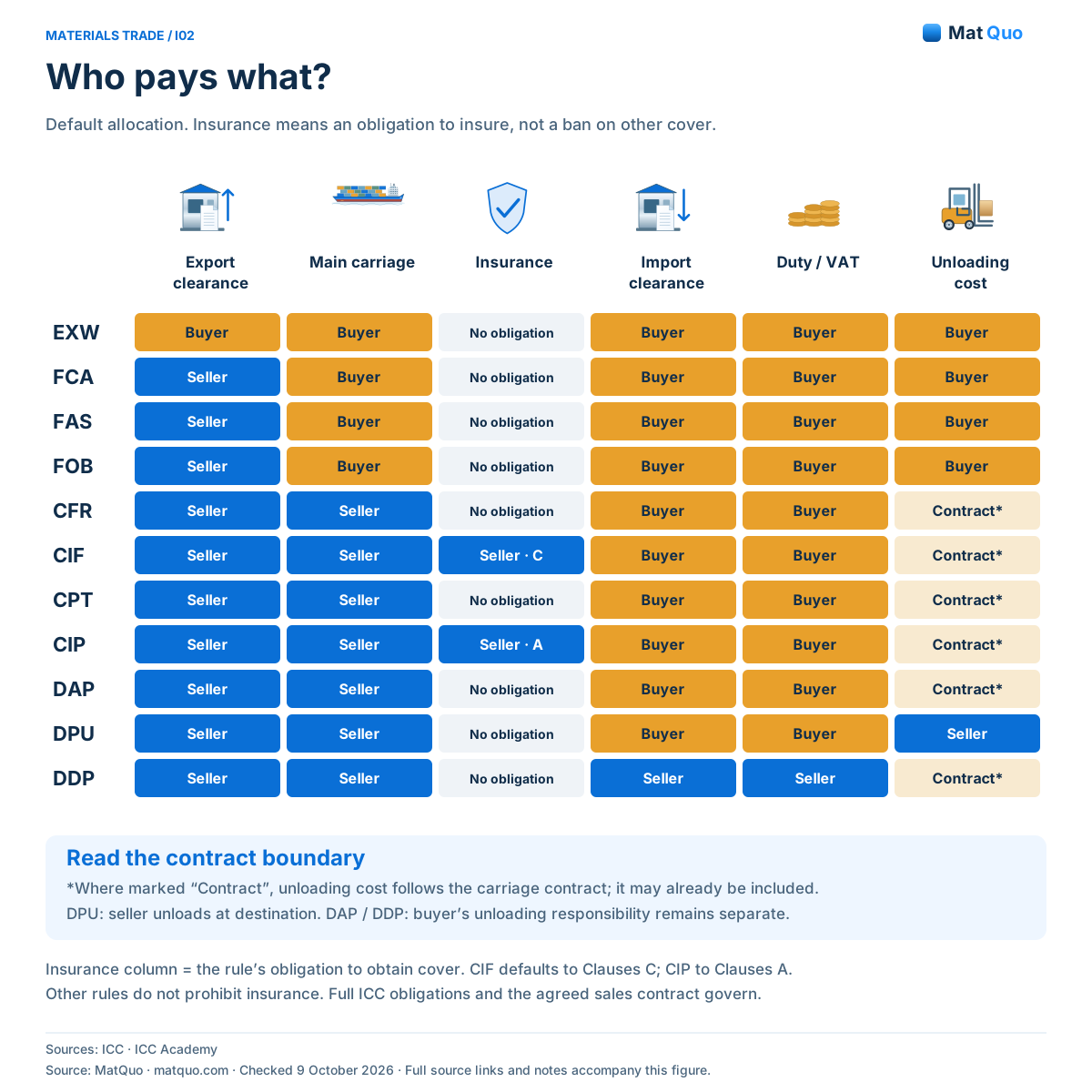
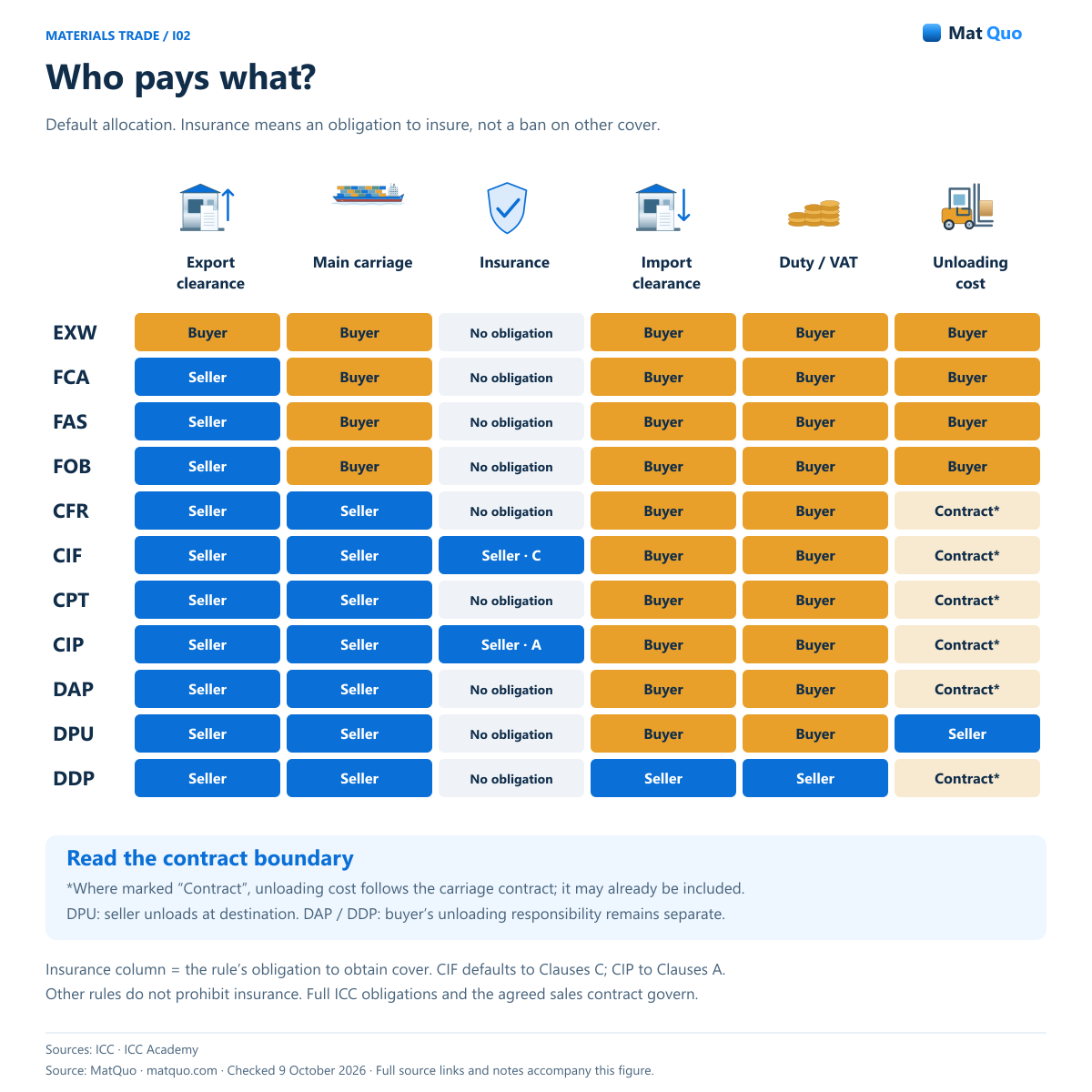
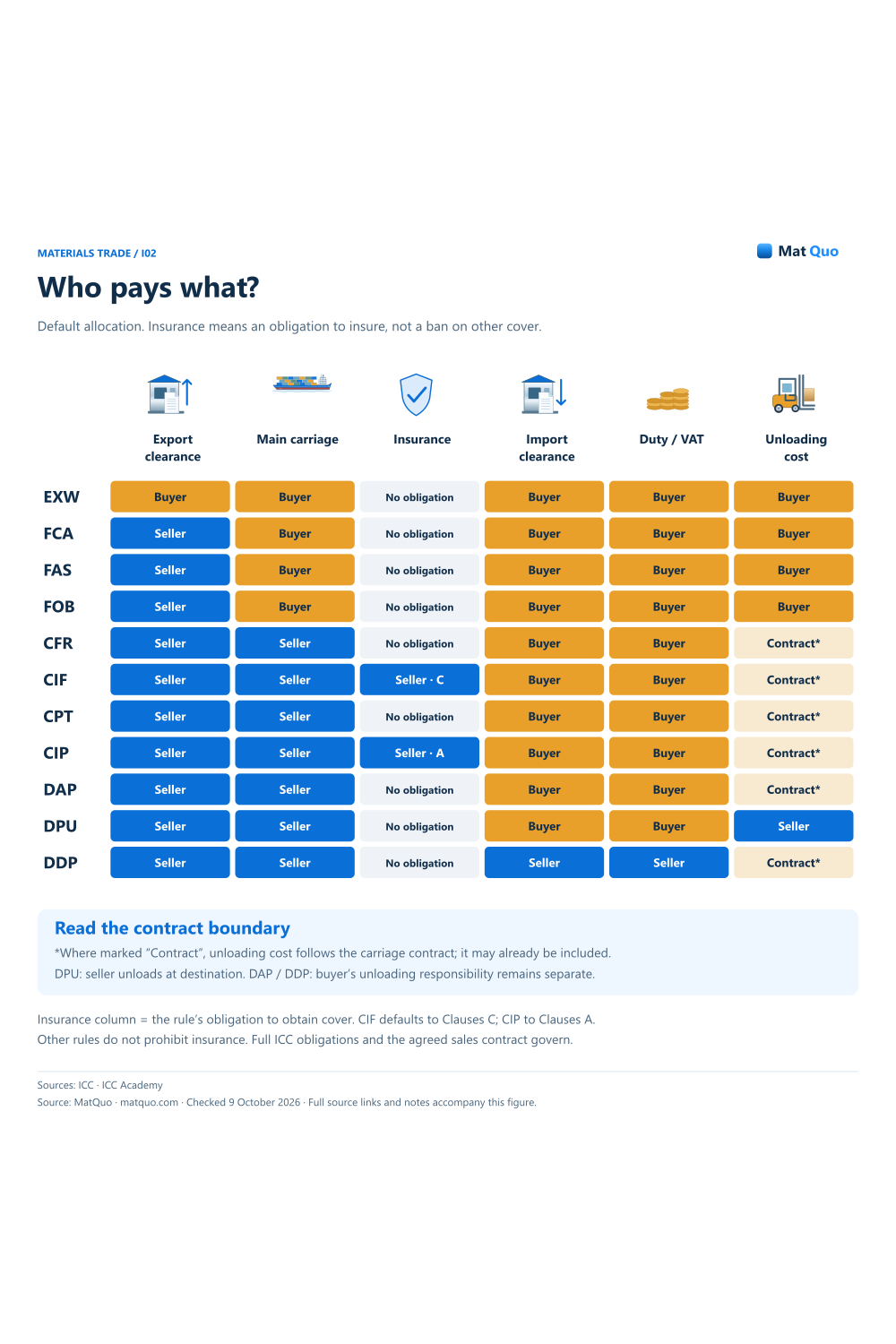
Who pays what?
Default allocation. Insurance means an obligation to insure, not a ban on other cover.
Detailed poster: scroll horizontally on a small screen, or open the full-size figure. The readable text equivalent is below.
ICC • Incoterms 2020 · ICC Academy • CPT and CIP · ICC Academy • DAP and DDP · Checked
Text equivalent and notes
- EXW
- Export: Buyer • Import: Buyer. Import duty / tax: buyer. Insurance: None. Main carriage: buyer. Unload: buyer at destination
- FCA
- Export: Seller • Import: Buyer. Import duty / tax: buyer. Insurance: None. Main carriage: buyer. Unload: buyer at destination
- FAS
- Export: Seller • Import: Buyer. Import duty / tax: buyer. Insurance: None. Main carriage: buyer. Unload: buyer at destination
- FOB
- Export: Seller • Import: Buyer. Import duty / tax: buyer. Insurance: None. Main carriage: buyer. Unload: buyer at destination
- CFR
- Export: Seller • Import: Buyer. Import duty / tax: buyer. Insurance: None. Main carriage: seller. Unload: check carriage contract
- CIF
- Export: Seller • Import: Buyer. Import duty / tax: buyer. Insurance: Seller • Clauses C. Main carriage: seller. Unload: check carriage contract
- CPT
- Export: Seller • Import: Buyer. Import duty / tax: buyer. Insurance: None. Main carriage: seller. Unload: check carriage contract
- CIP
- Export: Seller • Import: Buyer. Import duty / tax: buyer. Insurance: Seller • Clauses A. Main carriage: seller. Unload: check carriage contract
- DAP
- Export: Seller • Import: Buyer. Import duty / tax: buyer. Insurance: None. Main carriage: seller. Unload: check carriage contract
- DPU
- Export: Seller • Import: Buyer. Import duty / tax: buyer. Insurance: None. Main carriage: seller. Unload: seller at destination
- DDP
- Export: Seller • Import: Seller. Import duty / tax: seller. Insurance: None. Main carriage: seller. Unload: check carriage contract
Embed with credit
Common mistakes
- Calling an export movement simple merely because the goods are collected locally.
- Leaving loading arrangements outside the pickup instructions.
- Comparing an EXW price with an FCA price without reconciling included services.
Questions and answers
Is FCA always the seller’s warehouse?
No. FCA can name the seller’s premises or another agreed place. Those alternatives affect how delivery is completed. Put the location and practical handover instruction into the order, then ask dispatch and the carrier to confirm that the acceptance record will identify that same event without ambiguity.
Can the seller help with an EXW collection?
Operational assistance should be described clearly instead of assumed from the abbreviation. If the actual arrangement includes seller loading and export clearance, review whether FCA describes it more accurately. Record any agreed change in responsibility in the contract so that a helpful action at collection does not create uncertainty.
Which weights should the pickup instruction contain?
State product net mass, package count and gross cargo mass including pallets and bags. A fictional 20-pallet order containing 1,000 kg product and 30 kg packaging per pallet is 20,000 kg net but 20,600 kg gross cargo. The carrier needs the latter for its loading and vehicle checks.
Sources and review scope
- ICC Academy • EXW and FCA — Loading, export formalities and FCA delivery.
- ICC • 2024 checklist — Choice of delivery point; FCA for container terminals. No source artwork reproduced.
- ICC • Incoterms 2020 — Current edition; 11 rules; CIF/CIP insurance distinction.
- ICC Academy • CPT and CIP — Carrier delivery, destination carriage, CIP insurance.
- ICC Academy • DAP and DDP — Destination delivery and import obligations.