DAP, DPU and DDP at destination
DAP, DPU and DDP all place delivery at destination, but unloading and import obligations differ. DAP delivers ready for unloading, DPU delivers after unloading, and DDP adds seller import clearance and duties or taxes. Confirm the unloading equipment and the seller’s ability to perform import obligations before selecting the rule.
Name the physical receiving point
A site address may contain several gates, silos and warehouses. Specify the relevant receiving point and check access, appointment requirements and equipment. DPU needs an agreed unloading operation; it should not be chosen merely because an arrival price looks convenient. Clarify delays and extra services in the commercial terms.
Test the import arrangement
DDP requires more than adding a tax allowance to a spreadsheet. Confirm who can act as importer, what registrations are needed and how the actual declaration will be made. DAP leaves import clearance to the buyer. A delivered-cost comparison can quantify a budget without proving that a DDP arrangement is legally executable.
Comparison at a glance
| Rule | Destination delivery | Import responsibility |
|---|---|---|
| DAP | Ready for unloading | Buyer |
| DPU | After unloading | Buyer |
| DDP | Ready for unloading | Seller |
Worked example
Fictional destination budget: €12,000.00 goods and carriage, €400.00 unloading and €600.00 import charges. A DAP comparison that excludes both additions totals €13,000.00 when they are added. A DPU quote including the €400.00 unloading still needs the same €600.00 import item. Confirm the actual inclusions rather than adding all three amounts to every quote.
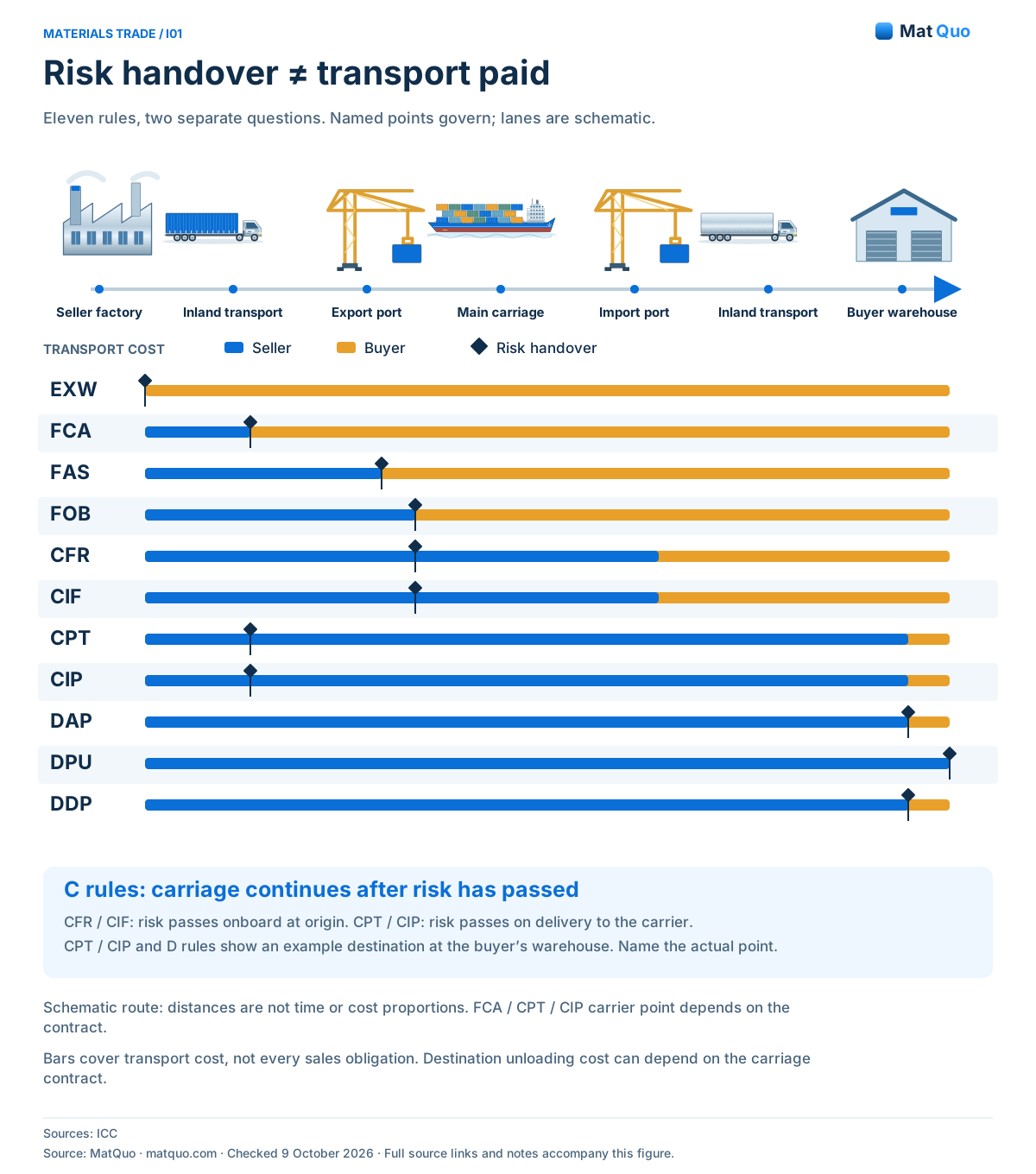
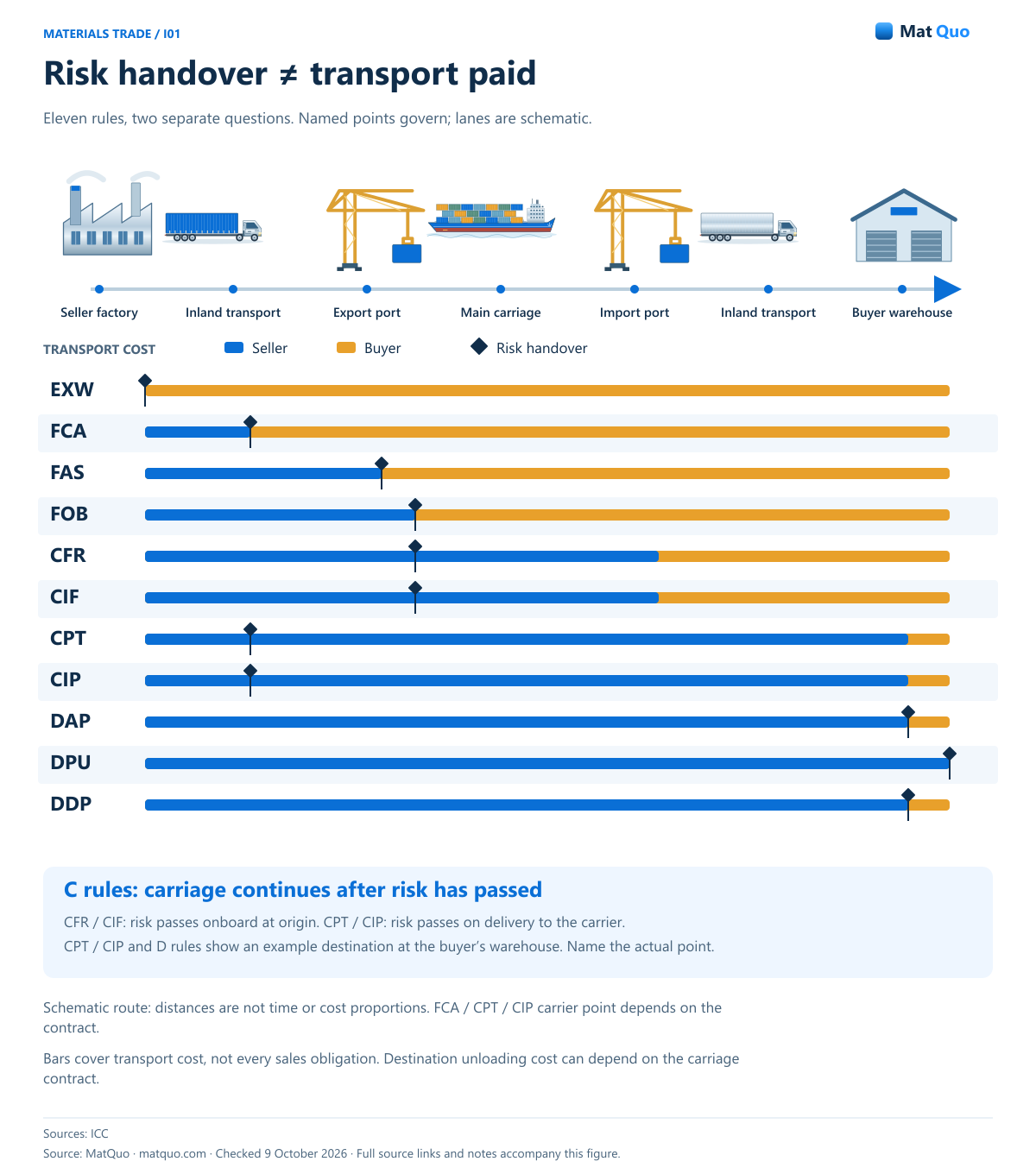
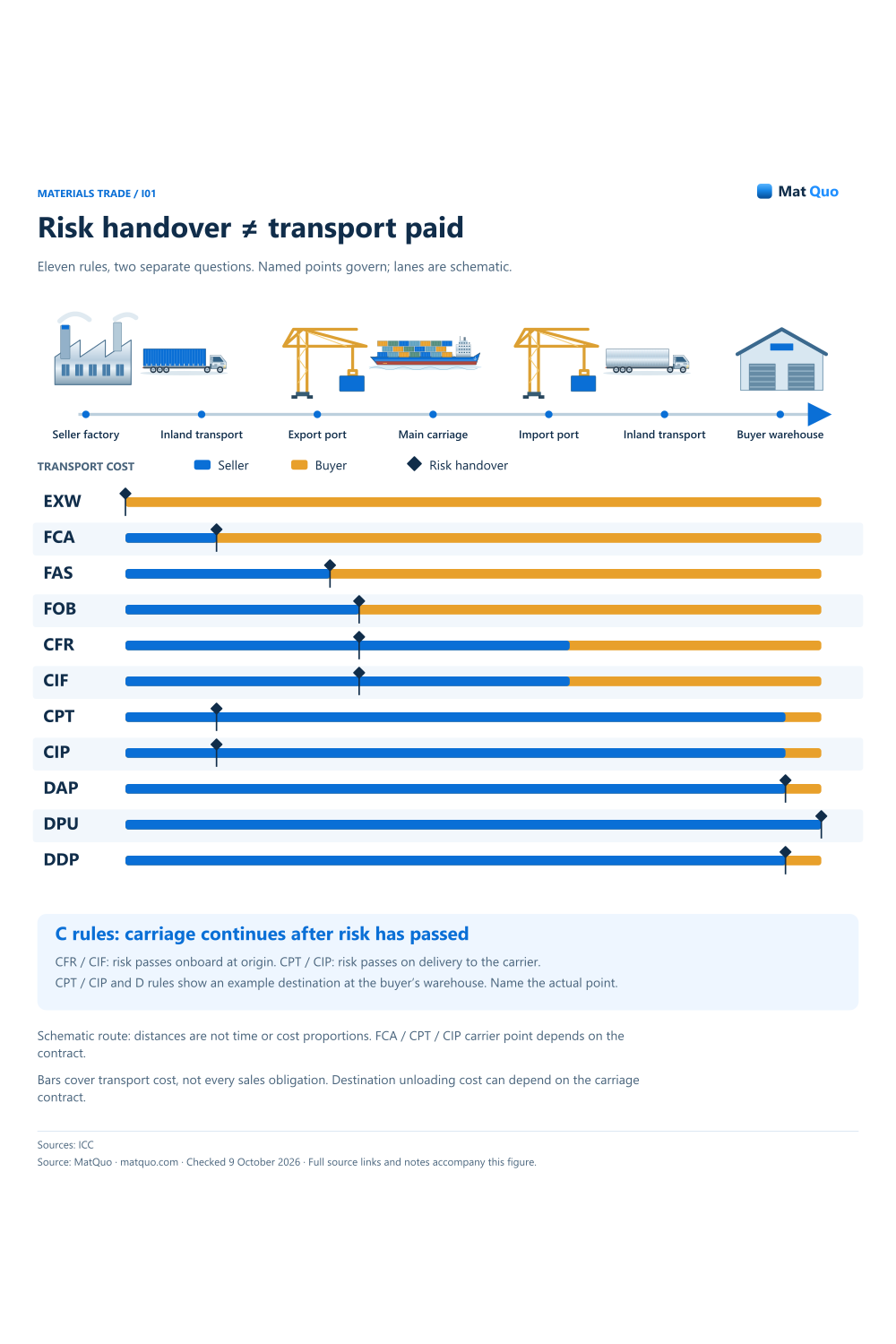
Risk handover ≠ transport paid
Eleven rules, two separate questions. Named points govern; lanes are schematic.
Detailed poster: scroll horizontally on a small screen, or open the full-size figure. The readable text equivalent is below.
ICC • Incoterms 2020 · ICC • 2024 checklist · Checked
Text equivalent and notes
- EXW
- Goods available, not loaded. Buyer arranges carriage
- FCA
- Carrier at named delivery point. Buyer arranges main carriage
- FAS
- Alongside vessel at origin. Buyer arranges main carriage
- FOB
- Onboard vessel at origin. Buyer arranges main carriage
- CFR
- Onboard vessel at origin. Seller pays to destination port
- CIF
- Onboard vessel at origin. Seller pays to destination port
- CPT
- Carrier at agreed delivery point. Seller pays to named destination
- CIP
- Carrier at agreed delivery point. Seller pays to named destination
- DAP
- Destination, ready to unload. Seller pays to named destination
- DPU
- Destination, after unloading. Seller pays through unloading
- DDP
- Destination, ready to unload. Seller pays; import duty/tax
Embed with credit
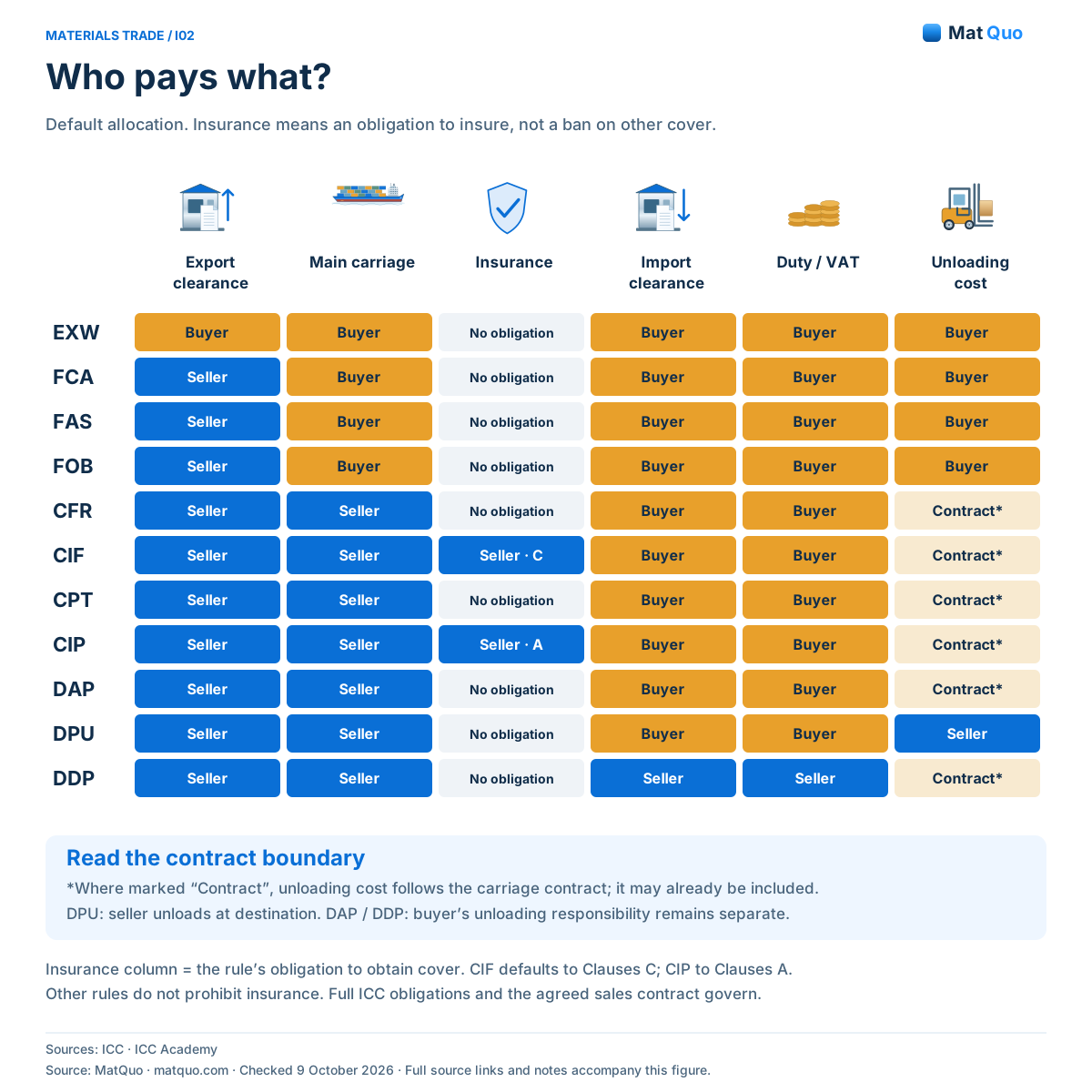
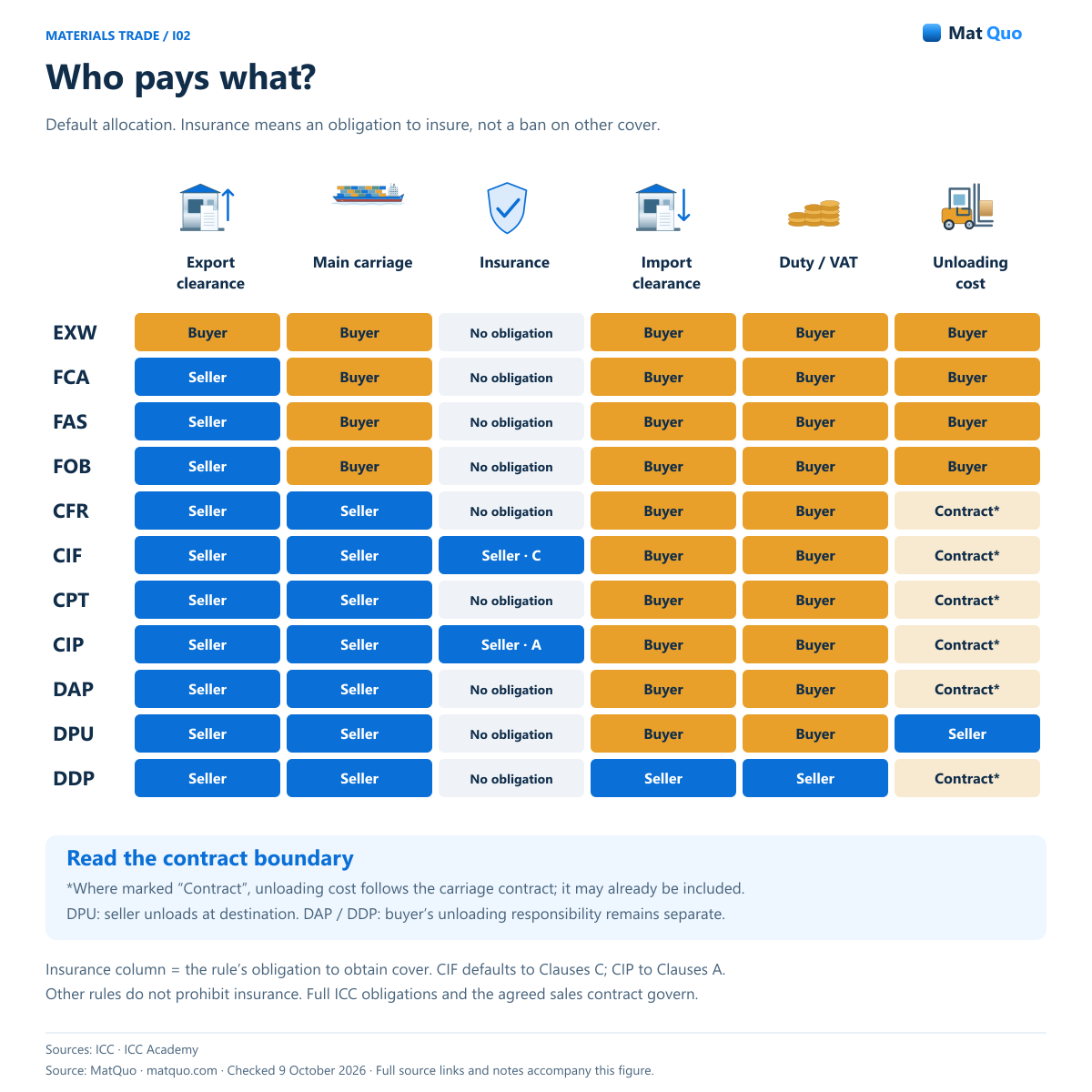
Who pays what?
Default allocation. Insurance means an obligation to insure, not a ban on other cover.
Detailed poster: scroll horizontally on a small screen, or open the full-size figure. The readable text equivalent is below.
ICC • Incoterms 2020 · ICC Academy • CPT and CIP · ICC Academy • DAP and DDP · Checked
Text equivalent and notes
- EXW
- Export: Buyer • Import: Buyer. Import duty / tax: buyer. Insurance: None. Main carriage: buyer. Unload: buyer at destination
- FCA
- Export: Seller • Import: Buyer. Import duty / tax: buyer. Insurance: None. Main carriage: buyer. Unload: buyer at destination
- FAS
- Export: Seller • Import: Buyer. Import duty / tax: buyer. Insurance: None. Main carriage: buyer. Unload: buyer at destination
- FOB
- Export: Seller • Import: Buyer. Import duty / tax: buyer. Insurance: None. Main carriage: buyer. Unload: buyer at destination
- CFR
- Export: Seller • Import: Buyer. Import duty / tax: buyer. Insurance: None. Main carriage: seller. Unload: check carriage contract
- CIF
- Export: Seller • Import: Buyer. Import duty / tax: buyer. Insurance: Seller • Clauses C. Main carriage: seller. Unload: check carriage contract
- CPT
- Export: Seller • Import: Buyer. Import duty / tax: buyer. Insurance: None. Main carriage: seller. Unload: check carriage contract
- CIP
- Export: Seller • Import: Buyer. Import duty / tax: buyer. Insurance: Seller • Clauses A. Main carriage: seller. Unload: check carriage contract
- DAP
- Export: Seller • Import: Buyer. Import duty / tax: buyer. Insurance: None. Main carriage: seller. Unload: check carriage contract
- DPU
- Export: Seller • Import: Buyer. Import duty / tax: buyer. Insurance: None. Main carriage: seller. Unload: seller at destination
- DDP
- Export: Seller • Import: Seller. Import duty / tax: seller. Insurance: None. Main carriage: seller. Unload: check carriage contract
Embed with credit
Common mistakes
- Assuming DDP includes unloading by default.
- Selecting DPU without arranging suitable unloading equipment.
- Treating an accounting model as evidence of the seller’s importer eligibility.
Questions and answers
Who unloads under DAP and DDP?
Delivery is on the arriving means of transport ready for unloading. The buyer ordinarily handles that unloading operation, while the carriage contract can affect whether its cost is already included. Ask both parties to identify the service and charge explicitly so that operational responsibility and invoicing are not confused.
What is different about DPU?
DPU requires delivery after unloading at the named destination. Before choosing it, confirm the method, equipment and receiving conditions for the material. A forklift movement, crane lift and bulk discharge are different operations. The order should identify the actual unloading arrangement rather than relying on a generic arrival instruction.
Can the calculator produce a binding DDP offer?
No. It can reconcile costs using your supplied figures and confirmed tax bases, but it cannot establish importer eligibility or create a supplier commitment. Treat the result as a budgeting comparison. Obtain a specific commercial offer and confirm the import arrangements before describing a transaction as an executable DDP sale.
Sources and review scope
- ICC Academy • DAP and DDP — Destination delivery and import obligations.
- ICC • Incoterms 2020 — Current edition; 11 rules; CIF/CIP insurance distinction.
- European Commission • Customs valuation — Transaction value and valuation additions/exclusions.
- ICC • 2024 checklist — Choice of delivery point; FCA for container terminals. No source artwork reproduced.
- ICC Academy • CPT and CIP — Carrier delivery, destination carriage, CIP insurance.