Incoterms 2020 for materials trade
Incoterms 2020 allocate delivery tasks, transport costs and the risk of loss or damage between seller and buyer. Start with the actual handover point, then choose a rule and name the place precisely. For material shipments, compare quotations on the same delivered-cost basis and document quality requirements separately.
Start with three decisions
Record where the supplier can hand over the material, who will contract the main carriage and who can complete import formalities. These decisions are more useful than ranking the eleven abbreviations from “least” to “most” responsibility. A container delivered to a terminal and a bulk parcel delivered onboard a vessel have different operational handovers.
Keep the contract readable
Write the chosen rule, named place or port and “Incoterms 2020” together. For C terms, also agree the delivery point where risk passes. Add a separate product schedule: resin grade, quantity tolerance, packaging, inspection evidence, claims process and payment. Incoterms do not settle ownership or the full quality specification.
Choose a focused guide
Use EXW/FCA for collection, the sea rules for alongside/onboard delivery, CPT/CIP for seller-paid multimodal carriage, or DAP/DPU/DDP for arrival obligations.
Comparison at a glance
| Question | Contract record |
|---|---|
| Risk | Delivery event and evidence |
| Cost | Included transport and terminal charges |
| Import | Responsible party and legal ability |
| Quality | Separate material specification |
Worked example
Fictional comparison: a €10,000.00 goods quote plus €1,000.00 transport and €100.00 insurance gives €11,100.00 before import charges. A second quote of €11,100.00 already including those two services has the same subtotal. Adding transport again would overstate it by €1,100.00. Use the landed-cost calculator to compare explicit inclusions.
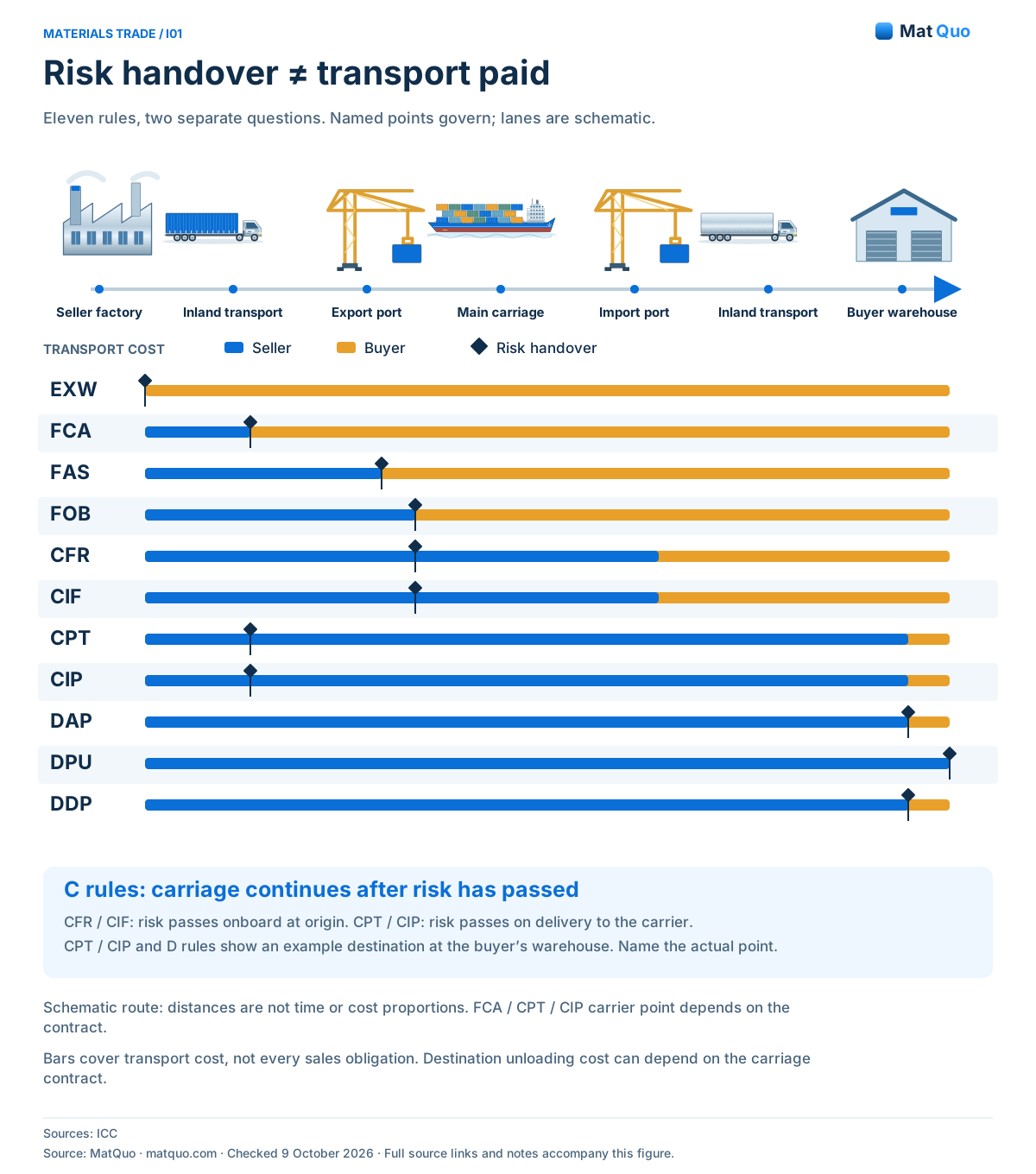
Risk handover ≠ transport paid
Eleven rules, two separate questions. Named points govern; lanes are schematic.
Detailed poster: scroll horizontally on a small screen, or open the full-size figure. The readable text equivalent is below.
ICC • Incoterms 2020 · ICC • 2024 checklist · Checked
Text equivalent and notes
- EXW
- Goods available, not loaded. Buyer arranges carriage
- FCA
- Carrier at named delivery point. Buyer arranges main carriage
- FAS
- Alongside vessel at origin. Buyer arranges main carriage
- FOB
- Onboard vessel at origin. Buyer arranges main carriage
- CFR
- Onboard vessel at origin. Seller pays to destination port
- CIF
- Onboard vessel at origin. Seller pays to destination port
- CPT
- Carrier at agreed delivery point. Seller pays to named destination
- CIP
- Carrier at agreed delivery point. Seller pays to named destination
- DAP
- Destination, ready to unload. Seller pays to named destination
- DPU
- Destination, after unloading. Seller pays through unloading
- DDP
- Destination, ready to unload. Seller pays; import duty/tax
Embed with credit
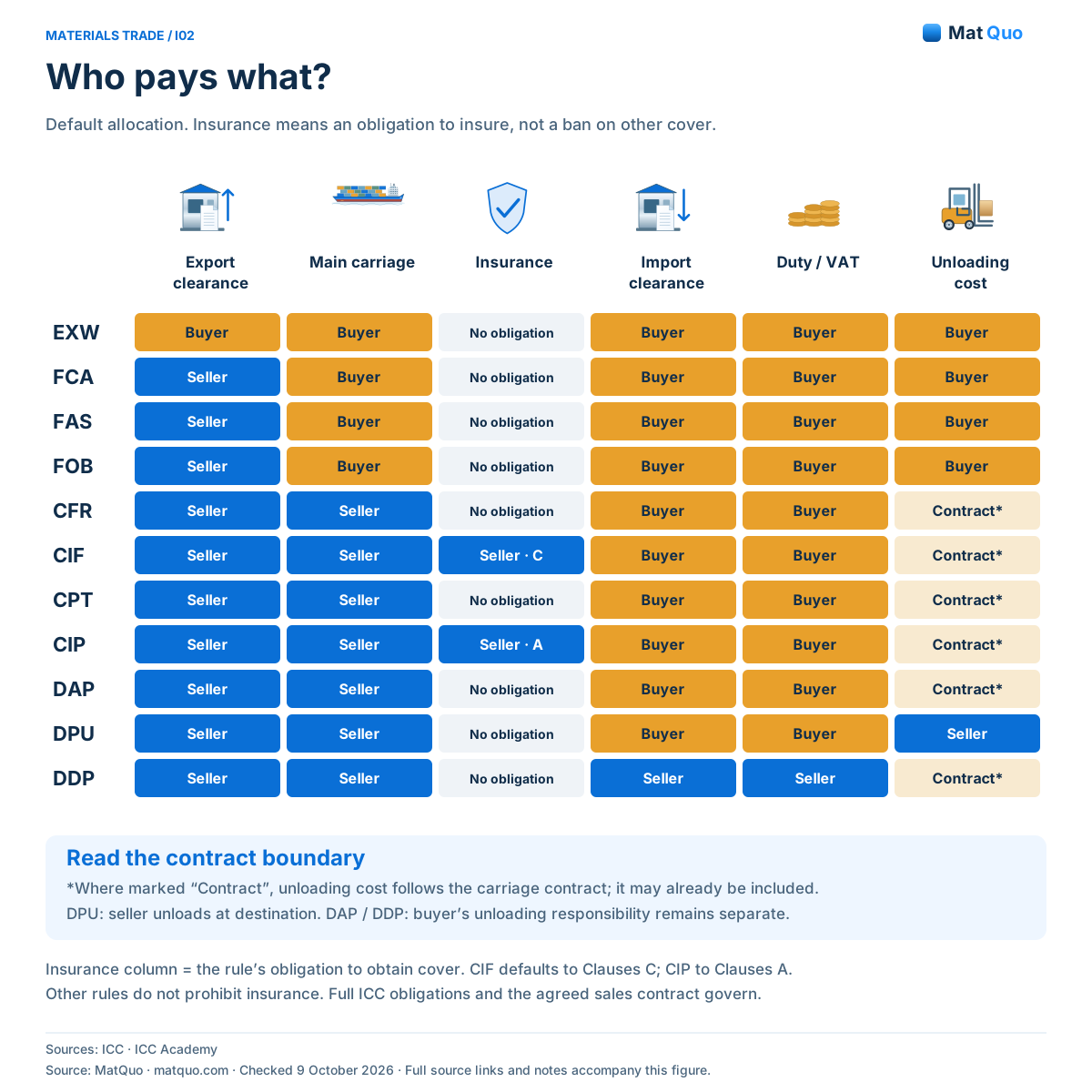
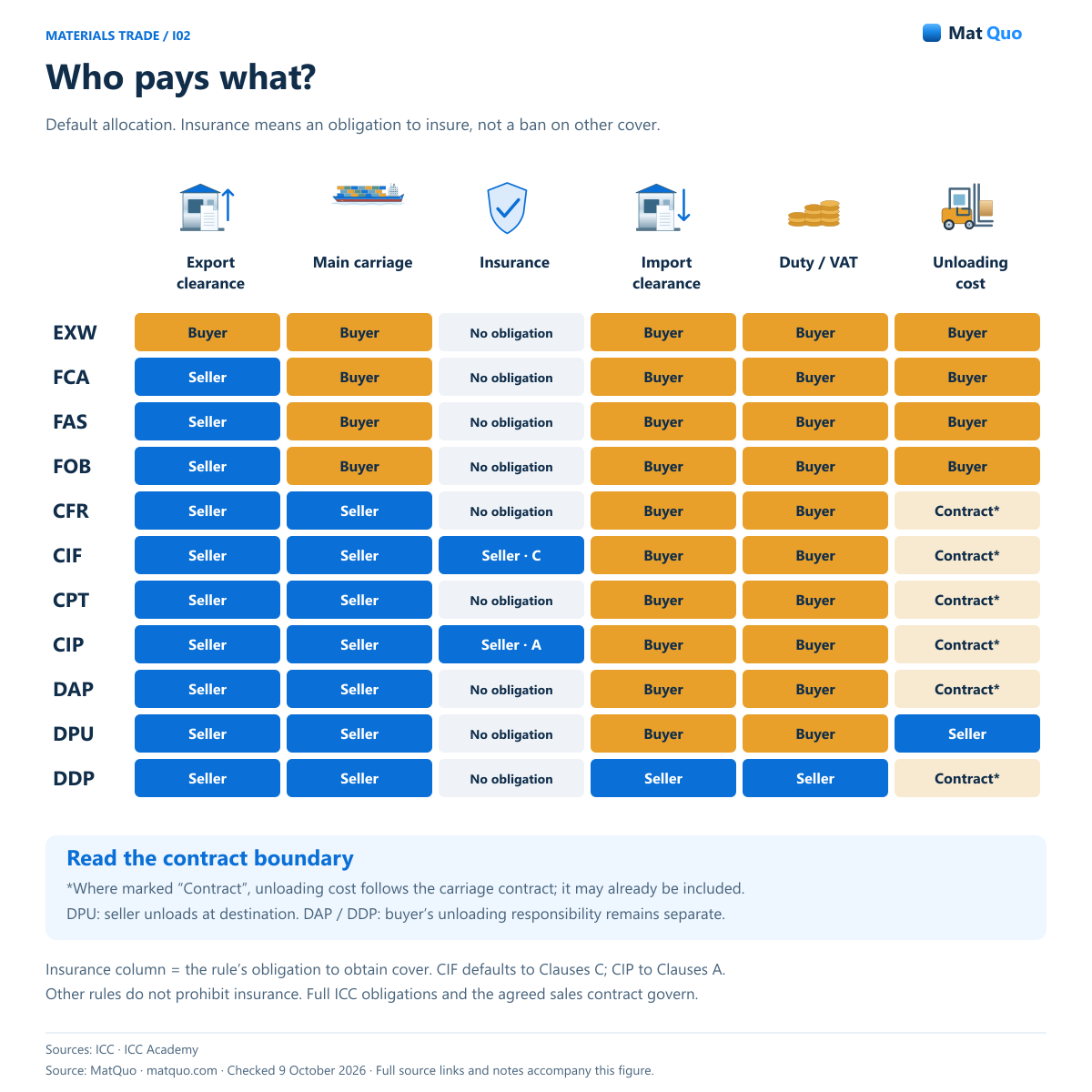
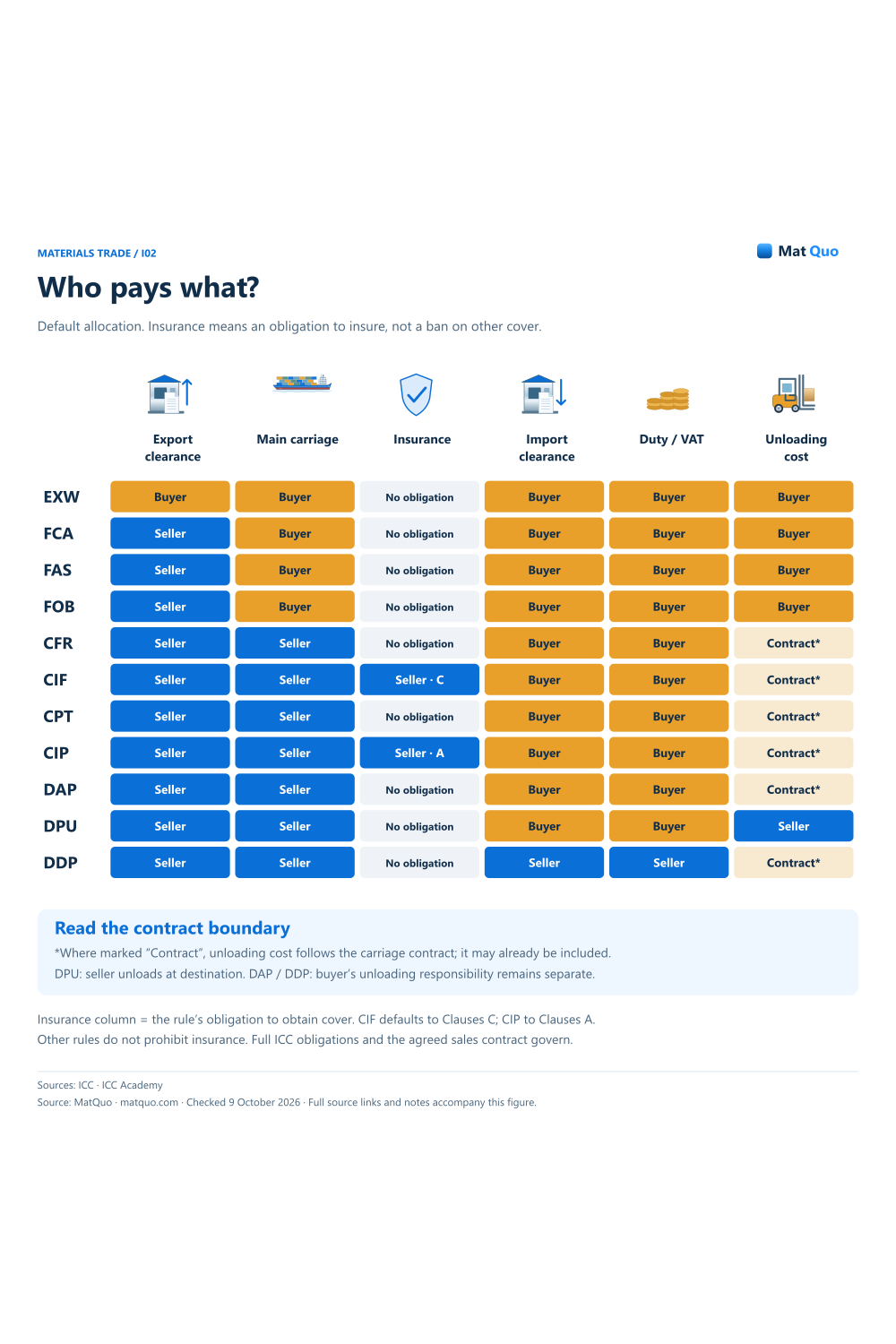
Who pays what?
Default allocation. Insurance means an obligation to insure, not a ban on other cover.
Detailed poster: scroll horizontally on a small screen, or open the full-size figure. The readable text equivalent is below.
ICC • Incoterms 2020 · ICC Academy • CPT and CIP · ICC Academy • DAP and DDP · Checked
Text equivalent and notes
- EXW
- Export: Buyer • Import: Buyer. Import duty / tax: buyer. Insurance: None. Main carriage: buyer. Unload: buyer at destination
- FCA
- Export: Seller • Import: Buyer. Import duty / tax: buyer. Insurance: None. Main carriage: buyer. Unload: buyer at destination
- FAS
- Export: Seller • Import: Buyer. Import duty / tax: buyer. Insurance: None. Main carriage: buyer. Unload: buyer at destination
- FOB
- Export: Seller • Import: Buyer. Import duty / tax: buyer. Insurance: None. Main carriage: buyer. Unload: buyer at destination
- CFR
- Export: Seller • Import: Buyer. Import duty / tax: buyer. Insurance: None. Main carriage: seller. Unload: check carriage contract
- CIF
- Export: Seller • Import: Buyer. Import duty / tax: buyer. Insurance: Seller • Clauses C. Main carriage: seller. Unload: check carriage contract
- CPT
- Export: Seller • Import: Buyer. Import duty / tax: buyer. Insurance: None. Main carriage: seller. Unload: check carriage contract
- CIP
- Export: Seller • Import: Buyer. Import duty / tax: buyer. Insurance: Seller • Clauses A. Main carriage: seller. Unload: check carriage contract
- DAP
- Export: Seller • Import: Buyer. Import duty / tax: buyer. Insurance: None. Main carriage: seller. Unload: check carriage contract
- DPU
- Export: Seller • Import: Buyer. Import duty / tax: buyer. Insurance: None. Main carriage: seller. Unload: seller at destination
- DDP
- Export: Seller • Import: Seller. Import duty / tax: seller. Insurance: None. Main carriage: seller. Unload: check carriage contract
Embed with credit
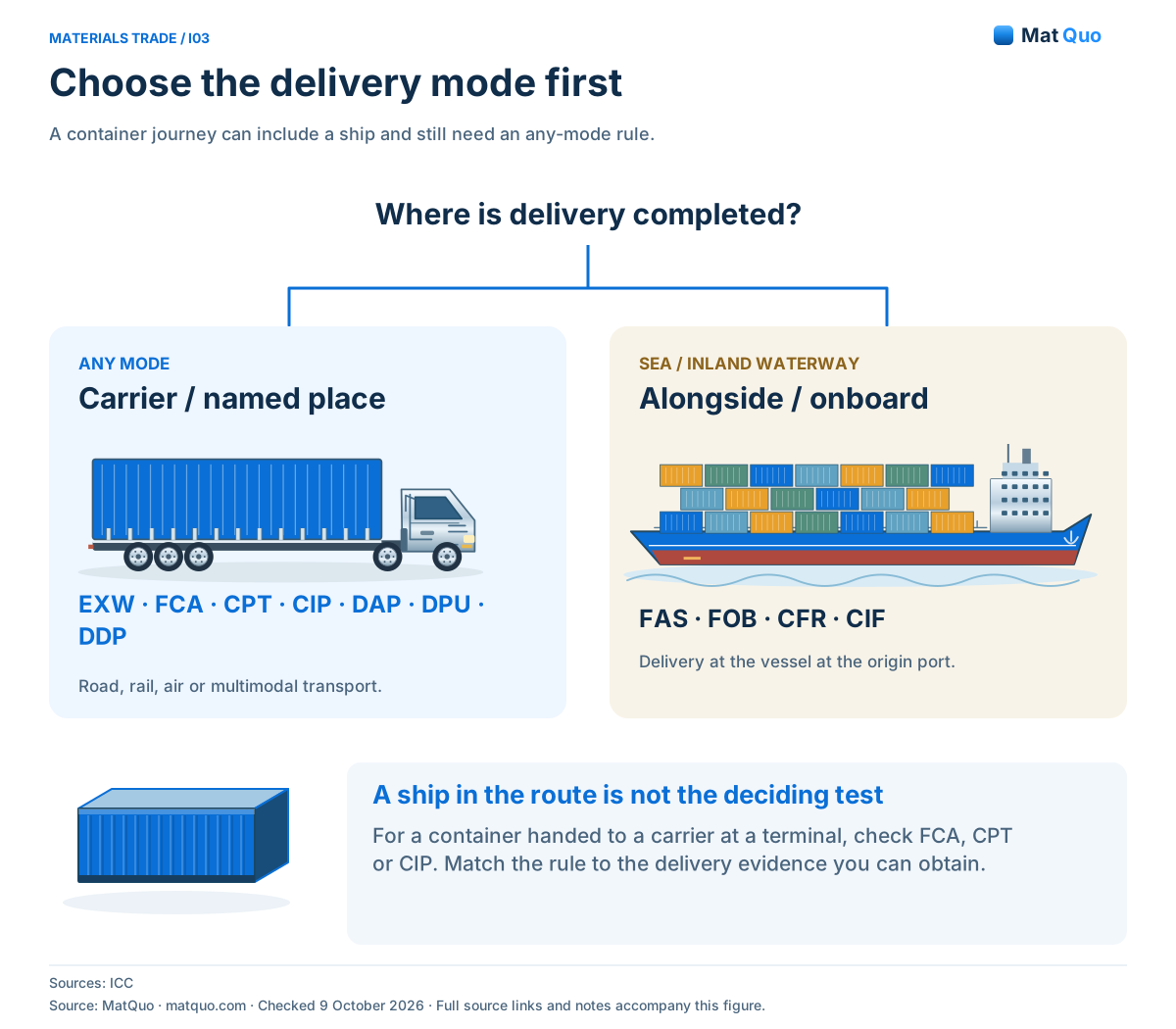
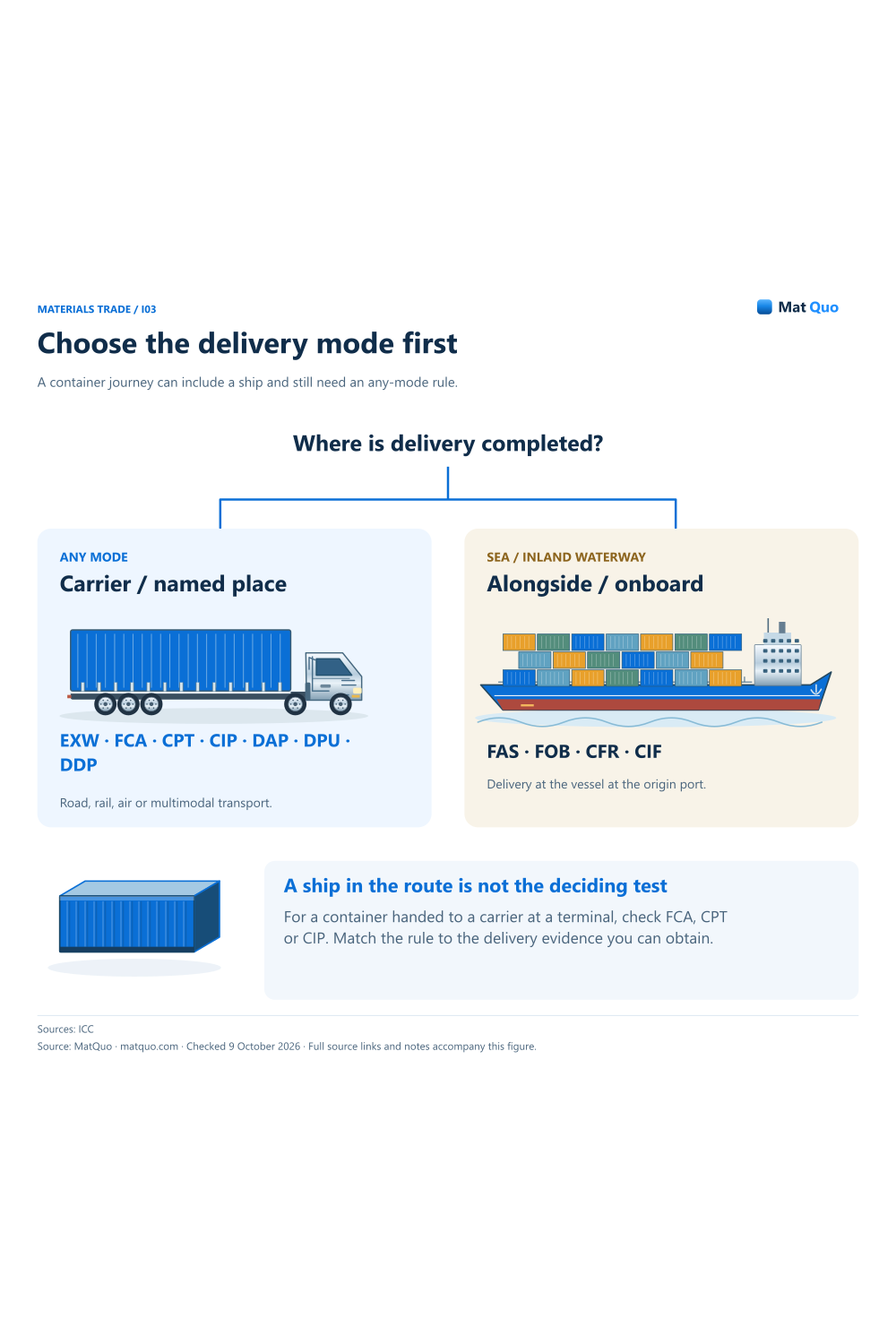
Choose the delivery mode first
A container journey can include a ship and still need an any-mode rule.
Detailed poster: scroll horizontally on a small screen, or open the full-size figure. The readable text equivalent is below.
ICC • Incoterms 2020 · ICC • 2024 checklist · Checked
Text equivalent and notes
- Any mode
- EXW • FCA • CPT • CIP. DAP • DPU • DDP. Road, rail, air or multimodal
- Sea / inland waterway
- FAS • FOB • CFR • CIF. Delivery alongside or onboard. a vessel at the origin port
- Terminal handover?
- Check FCA, CPT or CIP.. Match the rule to the carrier. handover you can document.
Embed with credit
Common mistakes
- Treating seller-paid freight as proof that the seller still bears transit risk.
- Using only a country name when a terminal or delivery point is needed.
- Assuming the rule defines title, payment, grade acceptance or every insurance exclusion.
Questions and answers
Which Incoterms edition should a new contract name?
Name the edition actually agreed by both parties. This guide uses Incoterms 2020, the current ICC edition checked for this page. Writing the edition beside the rule and named place reduces ambiguity. If an older contract names another edition, review that wording before applying this guide to it.
Does an Incoterm calculate the landed price?
No. It helps identify responsibilities, but a cost calculation still needs actual quoted amounts, explicit inclusions, currency conversion and applicable tax bases. Build a line-by-line comparison before selecting a supplier. A lower goods price can be offset by services or charges that the buyer must arrange separately.
What should a materials buyer attach to the order?
Attach the material grade and quantity specification, packing details, agreed delivery evidence and a list of included services. Record the quality documents and claims procedure separately from the trade term. This gives the receiving and finance teams a practical reference when the transport invoice and physical shipment arrive.
Sources and review scope
- ICC • Incoterms 2020 — Current edition; 11 rules; CIF/CIP insurance distinction.
- ICC • 2024 checklist — Choice of delivery point; FCA for container terminals. No source artwork reproduced.
- ICC Academy • Scope of the rules — Ownership and payment are separate contractual questions.
- ICC Academy • CPT and CIP — Carrier delivery, destination carriage, CIP insurance.
- ICC Academy • DAP and DDP — Destination delivery and import obligations.