FAS, FOB, CFR and CIF for sea freight
FAS, FOB, CFR and CIF are rules for sea and inland-waterway transport. FAS delivers alongside the vessel; FOB, CFR and CIF deliver onboard at the shipment port. CFR and CIF add seller-paid carriage to the destination port, while CIF also requires insurance. That payment does not move delivery risk to arrival.
Describe the shipment-port event
A berth, loading window, terminal arrangement and documentary record matter more than the abbreviation alone. For a bulk material parcel, confirm which record establishes alongside or onboard delivery. Containerised cargo commonly reaches a terminal before the vessel is loaded; review FOB versus FCA before selecting a sea-only rule.
Separate carriage and cover
For CFR and CIF, name the destination port while documenting the shipment-port handover separately. CIF’s default insurance requirement uses Institute Cargo Clauses C; the contract can agree different cover. Ask for the insurance document and review exclusions, insured value and claims steps rather than treating the word “insured” as complete protection.
Comparison at a glance
| Rule | Delivery / risk | Main carriage | Seller insurance obligation |
|---|---|---|---|
| FAS | Alongside at origin | Buyer | No |
| FOB | Onboard at origin | Buyer | No |
| CFR | Onboard at origin | Seller | No |
| CIF | Onboard at origin | Seller | Yes, default Clauses C |
Worked example
Fictional 100 t parcel: goods and origin obligations total €90,000.00; ocean freight is €5,000.00; an insurance quote is €300.00. The arithmetic comparison is €900.00/t before those two additions, €950.00/t including freight, and €953.00/t including both. These numbers illustrate quote boundaries, not actual freight or insurance rates.
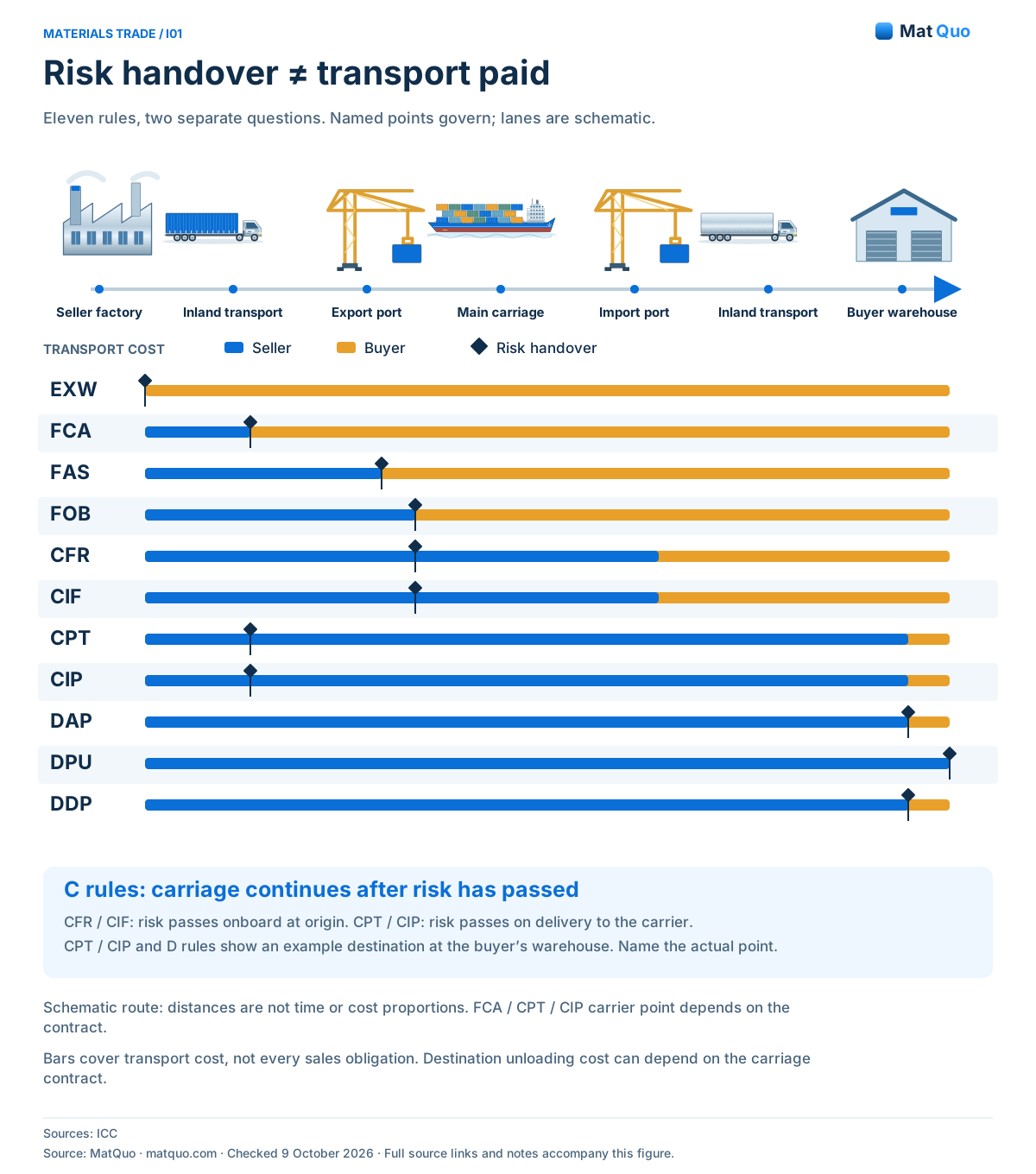
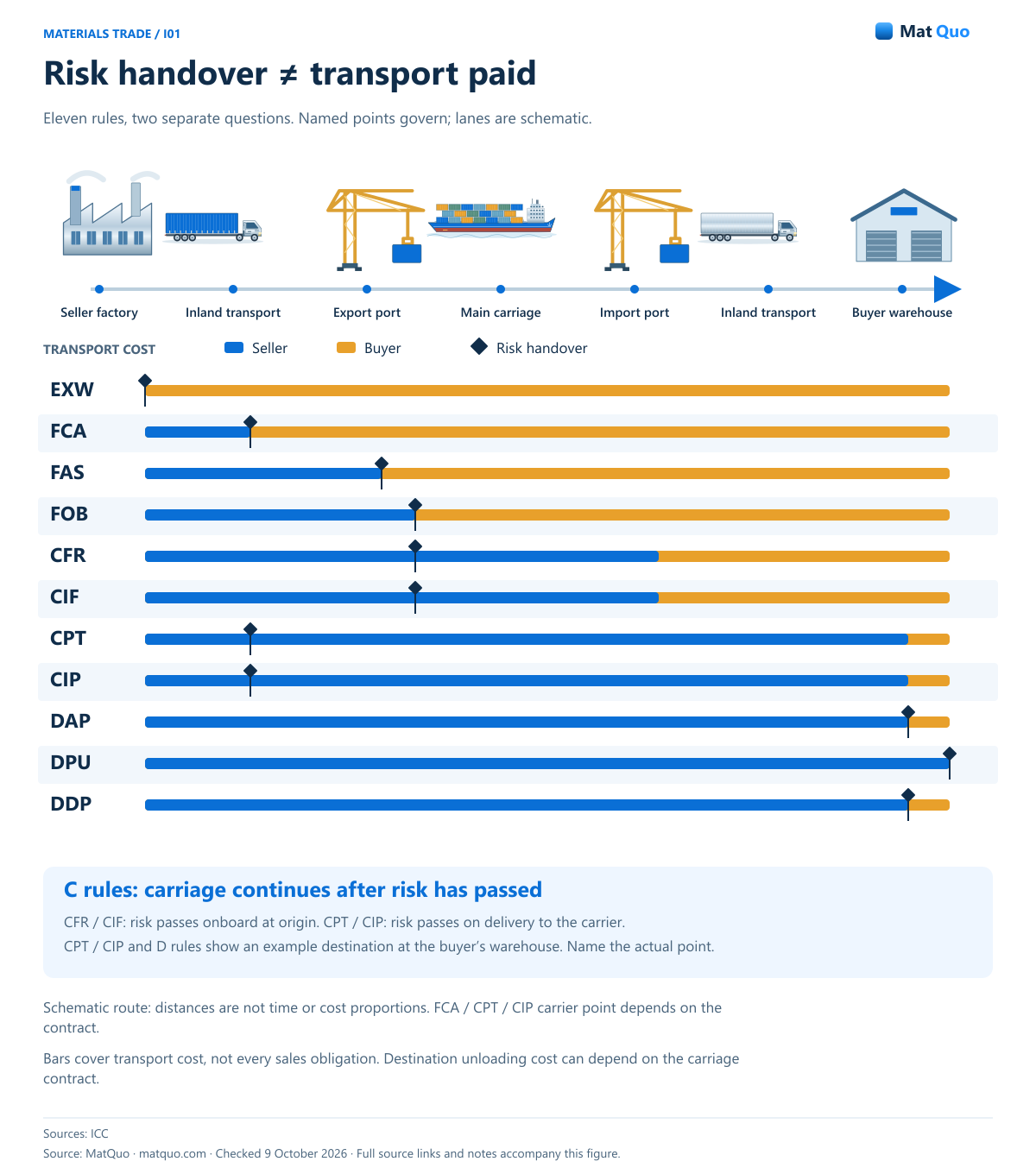
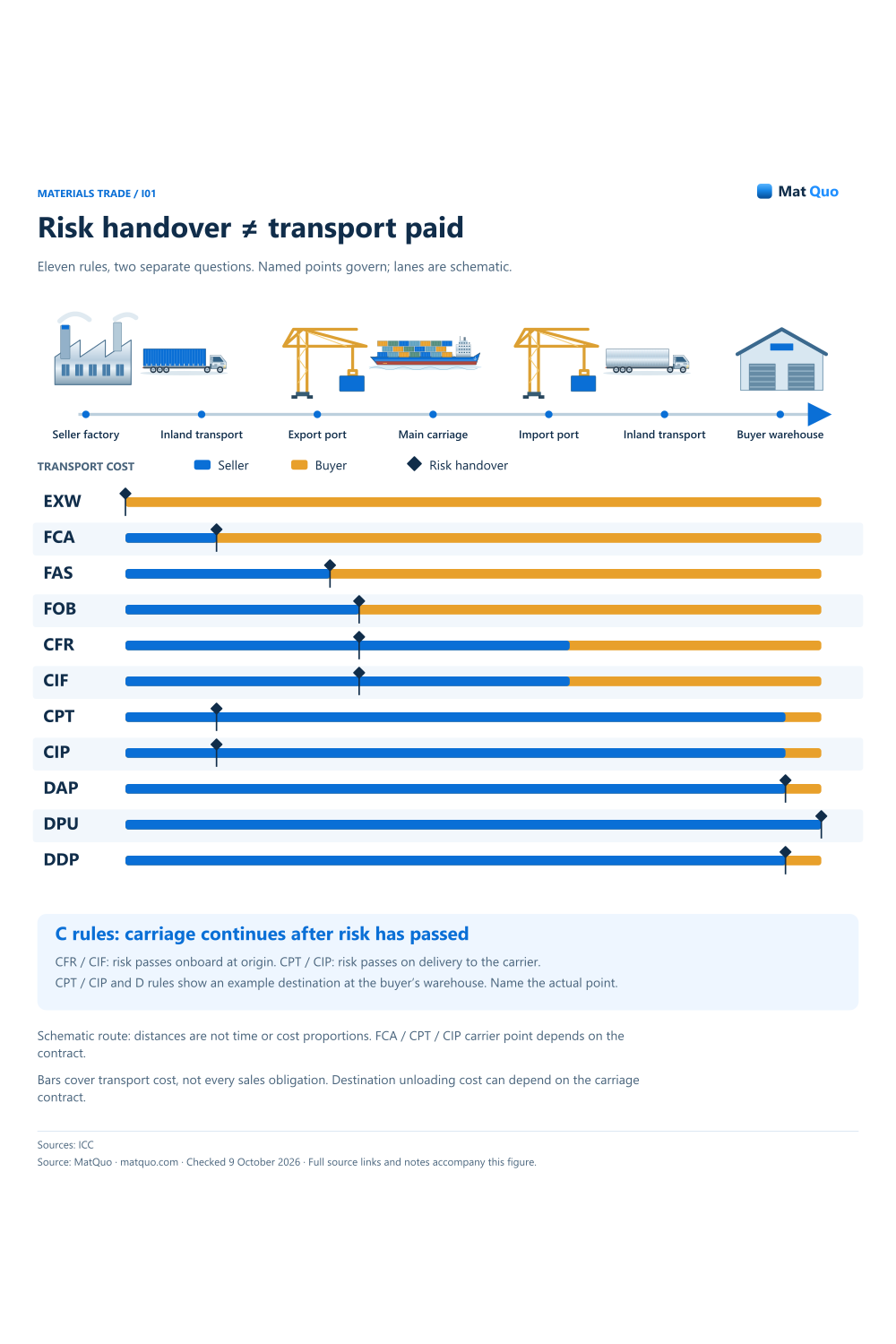
Risk handover ≠ transport paid
Eleven rules, two separate questions. Named points govern; lanes are schematic.
Detailed poster: scroll horizontally on a small screen, or open the full-size figure. The readable text equivalent is below.
ICC • Incoterms 2020 · ICC • 2024 checklist · Checked
Text equivalent and notes
- EXW
- Goods available, not loaded. Buyer arranges carriage
- FCA
- Carrier at named delivery point. Buyer arranges main carriage
- FAS
- Alongside vessel at origin. Buyer arranges main carriage
- FOB
- Onboard vessel at origin. Buyer arranges main carriage
- CFR
- Onboard vessel at origin. Seller pays to destination port
- CIF
- Onboard vessel at origin. Seller pays to destination port
- CPT
- Carrier at agreed delivery point. Seller pays to named destination
- CIP
- Carrier at agreed delivery point. Seller pays to named destination
- DAP
- Destination, ready to unload. Seller pays to named destination
- DPU
- Destination, after unloading. Seller pays through unloading
- DDP
- Destination, ready to unload. Seller pays; import duty/tax
Embed with credit
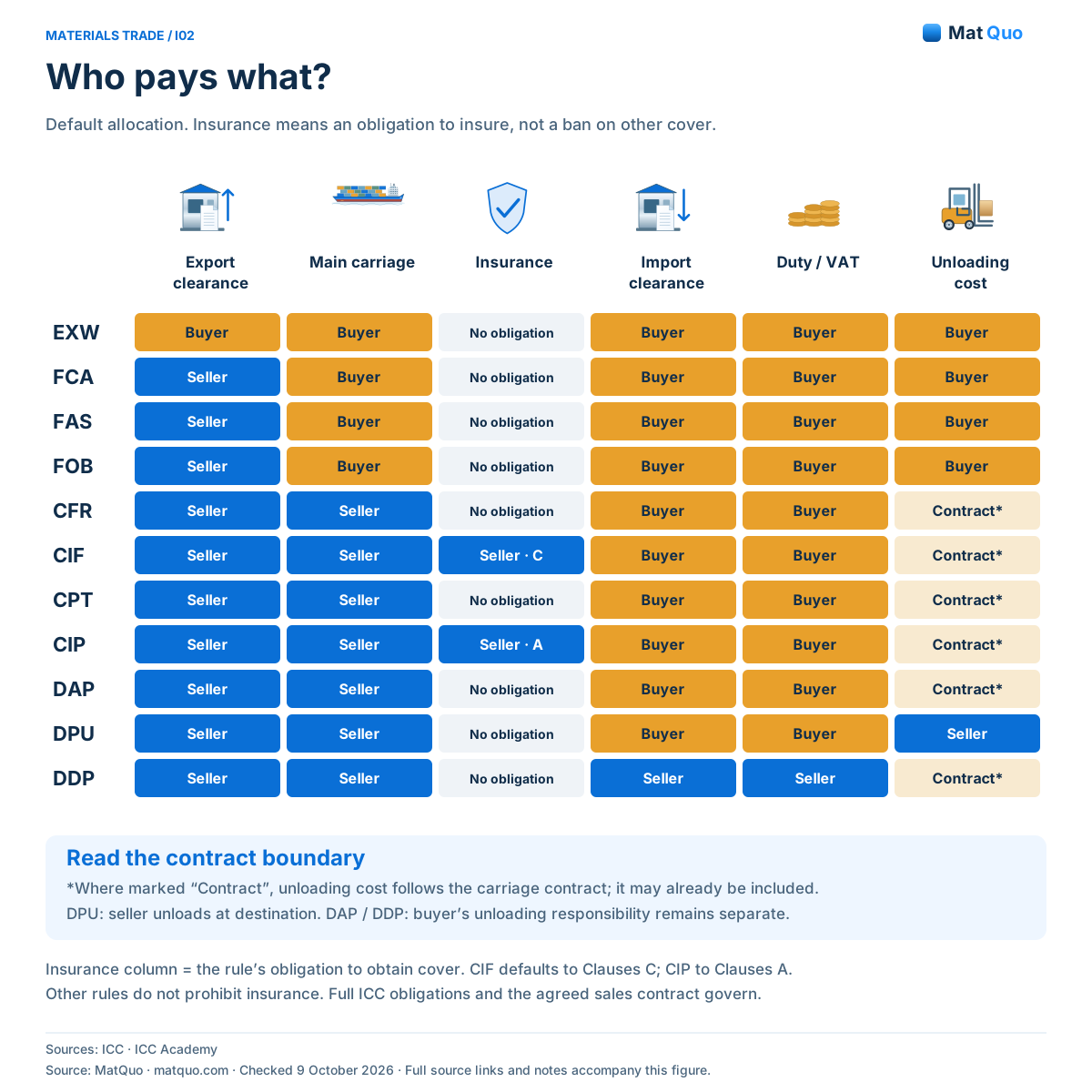
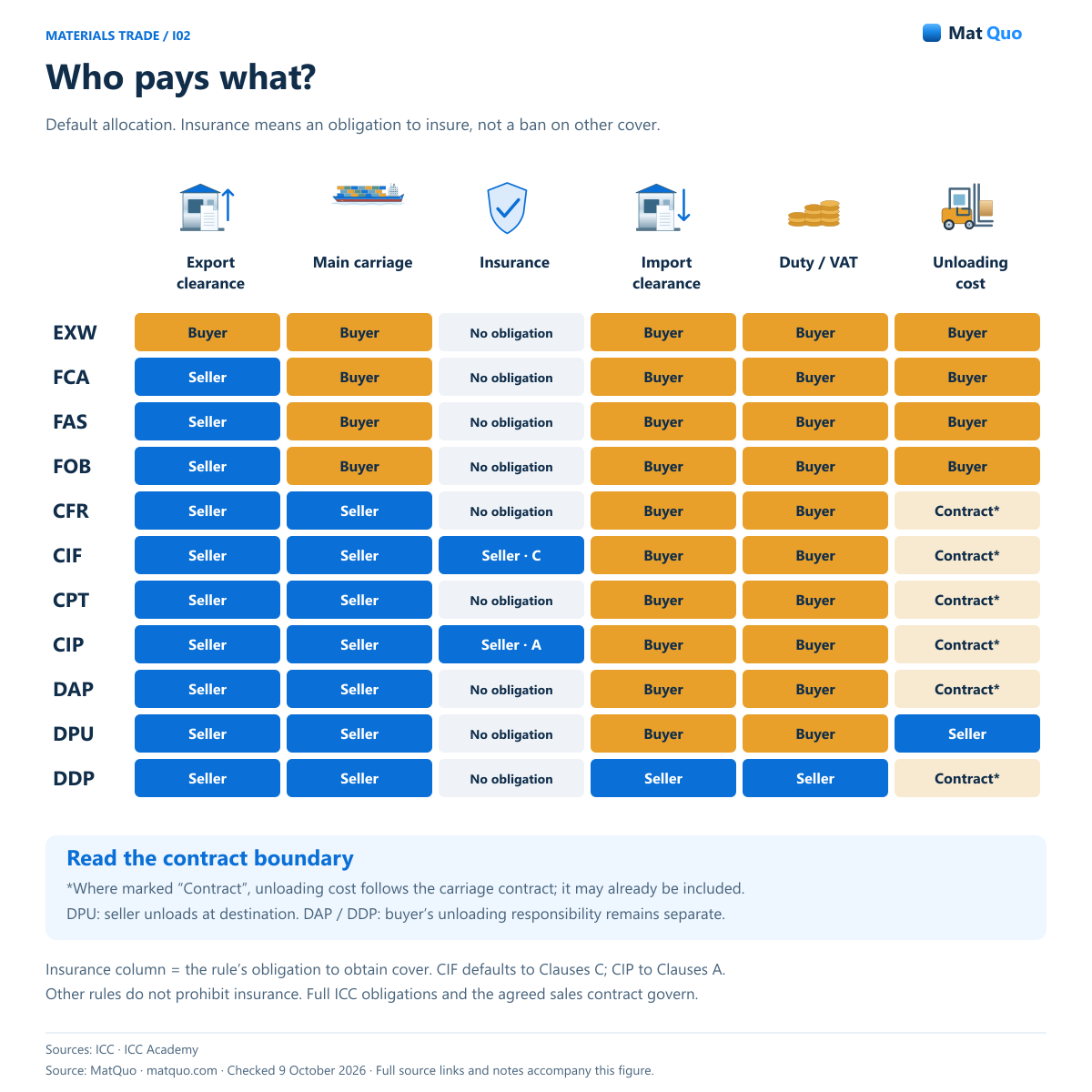
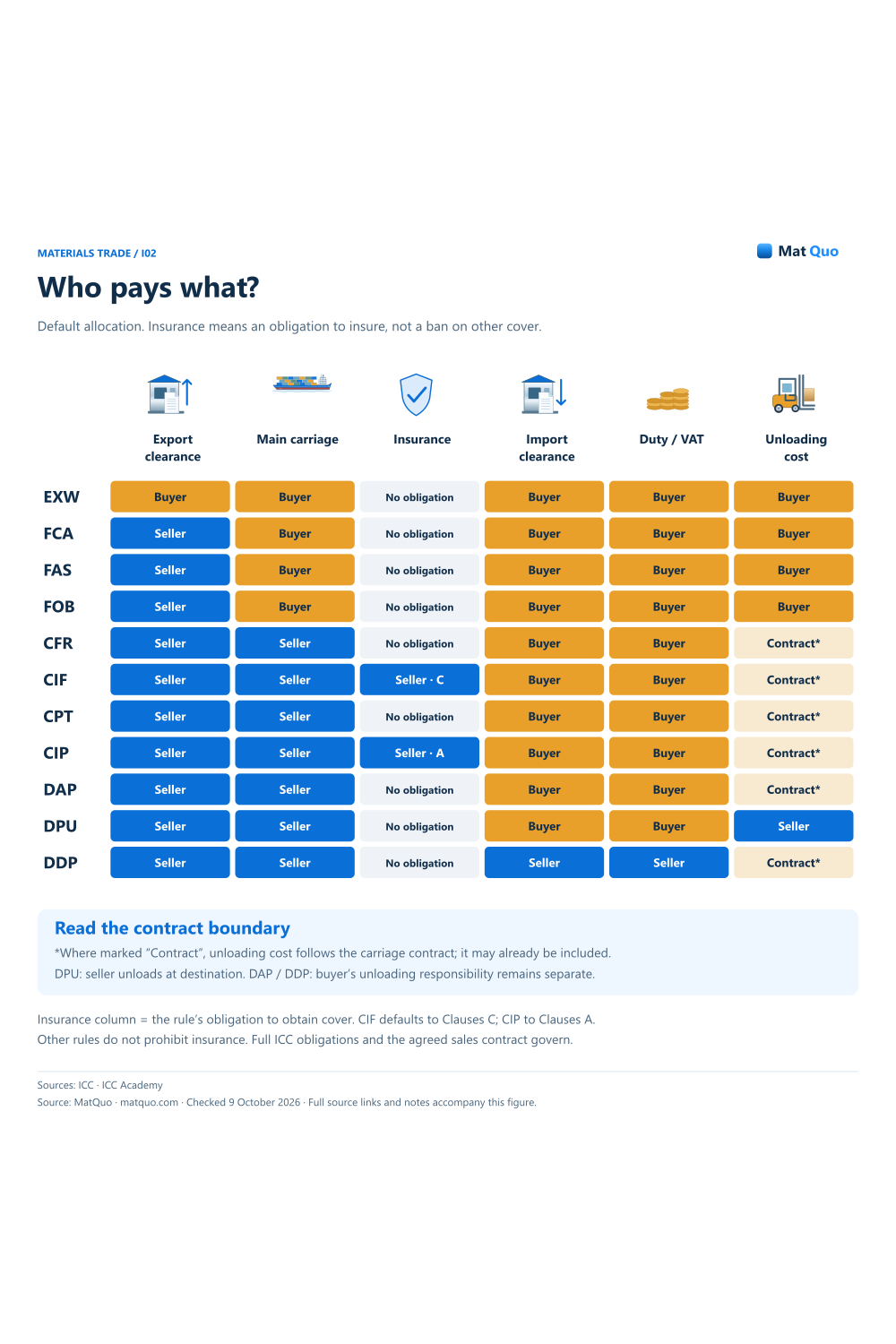
Who pays what?
Default allocation. Insurance means an obligation to insure, not a ban on other cover.
Detailed poster: scroll horizontally on a small screen, or open the full-size figure. The readable text equivalent is below.
ICC • Incoterms 2020 · ICC Academy • CPT and CIP · ICC Academy • DAP and DDP · Checked
Text equivalent and notes
- EXW
- Export: Buyer • Import: Buyer. Import duty / tax: buyer. Insurance: None. Main carriage: buyer. Unload: buyer at destination
- FCA
- Export: Seller • Import: Buyer. Import duty / tax: buyer. Insurance: None. Main carriage: buyer. Unload: buyer at destination
- FAS
- Export: Seller • Import: Buyer. Import duty / tax: buyer. Insurance: None. Main carriage: buyer. Unload: buyer at destination
- FOB
- Export: Seller • Import: Buyer. Import duty / tax: buyer. Insurance: None. Main carriage: buyer. Unload: buyer at destination
- CFR
- Export: Seller • Import: Buyer. Import duty / tax: buyer. Insurance: None. Main carriage: seller. Unload: check carriage contract
- CIF
- Export: Seller • Import: Buyer. Import duty / tax: buyer. Insurance: Seller • Clauses C. Main carriage: seller. Unload: check carriage contract
- CPT
- Export: Seller • Import: Buyer. Import duty / tax: buyer. Insurance: None. Main carriage: seller. Unload: check carriage contract
- CIP
- Export: Seller • Import: Buyer. Import duty / tax: buyer. Insurance: Seller • Clauses A. Main carriage: seller. Unload: check carriage contract
- DAP
- Export: Seller • Import: Buyer. Import duty / tax: buyer. Insurance: None. Main carriage: seller. Unload: check carriage contract
- DPU
- Export: Seller • Import: Buyer. Import duty / tax: buyer. Insurance: None. Main carriage: seller. Unload: seller at destination
- DDP
- Export: Seller • Import: Seller. Import duty / tax: seller. Insurance: None. Main carriage: seller. Unload: check carriage contract
Embed with credit
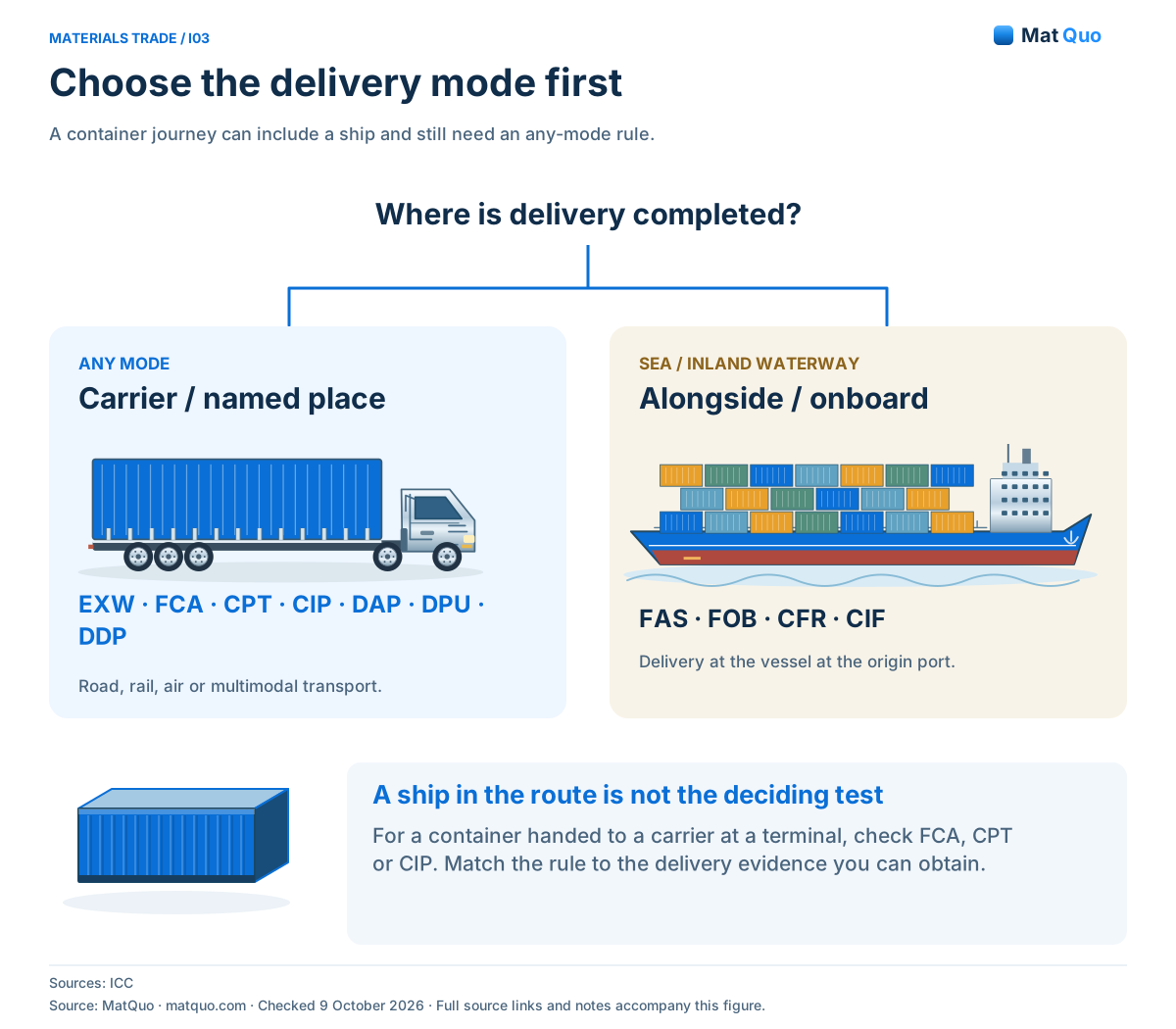
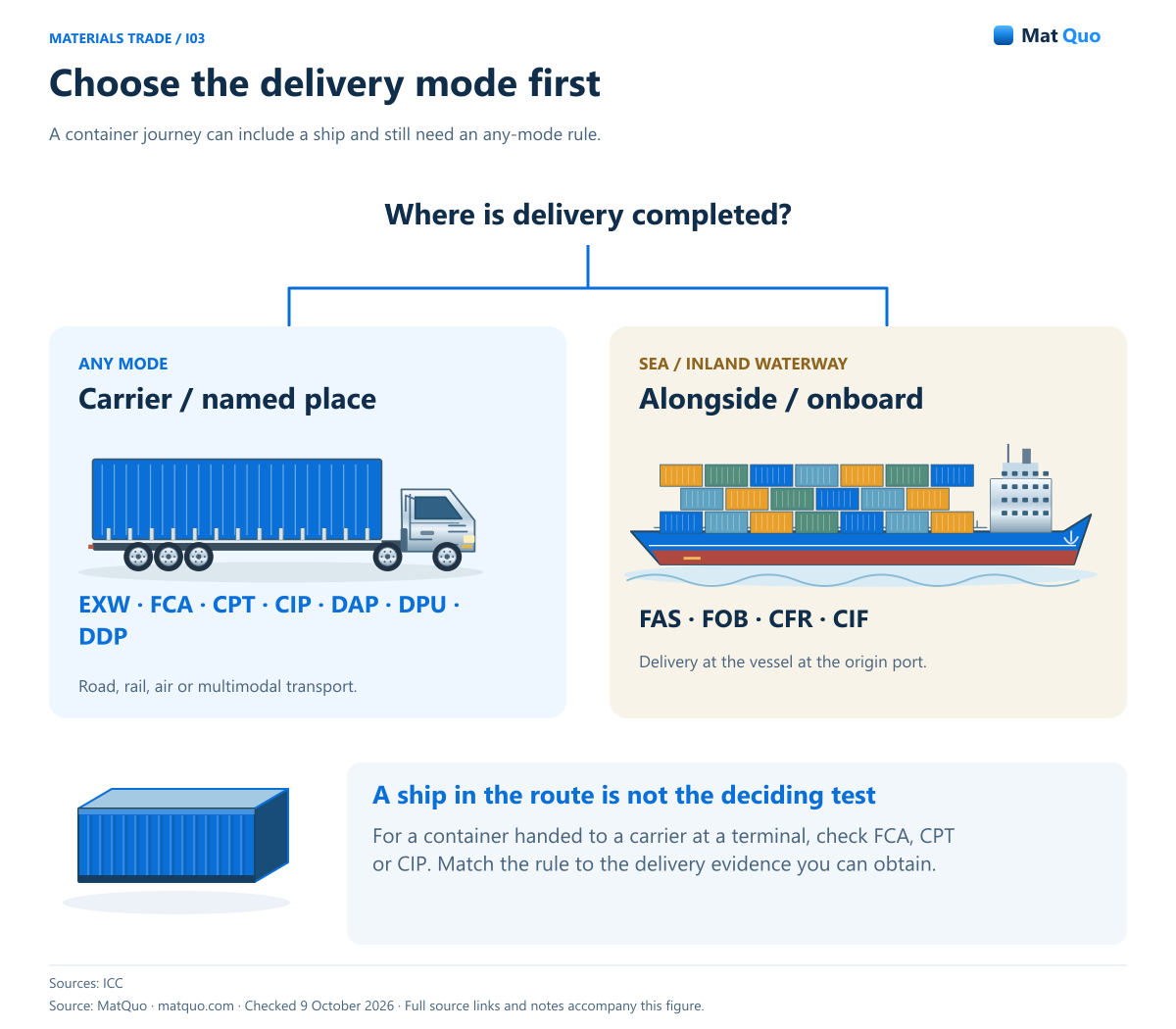
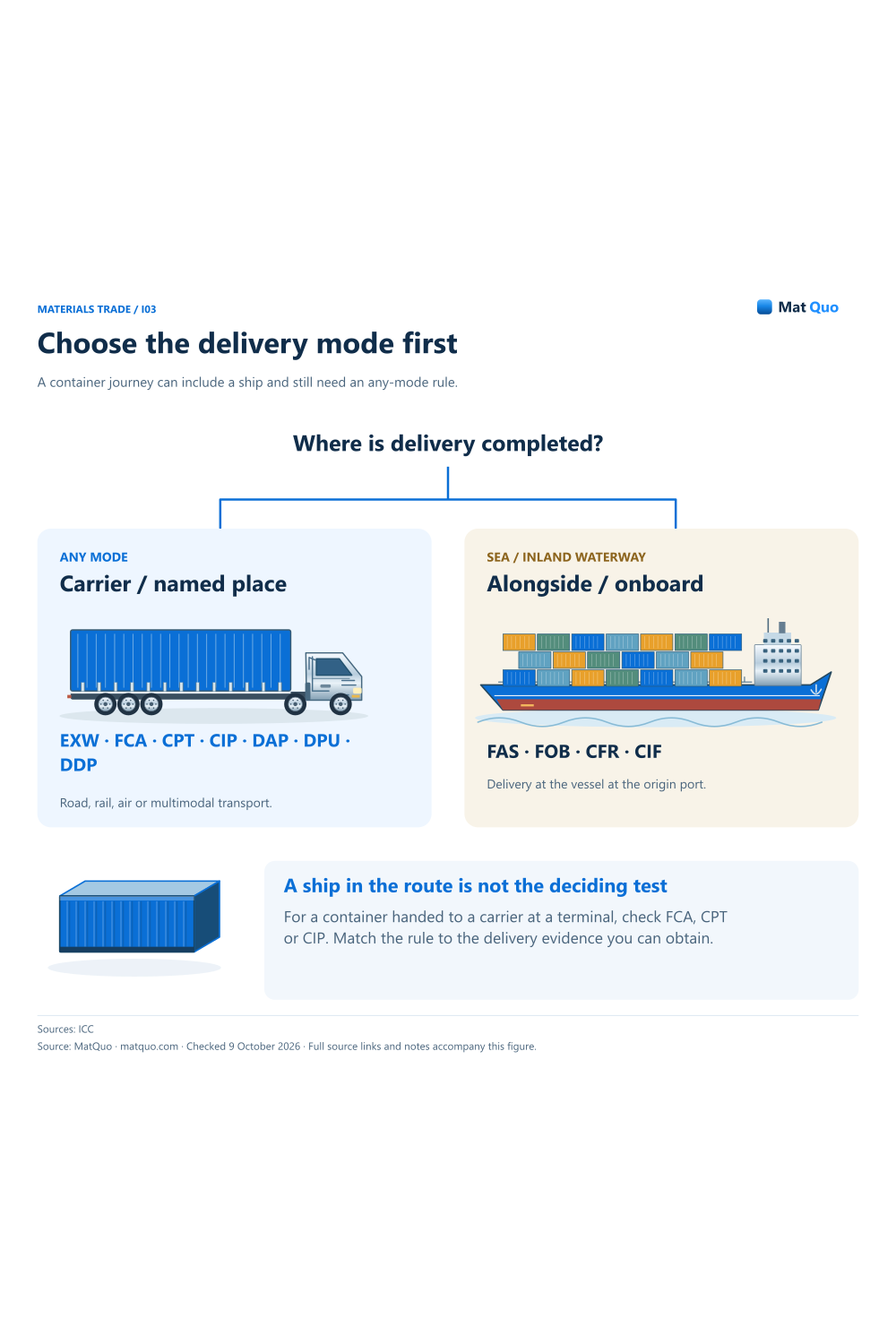
Choose the delivery mode first
A container journey can include a ship and still need an any-mode rule.
Detailed poster: scroll horizontally on a small screen, or open the full-size figure. The readable text equivalent is below.
ICC • Incoterms 2020 · ICC • 2024 checklist · Checked
Text equivalent and notes
- Any mode
- EXW • FCA • CPT • CIP. DAP • DPU • DDP. Road, rail, air or multimodal
- Sea / inland waterway
- FAS • FOB • CFR • CIF. Delivery alongside or onboard. a vessel at the origin port
- Terminal handover?
- Check FCA, CPT or CIP.. Match the rule to the carrier. handover you can document.
Embed with credit
Common mistakes
- Placing the CIF risk marker at the destination port.
- Using FOB merely because some part of a multimodal journey goes by ship.
- Omitting destination handling from the list of charges to confirm.
Questions and answers
Why can a CIF buyer bear risk during the voyage?
CIF separates delivery from the destination to which carriage is paid. The goods are delivered onboard at the shipment port, while the seller pays freight and arranges the required insurance onward. Read the delivery and insurance documents together instead of assuming that the freight payer must bear every transit loss.
Are destination terminal charges always included?
Check the sale and carriage arrangements for the actual service. Do not assume that one abbreviation resolves every terminal invoice. Ask the forwarder to identify unloading, handling, storage and onward delivery separately, and reconcile those items with the supplier’s quotation before adding them to a landed-cost comparison.
Can this table replace the full ICC rules?
No. It is a practical comparison of a few core obligations, with links to primary explanations. A transaction can involve documentary, transport and regulatory details beyond the table. Use the agreed edition of the complete rules and qualified contract review when deciding how those details should be allocated.
Sources and review scope
- ICC Academy • FAS and FOB — Waterway rules; alongside versus onboard delivery.
- ICC • Incoterms 2020 — Current edition; 11 rules; CIF/CIP insurance distinction.
- ICC • 2024 checklist — Choice of delivery point; FCA for container terminals. No source artwork reproduced.
- ICC Academy • CPT and CIP — Carrier delivery, destination carriage, CIP insurance.
- ICC Academy • DAP and DDP — Destination delivery and import obligations.