CIF vs DDP for materials buyers
CIF and DDP quotations cover different delivery, risk and import boundaries. CIF is a sea rule with origin onboard delivery and seller-paid freight and insurance to a destination port. DDP is an any-mode destination rule with seller import obligations. Reconcile all excluded services and taxes before comparing their prices.
Build one comparison boundary
Choose a common destination and decide whether the comparison excludes recoverable import VAT or shows total cash required. Ask each supplier for a service breakdown. A port quote, warehouse quote and tax-inclusive quote cannot be compared fairly by dividing their headline amounts by tonnes alone.
Use confirmed customs and VAT bases
EU customs valuation and import VAT have their own inclusion rules. The trade term is evidence about the commercial arrangement, not a universal tax formula. The upgraded landed-cost calculator therefore accepts explicit tax bases and separately shows VAT cash. Check classification, origin and applicable measures through official customs resources.
Comparison at a glance
| Question | CIF | DDP |
|---|---|---|
| Risk handover | Onboard at origin | Destination, ready to unload |
| Mode | Sea / inland waterway | Any mode |
| Import clearance | Buyer | Seller |
| Seller insurance requirement | Yes | No rule obligation |
Worked example
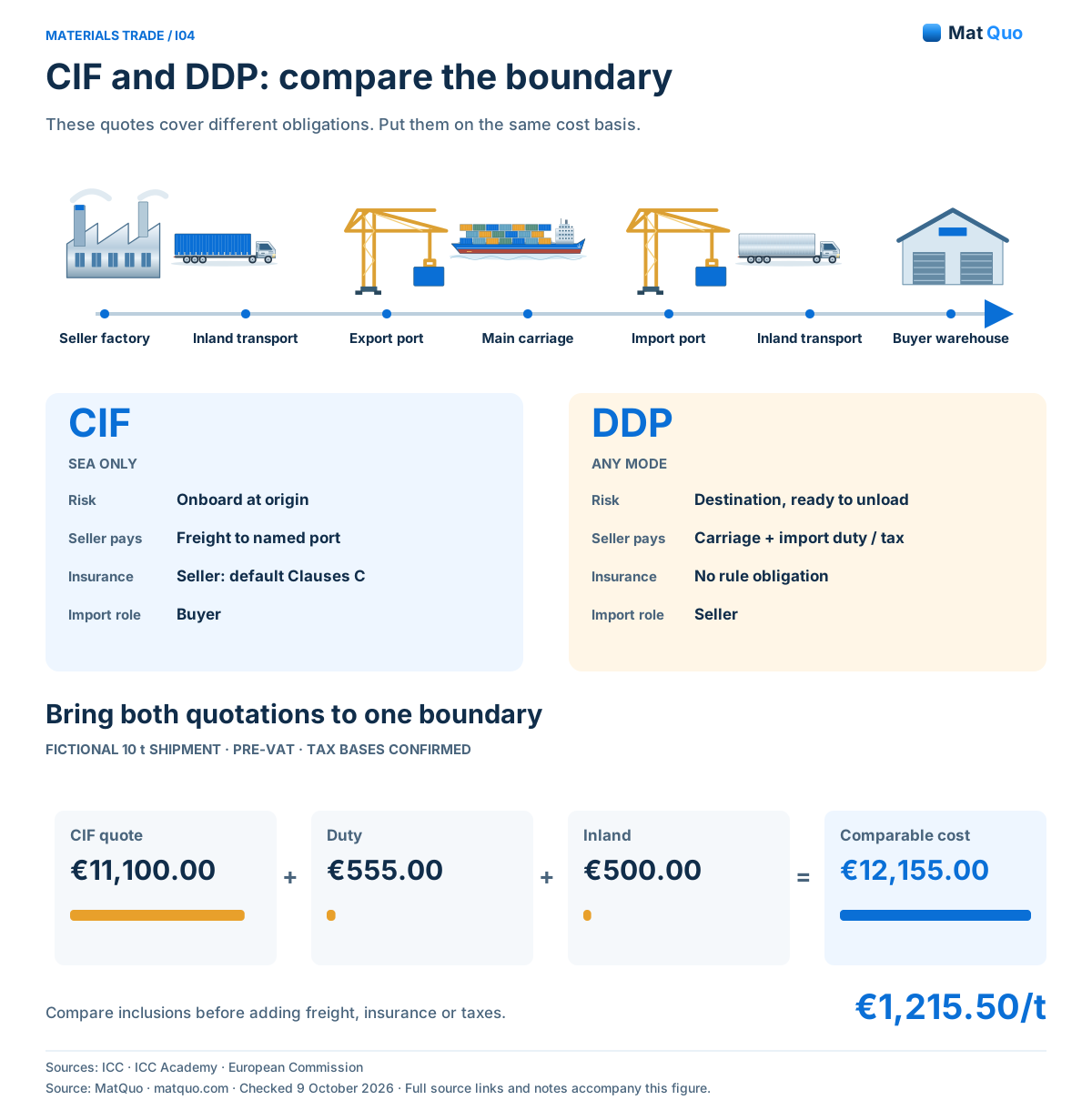
Fictional 10 t shipment: CIF quote €11,100.00; confirmed customs base €11,100.00; test duty 5% = €555.00; inland delivery €500.00. Pre-VAT cost is €12,155.00 or €1,215.50/t. An explicitly confirmed VAT base of €12,155.00 at a fictional 20% produces €2,431.00 VAT and €14,586.00 cash. These are test inputs, not a country tariff or tax recommendation.
CIF and DDP: compare the boundary
These quotes cover different obligations. Put them on the same cost basis.
Detailed poster: scroll horizontally on a small screen, or open the full-size figure. The readable text equivalent is below.
ICC • Incoterms 2020 · ICC Academy • DAP and DDP · European Commission • Customs valuation · Checked
Text equivalent and notes
- CIF • sea only
- Risk: onboard at origin. Freight: seller to named port. Insurance: seller, default C. Import formalities: buyer
- DDP • any mode
- Risk: destination, ready unload. Carriage: seller to named place. Import duty / tax: seller. Insurance: no rule obligation
- Fictional 10 t comparison
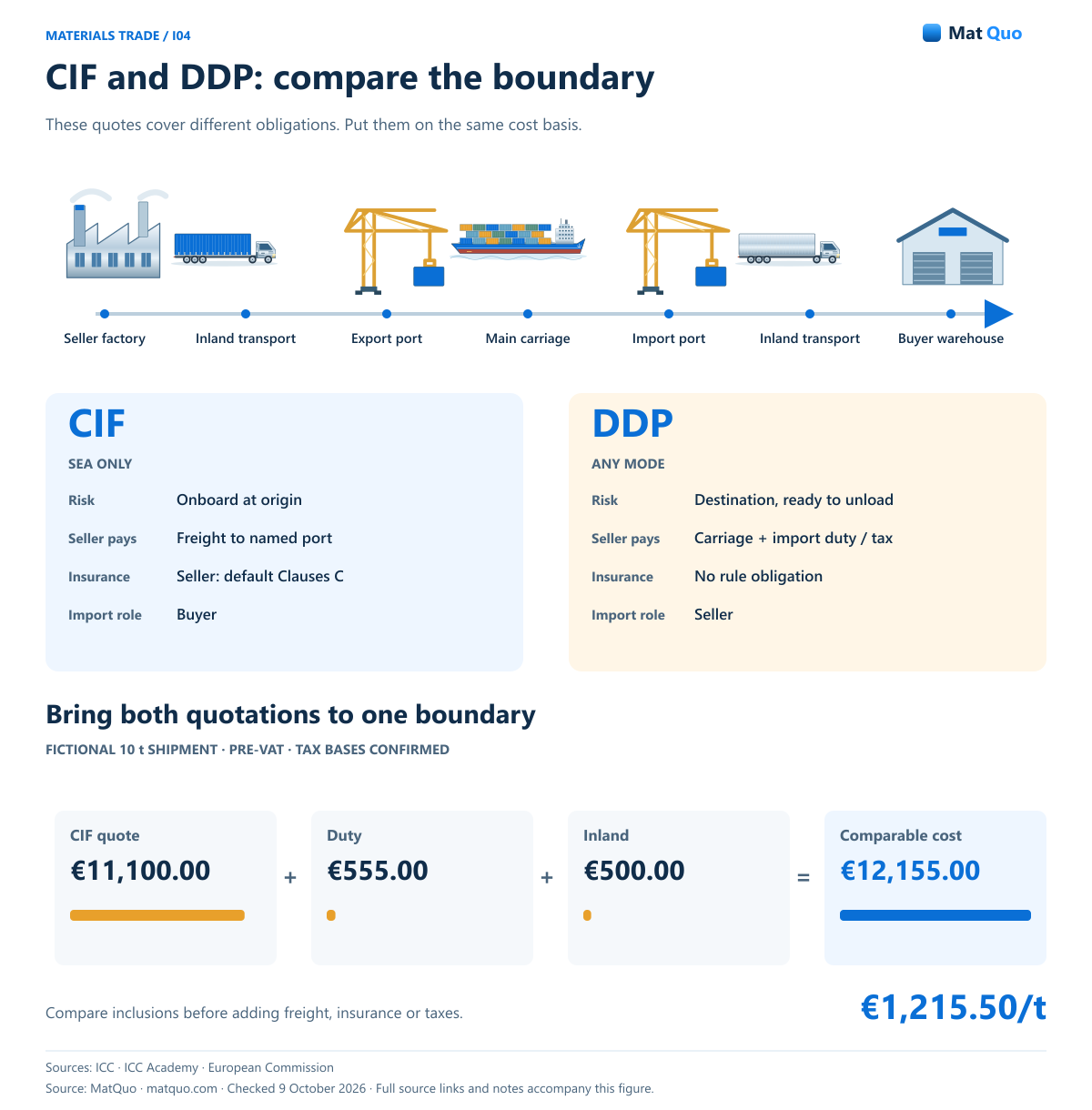
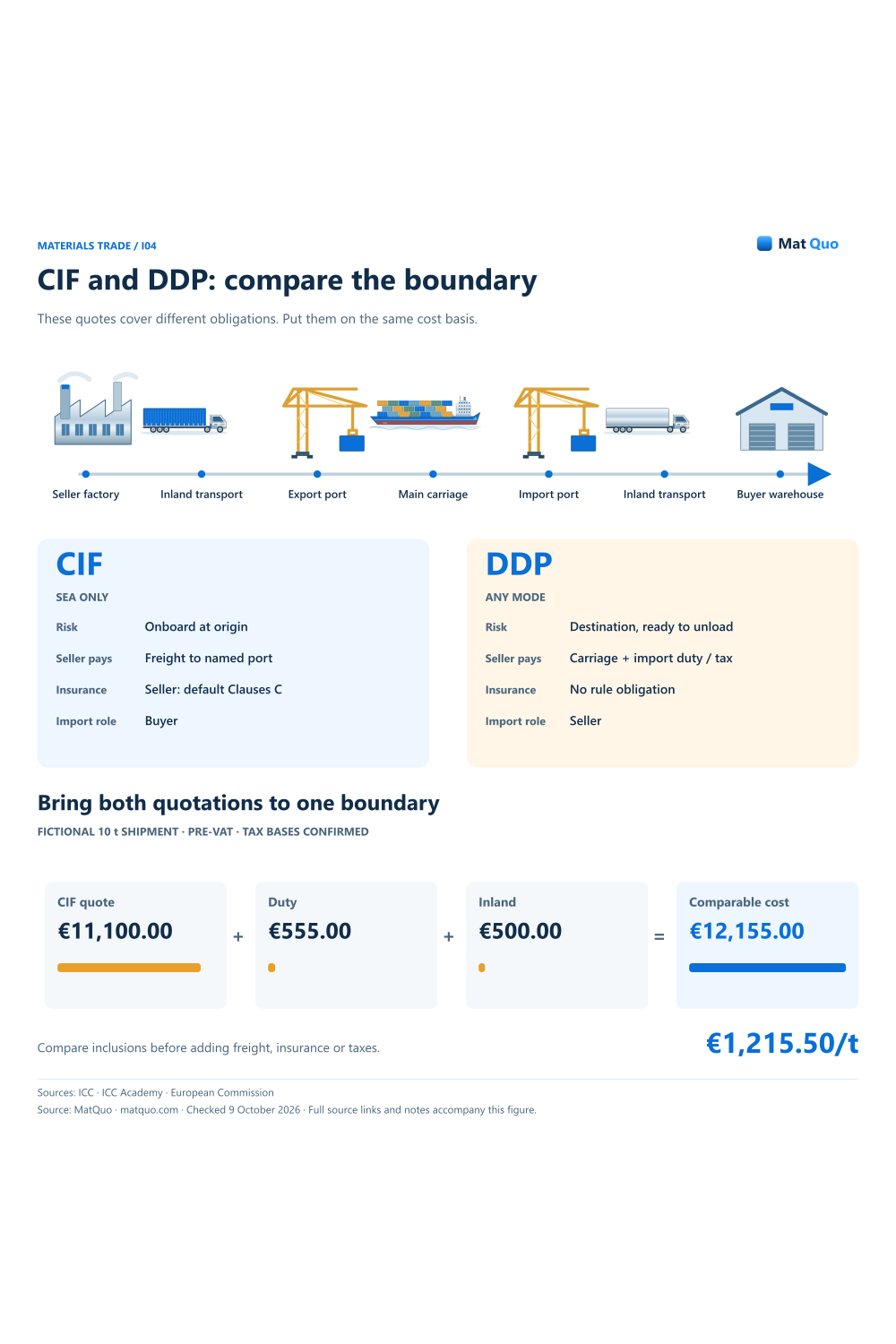
- CIF quote €11,100.00 + duty €555.00. + inland €500.00 = €12,155.00. Pre-VAT basis: €1,215.50/t. Tax bases explicitly confirmed
Embed with credit
Common mistakes
- Comparing a pre-import CIF price with a tax-inclusive delivered offer.
- Adding freight and insurance again when the CIF quote already includes them.
- Assuming VAT paid is always recoverable or always a permanent material cost.
Questions and answers
Is the lower CIF price necessarily the cheaper offer?
No. It can exclude import costs and inland services that another offer includes. Put both offers on the same destination, quantity and VAT basis using actual quotations. Then check delivery risk and insurance separately, because a cost comparison alone does not show which party bears loss during the shipment.
Should import VAT appear in cost per tonne?
Show it separately until the accounting treatment is confirmed. A cash requirement and a net economic cost answer different questions. The example displays both without assuming a right to deduction. Ask the responsible tax adviser or finance team to establish how the actual transaction should treat that VAT amount.
Can a CIF quote be used as the customs value?
It may contain relevant valuation components, but do not assume the quoted total is automatically the legally correct customs value. Review the transaction and applicable additions or exclusions. Enter a confirmed customs base into the calculator and retain the supporting invoice, freight evidence and valuation record with the shipment file.
Sources and review scope
- ICC • Incoterms 2020 — Current edition; 11 rules; CIF/CIP insurance distinction.
- ICC Academy • DAP and DDP — Destination delivery and import obligations.
- European Commission • Customs valuation — Transaction value and valuation additions/exclusions.
- European Commission • VAT taxable amount — Import VAT Articles 85–87. Use explicitly confirmed bases.